

Green Wood at Half Past Midnight
A horror story retold and reimagined from the documented Brandjockele core and the older legend-world of the wooded country near Keuerstadt, stretching toward Matzenbach.

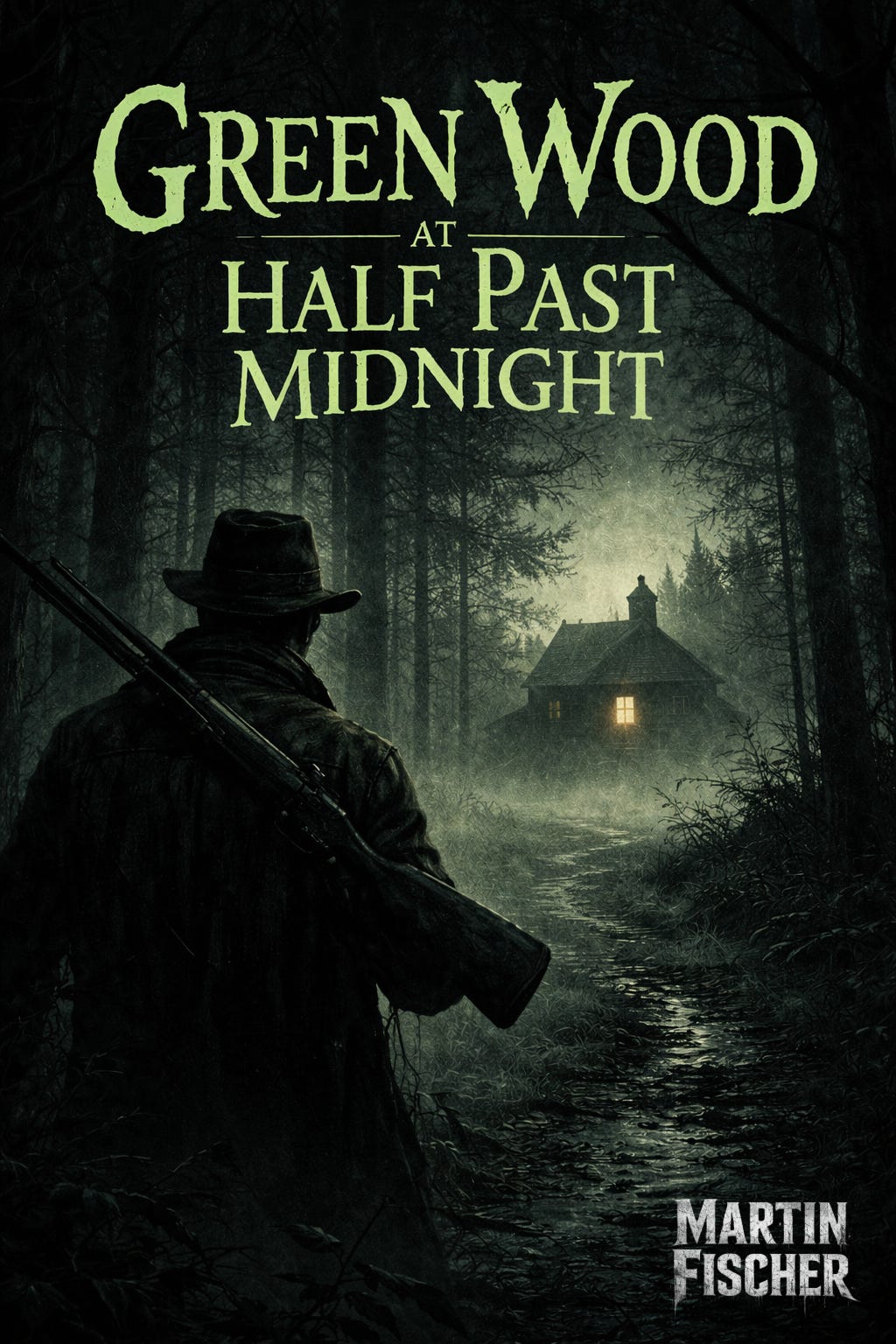
I was fifteen when they sent me to Hinterbrand.
My father had no more room for me in the house and no more patience either. There had been two bad harvests, a cough in the cows, damp in the grain and my younger brothers were still small enough to be loved without effort. So he took me by the wrist before dawn and led me along the wood road where the ruts held black water and the firs stood close enough to make their own weather. We did not speak much. His hand was warm. The morning was not.
When the trees opened, the farm lay there low and wide under a roof the color of old soot. The dogs began first. You heard them before you saw the place. Not barking, not properly. A throat-deep sound, uneasy, as if something had passed that did not belong to dogs or men.
Brandjockele came out while my father was still taking off his cap. I remember the hunter’s boots, caked with mud to the calf. I remember the gun held so lightly it seemed part of him. I remember his face least of all, which is the way fear works when it settles young. You keep the hands. You keep the mouth. You keep the boots.
He looked at me once and said, “This one will do.”
My father left before noon.
That first night I learned the order of the house. The men ate quickly. The women did not sit. Nobody spoke unless spoken to. When he laughed the room answered with silence. He shot when he pleased, drank when he pleased, slept when he pleased and if the lord’s deer crossed his sightline he treated that, too, as his pleasure. There was no law on that yard except his.
The loft where I slept with the others smelled of damp straw, mouse droppings and old wool. A girl named Leni lay beside me under a torn blanket and told me, without turning her head, that he liked to let people think the day was over before beginning with them again.
“What do you mean?” I whispered.
“You’ll see.”
At midnight the house finally went still.
At half past midnight he fed the fire green wood.
The first time it happened I woke choking. The smoke came up through the planks in soft poisonous breaths, thick with resin and sap, not the clean smoke of seasoned logs but something wet, bitter and raw, a smell that clung to the tongue. In the dark around me people coughed into blankets. Someone sat up and gagged. Below us I heard him moving the poker through the hearth, slow and cheerful, taking his time. Then he laughed.
That was the worst part. Not the smoke. The laughter in it.
He did this often. Let the servants crawl into sleep and then dragged them back out of it with stench and burning eyes. By morning the women moved like old people and the men stared at nothing, their mouths open, while he stood in the yard with his dogs and looked fresher than the frost.
Weeks passed that way. The wood pressed close around the farm. Even at noon there were places beyond the sheds where the light seemed used up. The older hands crossed themselves when the wind changed. They said little in front of me, thinking I was too new to carry the weight of it, but houses speak at night in ways walls cannot stop. I heard names. I heard whispers about Keuerstadt and the little chapel among the trees. I heard that some sounds must never be answered after dark, no matter how clearly they called.
Once, hauling water, I asked Leni why.
She stopped so suddenly the bucket knocked against her shin.
“Because he answers,” she said.
I thought she meant the master, but she would say no more.
Winter came hard. The ruts froze. The dogs’ breath stood white in the yard. One evening a strange stillness fell before dark, the kind that makes a candle flame burn straight and small. Even Brandjockele seemed to notice it. He stood in the doorway with his cup in one hand and listened into the trees as if waiting for hooves.
That night nobody slept.
Not because of the smoke. Not at first.
It began high above the roof, far off and then all at once near, a running in the air where no road went. Not the beat of one horse or two but a rushing company, a tearing through the dark as if the sky itself had become a frozen field and something wild was driving over it at full speed. The dogs shrank under the bench. One of the women began to pray through her teeth.
Then came the voices.
They did not shout. That would have been easier. They called the way neighbors call from one field to another, almost pleasantly and each time the name came clearer.
“Jockele.”
A pause.
“Brandjockele.”
He was sitting by the hearth with the poker in his hand. I saw the red tip of it dim, then brighten again. Nobody moved. Nobody breathed.
The voice came a third time from over the roof, from beyond the shutter, from the black place where the trees stood.
He smiled.
It was not a broad smile, not madness, nothing so simple. It was the crooked pleased smile of a man recognized.
“Yes?” he said.
The sound at the door was soft.
A wet little slap. Nothing more.
For a moment we all stared at the planks as if we had imagined it. Then one of the dogs screamed. Not barked. Screamed.
He rose swearing and threw the door latch back.
Something hung there.
I cannot tell it better now than I saw it then. It looked like half a person, though not in any way the world should permit. Pale. Bare. Wrong in its shape and too heavy for what seemed to hold it there, yet pressed against the wood as if fastened by its own dead weight. The head hung sideways, the mouth slack and under it on the threshold a heap of coals glowed and settled, glowed and settled, as though a fire had been dropped from above and meant to burn its way into the house.
The smell that came in was worse than the green smoke. Something raw in the winter air. Wet ashes. Something scorched and close.
Leni made no sound at all. She simply folded to her knees.
Brandjockele slammed the door but the shape remained. You could hear it brushing the boards when the wind moved. He would not go out after that. He cursed us for staring and made us sit till dawn while the coals hissed at the threshold and the thing outside shifted once, very slowly, as if remembering it had once been alive.
No one opened until the first Ave drifted through the wood from the chapel.
It was faint. A bell, then prayer, then the kind of silence that follows words meant for mercy.
He pulled the door wide.
Nothing was there.
Only a blackened mark where the coals had been and a smell that lived in the house for days.
If fear could have changed him, it would have done it that morning. It did not. He grew harsher after that. He would stand in the yard at dusk listening with his head cocked and then turn on the nearest servant for spilling grain or missing a strap hole. Twice he woke us before midnight only to make us wait for half past, as though he wanted to prove that his hand still lay heavier on us than anything passing above the roof.
Before spring was out, he was dead.
Nobody told the story of it the same way. Men came. Some prayed. Some did not. By the next evening axes were biting the beams and hooks were dragging the roof down. Within two days the yard was opened to the weather. By week’s end the farm was no more than black stones, char and broken iron half sunk in mud.
They said that was the end.
It was not.
Years later, when I had gone into service farther south and had nearly taught myself not to remember, I came through that wood again in bad light with a sack on my back and rain coming in. I had missed the safer road. The trees closed in early. Water dripped from branch to branch. Mud gripped at my boots.
Then, without reason, I smelled green wood smoke.
There was no house. No hearth. No living farm for miles.
I kept walking.
The smell thickened. Ahead of me the path bent between fir trunks and something passed across it, not fast, not slow, just enough to blot what little light remained. A man in a hunter’s coat. A gun against one shoulder. The brim of his hat dark with wet.
I stopped.
He stopped too.
There are moments when the body knows a thing before the mind consents to it. Mine knew him by the set of the shoulders. By the lazy angle of the gun. By the patient way he stood, as if he had all night and I had none.
Then he stepped off the path into the trees.
Not away from me.
Alongside me.
I began to walk faster. So did he. Branches cracked where he moved, though I saw almost nothing of him now except the pallor of one hand and, once, the long pale blur of a face between wet needles. No dogs. No voices. Just that measured keeping pace, close enough to hear, never close enough to touch.
Until I ran.
The sack thumped against my spine. Mud splashed my stockings. Breath tore at my throat. The wood had no shape left, only black trunks, ditch water, bramble and the wild panic of getting one foot down before the next gave way. Once I glanced behind and saw him plainly at last.
He was smiling.
Not broadly. Not madly.
The same small pleased smile from the night the sky called his name.
I broke through a stand of spruce and saw the chapel clearing open ahead of me, the wet grass silvering under a thin wash of dawn. I stumbled to the door and struck it with both hands. It was locked. Of course it was locked. I turned and put my back against the wood.
He came to the edge of the clearing and stopped.
Rain slipped from the brim of his hat. Smoke moved around him though nothing burned. One hand stroked the barrel of the gun as gently as another man might calm a frightened horse. He did not hurry. That was what made it terrible. He knew exactly how little distance lay between us.
Then from inside the chapel or above it or perhaps only from that hour when night loses its grip, came the first bell.
One note.
Then another.
His face changed. Not with pain. Not with remorse. With annoyance. A man called away from his own amusement.
The smoke thickened around him. For an instant I saw his coat, his hand, the line of the hat. Then the clearing was empty except for rain and the dark edge of the wood.
I stayed against the door until full morning.
After that I never answered when a voice called my name from trees or field or road after dark. I do not care how kind it sounds. I do not care if it sounds like my mother.
And sometimes, even now, when a fire is fed before its time and the smoke comes up wet and bitter, I wake with my throat shut and see again the black mark on the threshold, the thing hanging where no thing should hang and a man beyond the trees listening for his own name.
Appendix: The Recorded Core of the Legend
1. The narrow documented core
The strongest older core I could verify is the Brandjockele material attached to Keuerstadt/Hinterbrand, later also regionally associated with the area between Ellwangen and Matzenbach.
In the 19th-century folklore record, Brandjockele is a cruel hunter near Keuerstadt who mistreats his servants, lets them go to bed only at midnight, then wakes them again by burning green wood around half past midnight. A later municipal retelling rounds this to midnight and one in the morning. After his death, he is said to continue going about as a hunter in the woods. A related Keuerstadt tale says the Wild Hunt called his name, that he answered and that a grotesque half-human body appeared at his door until the morning Ave.
The Jagstzell municipal history page preserves the same broader regional association and places Brandjockele in the area between Ellwangen and Matzenbach.
The physical setting is real, but the chapel associations are not limited to one single site and the chronology is not uniform across the places invoked in later retellings. The Matzenbacher Bild is a real pilgrimage site in the forest near Matzenbach. Its official local history dates the pilgrimage origin to 1746, notes a first simple chapel in 1913 and the present Matzenbacher Bildkapelle in 1973.
The Nikolauskapelle at Keuerstadt is also real and is described in current tourism sources as having been built in 1280 and restored in 1971. Local-history reporting refers to documentary mention of the chapel from 1384 onward, which, if accurate, would indicate attestation by the late medieval period.
As an interpretive conclusion based on the chronology of the sites, the older Keuerstadt chapel appears to align more plausibly with the older Brandjockele and Wild Hunt material than the modern Matzenbacher Bildkapelle does. That conclusion is a historical inference from the dates and associations above, not a separately documented fact of transmission.
2. The transmitted legend
In modern circulation under the name Matzenbacher Wald, several motifs recur: a forest divided into a “good” and a “bad” side by a bridge, an uncanny additional path at a forest crossing and chapel-centered haunting motifs including an allegedly hanged monk or priest. These belong to the transmitted legend layer as it is currently repeated in recent media summaries, forum discussions and informal retellings. The details are not stable across versions and that instability matters.
As an interpretive reading of the source pattern rather than a documented fact of transmission, today’s “Matzenbacher Wald” horror legend can be understood as a composite rather than a single stable old tale: an older Keuerstadt and Brandjockele folklore stratum, newer chapel-haunting stories and recent internet-era circulation that appears to have fused them under one forest name. This is an interpretive model, not a claim that any single source states the composite explicitly in those terms.
3. Later embellishments or uncertain additions
The most unstable layer is the recent one: child handprints on cars, numbered-path “tests,” stories about the forester’s house or supposed former youth hostel, Satanic ritual rumors and various apparition narratives. These are widely repeated online, but they do not stand on the same evidentiary footing as the older Brandjockele record. Their significance lies mainly in showing how the forest has become a site of contemporary legend circulation and thrill-seeking.
One caution matters especially. Recent local-history reporting quotes Nikolaus Kurz as saying there is no historical evidence that anyone hanged himself in the Nikolauskapelle and that the supposed former youth hostel was in fact always a forester’s house. Even apart from that testimony, if a hanging-priest story is attached specifically to the present Matzenbacher Bildkapelle, it cannot be projected back as a centuries-old event in that exact building, because the current chapel dates to 1973 and the first simple chapel on that site only to 1913. That does not disprove later storytelling, but it does limit what can be claimed as historical fact.
For that reason, the story above keeps to the most durable overlap: the forest setting, the nearby chapel implied by the morning Ave, the cruel hunter Brandjockele, the green-wood smoke, the Wild Hunt connection and the hunter’s posthumous return in local belief. The bridge, the extra path, the hanging priest or monk and the more sensational modern motifs belong to a later and less stable layer of transmission.