

House Twenty-One
This house was not built to be lived in.

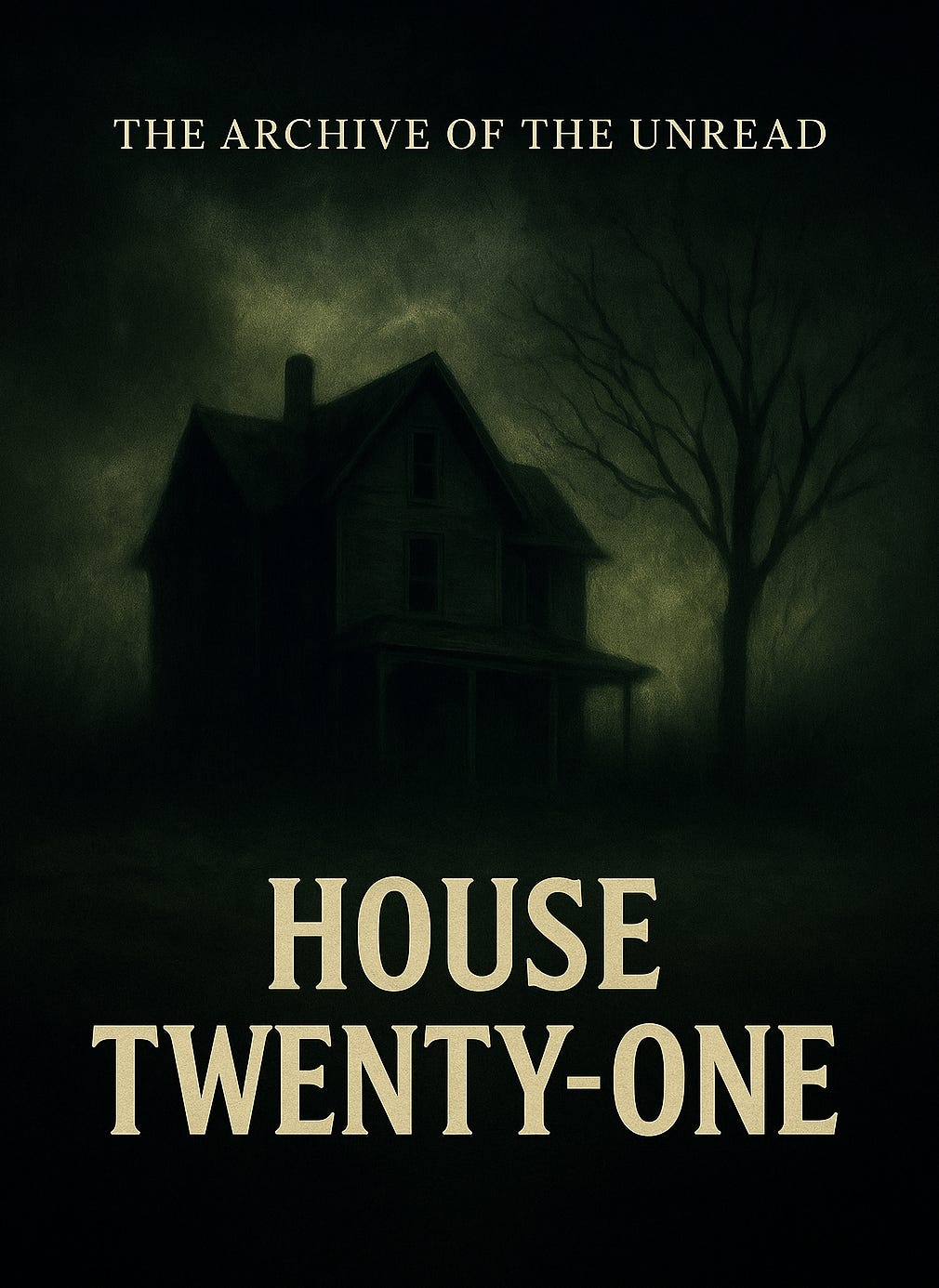
They only called it the “Twenty-One”. As if the year itself was a curse, a warning, a number that should have been branded into the wall. No one remembered who said it first, but everyone knew what it meant. The big house with the overgrown garden, right in the middle of town. So much space, so little luck.
Almost every family who lived there had broken. One man ended up in the asylum. A woman laid herself in the pond behind the house, in January, barefoot. And always the divorces. Seven couples in sixty years: six ended in courts. One just vanished. Someone once said there are rooms that suck the love out like sponges.
The town didn’t talk much about it. They knew not to buy it. Knew it stood empty more often than not. The windows never seemed bright. Kids pushed their bikes along the far side of the street, even when they hated the detour. A big property, yes. But the land was too quiet. No wind moved the trees. The grass never wilted, just stayed gray.
Still, another family moved in. Four children. Two cats. The third car came later. The man, Daniel, had taken over the house from his ex-wife. They’d lived there before. Back then with three children, forgotten by most in town. Daniel had no contact with them anymore. Sometimes, in the middle of a sentence, his voice would falter as if tripping over the memory. Nobody asked. Not even Jana, his new wife. She spoke of a “fresh start”, of “finally enough space”. And she meant it. At first.
They moved in late spring. The lilacs were blooming. Jana cut branches, put them in an old milk can on the window ledge. She thought: now it begins. Now it will be good. The children, sweaty from the move, ran through the house laughing, shouting. Loud. Happy. And for a moment, she believed the house might keep that laughter.
But the moment the old parquet was sanded, the creaking started. Not loud. A fine, weeping sound, like children’s feet moving where there were none. The power outlets failed not all at once, but in rhythm, like heartbeats. Always at night.
The cats started avoiding doors. Especially the one to the attic. They sat there, staring. No sound. No growl. Just waiting. Like they knew someone was coming.
The children started whispering. First to each other. Then in their sleep. Jana heard them murmur, “I don’t want to sleep upstairs,” and “Someone’s in the doorway.” Always: “No more remodeling. Please.”
But they kept building. Tore out one wall, put up another. Open kitchen. Bright dining room. More and more light, as if to press out the dark. But with every nail, something in the walls shuddered. The workers slowed. Some didn’t return. One, a Pole, muttered as he left, "krzyczące ściany." Screaming walls.
The cats vanished. First one. Then the other. No blood. No trace. Just an empty basket, slightly indented. As if something heavy had rested there.
Daniel talked less. Stared into space, like trying to see if something was still there-or gone. Jana grew thinner. Almost translucent. The bedroom always smelled faintly of sour milk. Each morning, a thin layer of dust, even if she’d cleaned the night before.
The house fell quieter, though they still lived in it. The children didn’t run. They walked. Slowly. Like inside a strange museum that swallowed voices. The oldest, Marlene, began to walk into the garden at night. Barefoot. Silent. Always to the same spot. Where the soil stayed soft, even when it hadn’t rained.
One morning, Jana found a note there. Yellowed, as if it had lain in the ground for decades. In a child’s hand: "Don’t dig. They hear you."
She burned it. Said nothing.
In town, people whispered again. The butcher said she saw Daniel standing at the window at night. No light. The flower woman at the market said she heard one of the children speaking, but not in words. Just a low, gurgling murmur. Like an animal dreaming.
Then winter came. The fireplace, freshly renovated, wouldn’t draw. Smoke filled the living room, clung to the furniture. The chimney sweep came, shrugged. “There’s nothing. But...” He broke off. Looked up to the attic. Left early.
In the end, there was only one sentence. It was written nowhere, but everyone knew it. You heard it when the wind moved through the flue, when the toilet tank dripped at night:
"This house was not built to be lived in."
And that was true. It was only built so people could fail inside it.
Looking Back - The Woman from the North (1957)
Her name was Margarete Andersson. She came from Lübeck. No one knew why she had chosen Stockach of all places. Her husband had died young. Her child at six, from scarlet fever. They said she could no longer bear the sea - the sound, the vastness, the memories. So she came where the hills stood close and the fog hung heavy.
She bought House Twenty-One in late summer. The notary remembered her firm gaze. Not sad, just tired, as if her life had already been spent before she lived it. She moved into the upper floor, lived alone, spoke little.
Sometimes you saw her in the garden. Never in the sun. Always at dusk. She planted nothing. Pulled no weeds. Just stood there. Looking back at the house.
After a year, she avoided the attic. Once, she left the door open and a neighbor, Frau Kästner, swore she heard voices. Not loud, just the whispering of many, very small mouths.
Then Margarete began to write. Notebooks full of sentences. Rambling. Layered. Always the same passage:
"He was not dead. Just forgotten. And the house remembers."
They found her in 1960. By the window. Dead, but with warm hands. No doctor could explain it. On the table lay the last notebook, opened. A drawing, rough in charcoal: a face without eyes. Just an empty imprint, like someone had pressed their face against wood.
No one talked about it long. They said she’d been ill. They said many things. But they knew: it was the house.
Looking Back - The Child with the Voice (1932)
His name was Emil. He was nine years old and lived with his grandmother in House Twenty-One, shortly after his parents died. An accident, they said. But no one spoke about it. Emil was quiet. Too quiet, the teachers said. He barely wrote, but he spoke to the walls. For hours.
His grandmother, a stern woman with rough hands, thought it was just grief. But on the third night after they moved in, she found him in the attic, sitting on an old chair. He smiled. And his voice was no longer his.
It was deeper. Stranger. Like someone else was speaking through him.
“He says I should stay,” Emil said. “He doesn’t have any others.”
From that day on, Emil drew nothing but circles. Hundreds of them, in black chalk. On paper. On walls. On the attic floor itself. Again and again.
One morning, he was gone. Only the circles remained. And the sound that came when you went into the attic at night, a faint, scraping hiss, like chalk moving over wood. Slow. Repeated.
His grandmother died the same year. They found her in the garden. On her back. Eyes open. The neighbors said she had laid herself into the earth.
Looking Back - The Couple Who Wanted Too Much (1974)
Sabine and Holger. Both teachers, both ambitious, both in love with what they called “the life project.” They wanted a house they could change. Restore. Modernize. Make into something. When House Twenty-One went up for sale, they didn’t hesitate.
They moved in during a golden autumn. Everything was in motion-wallpaper peeled, doors were moved, tiles replaced. They lived in dust and blueprints, laughed a lot, drank red wine in empty rooms.
But something was strange. The hallway clock never stopped, it kept ticking, even without a battery. And at night, they heard steps on the stairs. Sabine said nothing at first, but Holger heard them too.
They began to argue. First in whispers, then in shouts. Always the same things: wall colors, furniture layout, who sleeps where. But it was never really about that.
“I feel like we don’t belong here,” Sabine said once. “Like the house... is working against us.”
One day, Holger smashed the clock. The next morning, it was back on the wall. No glass. Still ticking.
A year later, Sabine left him. Holger stayed. Drank. Turned gray. Years later, they found him in the kitchen, sitting on the floor. The wallpaper was old again. No one knew when he’d stopped renovating.
Looking Back - The First Ones (1921)
Friedrich and Lotte Weber were the first. The house was new then, the plaster still bright, the rafters thick with the scent of fresh wood. Friedrich was a carpenter, Lotte a seamstress. Both young. Full of plans. The Great War was over and they believed something good might finally begin.
They built the house with their own hands. Bit by bit, under the supervision of the city’s master mason. The windows were larger than needed. “So the light can get in,” Lotte had said. But it was dark from the start.
On the first night, they heard dripping. It hadn’t rained, but somewhere in the house, it sounded like water falling, slow, steady, onto something soft. Friedrich searched, found nothing. In the morning, the sound was gone.
Then came the dreams. Both had them, at the same time, but different. Friedrich saw doors opening where he hadn’t built any. Lotte dreamed of a child walking the halls, whispering, “too soon.” Again and again: “too soon, too soon.”
Their first child was stillborn. Lotte didn’t scream during the birth. She just said, “He didn’t want him.”
Friedrich changed. At night, he wandered the house, touched the walls, muttered numbers. By day, he no longer worked. Said he had to calculate something. Something had to be right. Lotte once found him in the cellar, naked, hands in the soil. He said the house needed quiet. That it was loud if you didn’t listen.
They lived there six years. Then Lotte vanished. No trace. Friedrich was taken to the asylum. He spoke of “voices in the wall” and “a breath beneath the floor.” When asked why he’d built the house, he only said:
“I didn’t build it. It used me.”
The house stood empty for three years. No one dared enter. Not until 1930, when someone moved in again. But that is another story.
Present - Crushing Days
February was long. Colder than the years before. In House Twenty-One, the air felt like it had forgotten how to move. Jana often sat for hours in the kitchen, the radio on, but silent. Power was there, the little red light glowed. But no sound came through. As if the house no longer let music pass.
Daniel barely worked anymore. He was often in the basement. Not with tools. Not with pipes. Just standing there, by the old wall they had never torn down. It was made of a different stone than the rest. Finer, more porous. Like pressed ash. Sometimes he pressed his ear to it. As if listening for something that moved beneath the house’s skin.
The children no longer spoke to each other. They sat together at the table, but never looked up. Even when they played - if they still played - they whispered strange words. Jana couldn’t understand them. The youngest spoke backward. One night, she woke her mother and said, “The milk is bad. It doesn’t come from the cow.”
Once, when Daniel was in the yard, Jana saw a face in the window across. She thought at first it was her own reflection. But it moved differently. Quieter. Deeper.
Marlene had stopped sleeping. She just lay in bed and stared at the ceiling. When Jana asked what was wrong, she said, “I’m just waiting until it needs me again.”
Then the power went out. Completely. Not for a few minutes, but three full days. No light. No sound. No outside. The technician came, looked at the breaker box and said, “This isn’t a power outage. This is deliberate.”
He left without taking off his shoes.
At night, they heard the dripping again. This time from the attic. But the floor was dry. Only the smell like old milk, like wet hair.
Jana started a diary. Not to remember. But to check if time still moved forward. She wrote: “Monday – nothing.”
Then: “Tuesday – the house breathed.”
By Friday, the diary was gone. In its place, an old school notebook. Yellowed. Ink-stained. Jana opened it. Page after page of names. Their names. Her children’s names. In a different hand. From a different time.
Marlene began to speak. Not stories. Pictures. With her eyes closed. She described the basement, how it was before the renovations. The old wall they’d never touched. The man with wet shoes who waited there. “He talks to me, Mama. But not with words. He shows me how it ends.”
Daniel sometimes laughed now. Quietly. When no one spoke. Once he said, “I think I was wrong. I don’t think I was ever married.”
The windows no longer let light through. Dim during the day. Black at night. The garden was suddenly bigger. Jana couldn’t see the fence anymore.
The youngest drew a picture. With soot. A house with no doors. Only windows. And in every window a face that wasn’t one. Just outlines. Like impressions in fog.
Jana wrote: “Saturday – the house knows now that we know.”
Present - Deeper Into the Basement
On the ninth day without sun, Jana went down. The basement was colder than usual and the stairs no longer creaked. As if the wood itself had decided to be silent. She took a flashlight, but its beam didn’t reach far. It chewed into the dark, but the dark swallowed it… slowly, like something hungry.
The wall was where it always had been. But something was new. A crack. Thin, barely visible. And no moisture seeped from it, just warmth. A slow, breathing warmth, like from an open mouth.
Jana laid her hand against it. It didn’t feel like stone. It felt like skin.
Nothing moved behind her. And yet she felt the room tighten. As if the house held its breath when you listened. She pressed her ear to the wall. Nothing. Then… scratching. First like a single nail. Then many. Thousands. The wall vibrated faintly.
She didn’t scream. She turned back. But upstairs, the door was gone.
Not locked. Not jammed. Just gone. Wall. Smooth. No handle. No frame. Just wall. Jana stood there a long while. Then turned around. And the basement was bigger.
Behind the old wall, something had opened. A passage. Not built. Grown. The walls were soil, threaded with veins, pulsing. It smelled of wet paper and metal.
She stepped in.
Upstairs, the youngest painted new pictures. Just black lines. Circles. Spirals. In one, a single word:
“Root.”
Daniel stood at the window again. His reflection was gone. Only the hallway behind him showed. Empty. Even though the children were there.
Jana walked deeper. The passage narrowed. The air grew thick. Then she saw it: an opening. Not a room. A sack. Like a huge cocoon, breathing. And beside it … a cradle. Wooden, but soft. Inside-nothing.
Or something pretending to be nothing.
She heard the dripping again. But it wasn’t water. It was language. Slow, fluid, overflowing. And she didn’t understand it with her ear, but with her spine. It said:
“You were always here.”
And Jana wept. Not from fear. But because she knew it was true.
Present - Deeper Into the Root
Jana kept walking. The cocoon was behind her, but the path hadn’t ended. It grew damp now, alive. No longer a basement. No longer earth. Flesh. The walls pulsed, contracted when she breathed. Sometimes the floor trembled underfoot, like from a massive heartbeat.
She didn’t try to turn back. Not out of courage, but because her body no longer belonged to her. Her legs kept moving. Her thoughts grew quiet.
A shaft opened in front of her. Round, like drilled, but not by hands. Twined with fibers, clinging with old things: children’s drawings, torn shirts, rusted glasses. Memories, soaked into the wall.
Jana stepped in. Not with arms and legs. The shaft took her, let her slide, as if being returned. It was warm. And horribly quiet.
Then she arrived. A chamber. Round. Wide. In its center… a tree. But not one with leaves. Just roots, reaching upward, bony and black. It breathed. And with each breath, shadows moved along the walls, shadows that weren’t hers.
In the root were faces. Half-grown, half-trapped. Some she knew. Others not. A child with closed lids. An old man with a screaming mouth. A woman with her own eyes.
The root didn’t speak. But Jana knew what it wanted.
Memory. Bond. Nearness.
She stepped close, laid her hand against the bark. And in that moment, she saw everything:
– Margarete at the window, the charcoal drawing under bluish light – Emil, who never let go of the chalk – Holger, whose clock never stopped – Lotte, who was too early
And herself. In all of them. Always there.
The root twitched. From its bark, something dark began to drip. Not liquid. Words. Names. Dates. Like a birth record dissolved.
Then it whispered. Soundless, straight into her mind:
“Now you know. Now you stay.”
And above her, the chamber closed. Like fruit, ripening.
Present - The Empty House
Upstairs, in the house, everything seemed unchanged.
Light fell through the windows but reached nothing. Dust hung in the air, slow like snow. The clocks still ticked, but no one looked. Marlene stood at the stove, stirring a pot that held nothing. The other children sat on the floor, staring at the ceiling. Sometimes they whispered. Not to each other. But upward.
Daniel didn’t sleep anymore. He lay on the sofa, eyes open, mouth slightly ajar, as if waiting for an order. His skin was gray. He breathed only because the room demanded it.
No one looked for Jana. No one asked. The basement door was back. But it was overgrown. Vines, dry and black, had crawled over the wood like hands. Every handle cold as iron.
Outside, the house seemed empty. No motion. No sound. Only the wind curling around corners, trying to speak. Yet the house no longer listened. It was full. It was fed.
Neighbors wondered. No more trash at the curb. No children’s voices. No music. But no one knocked. Not out of fear. But because they no longer remembered who lived there.
In the living room lay a broken picture frame. The photo inside had faded. Only outlines. No face. No smile.
Marlene began to hum. The melody was old. Much older than she was. She crawled beneath the table, pulled a blanket over her head and whispered:
“Now we are all root.”
And the house breathed. Slowly. Evenly. Content.
From Outside - The Boy With the Ball
Felix was eight and lived two doors down. He didn’t often play alone, but that afternoon the yard was empty. So he rolled his ball down the alley. And the ball, as if by chance, bounced against the gate of House Twenty-One.
He flinched, ran to get it. But as he picked it up, he heard it. A humming. Not like insects, more like a song, deep and wooden.
He looked up. And saw a window.
A girl stood there. Pale, with hair like wet leaves. Her eyes weren’t black. They were empty. No whites. No shine. Just void. Her lips moved. But no sound came.
Felix dropped the ball. It rolled back to the door. This time, it stayed.
Later, he told his mother he’d heard a song he already knew from the womb. But he didn’t know how to hum it.
She laughed. And forgot.
Like everyone else.
Echo - The Next Knock
The house stayed quiet. For weeks. Wind came and went and no one remembered that life had ever stirred there. Only the mailbox bulged, unopened, untouched. The vines at the basement window shriveled, fell like skin.
One morning, as fog sank over rooftops like cloth, a dark car stopped in front of the house. Two people stepped out. A couple, mid-thirties maybe. They looked tired but hopeful. Their hands clung to each other, as if bracing against something they didn’t yet know.
“This is it,” she said. “The big yard. School’s right nearby.”
He nodded. Looked at the roof, the garden, the door. Then stepped forward and raised his hand.
He knocked.
Just once.
Inside the house, nothing moved. No curtain twitched, no floorboard creaked. But deep below, in a chamber without air, something stirred.
A sound. Like a newborn’s first breath.
The woman looked at the man. “Did you hear that?”
“What?”
“Nothing,” she said. And smiled.
- The End -
This type of story would be great to submit to The Deadlands, if you haven't already tried them:
The Deadlands Homepage - PSYCHOPOMP.COM https://share.google/5O7mOYTEaKw8lcf74