

No One Counted It

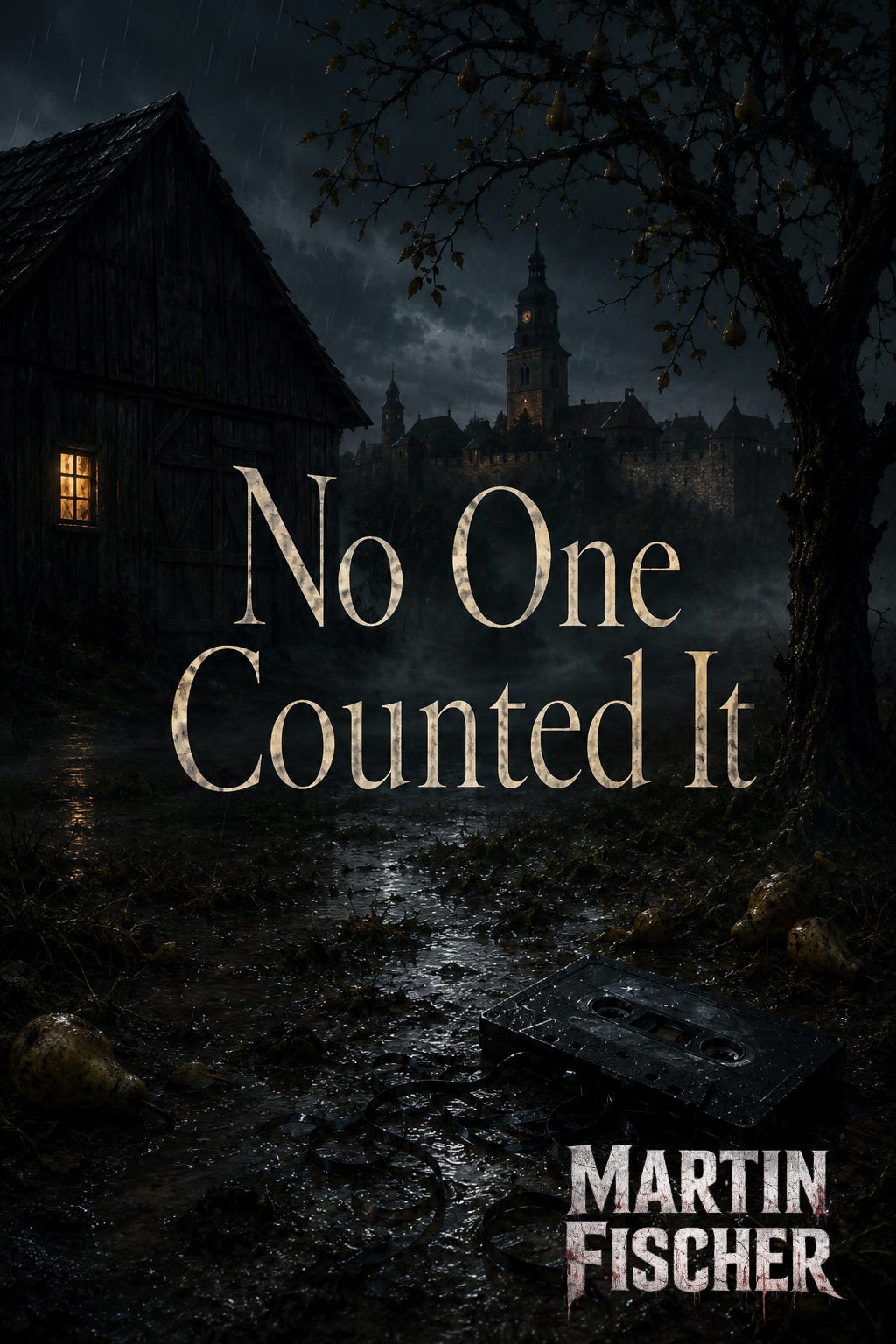
They called it a legend later, only because no one in town wanted to keep saying it had happened.
No one could agree how many bells had rung that night. Seven, some said. Twelve. Enough to wake the dead, said Frau Deininger, who had been awake already and had no patience for poetry.
Mara never corrected anyone.
She first heard the song beneath paper lanterns in the Spitalhof, on the night she married Frank Geiger.
The courtyard smelled of beer, wet stone and river air. It had rained before dusk. Water still stood between the old paving stones and caught the yellow light from the windows. Someone had brought a record player. Someone had said the song was beautiful, the sort of song made for holding someone forever.
Frank held her too tightly.
His palm rested between her shoulder blades. When she tried to turn toward her brother Kilian, laughing because he had bowed like a fool and asked for the next dance, the hand stayed there and stopped her.
“Later,” Frank said.
The singer’s voice carried over the courtyard. Tender, clean, in English, foreign to most of them.
Frank leaned close to Mara’s ear.
“That’s us,” he whispered.
She smiled because she was a bride and because everyone was watching.
Frank did not smile back.
Years later, when people asked when she first became afraid of him, she never mentioned the first broken plate. She never mentioned the red coat he held to his face after she came home from work, asking where she had been. She never mentioned the afternoon he stood outside the sewing shop until closing and asked why Herr Beck had made her laugh.
She remembered the wedding.
His hand.
His voice.
That song turning around them like a key in a lock.
When she left him, it was November.
The fields beyond Dinkelsbühl were black with rain. The Wörnitz had swollen into the grass and the apple trees along the road stood bare. Mara moved into her cousin’s empty house near the way to Segringen. It had a barn behind it, a low kitchen, a narrow stair and windows that looked out over the fields.
Beyond the lower pasture stood the Deininger farm. Even in daylight it looked half asleep, with its sagging roof and the black ribs of the old apple trees around it. Kilian had once said Frau Deininger could hear a fox cross a field in the snow. Mara had laughed then. That first evening, seeing one yellow window burning through the rain, she was glad of it.
Klara was with Mara’s mother inside the walls. Eight years old, feverish from a cold and asleep under two blankets. Mara had packed her winter clothes in a separate box and carried that one herself.
Kilian carried the last box inside and set it on the table.
“You call me,” he said.
“I know.”
“Any hour.”
“I know.”
He looked toward the barn. One of the doors hung badly, leaving a slit of dark between the boards.
“I’ll fix that Saturday.”
“It’s only a barn.”
He did not answer.
That night Mara slept in her coat because the stove would not draw properly. Rain tapped at the gutters. The house made small wooden sounds around her. Once, far off, a car passed on the wet road and did not stop.
At 3:14 the telephone rang.
Mara sat up before she knew she was awake.
The ring filled the room. Once. Twice. Again. The same ugly sound as always and wrong now.
On the fifth ring she lifted the receiver.
No voice answered.
Only breathing.
Not heavy. Not obscene. Just someone there, close enough to keep time with his lungs.
“Frank?”
The breathing stopped.
Then he hummed the first line of the song.
Mara put the receiver down.
In the morning there were footprints under her bedroom window.
They came from the road, crossed the yard, stopped beneath the sill and went back toward the barn. The mud had risen around each heel. Mara stood in her slippers and looked at them until the cold came through the soles.
Kilian arrived before noon. He saw the prints and said nothing for a while.
“He was here,” Mara said.
“Yes.”
“I called the police.”
“And?”
“They said they would speak to him.”
“Did they?”
Mara looked toward the road.
“They said they would.”
Kilian looked at the barn.
“Then I’ll speak to the door.”
He repaired the hinge with short, angry blows. Mara made coffee in the kitchen. Neither of them drank it. When he came back inside, he placed a black cassette tape on the table.
No case.
A strip of masking tape on one side.
In Frank’s handwriting:
FOR MARA
OUR SONG
Mara did not touch it.
“Found it just inside the door,” Kilian said. “Didn’t go farther in.”
He wiped rain from his face with his sleeve.
“Don’t play it.”
The barn door creaked.
Both of them turned.
The kitchen window showed the yard, the pear tree and the barn beyond it. The repaired doors were shut.
Kilian’s hammer was gone.
Then came a sound from inside.
One tap.
Kilian took the torch.
“Stay here.”
“No.”
“Mara.”
“No.”
She followed him into the yard because the kitchen had become worse than the dark.
The air smelled of mud and old fruit. Kilian crossed to the barn and lifted the latch. The door opened a hand’s width. Hay dust breathed out.
Something struck him from inside.
The sound was dull and hard.
Kilian fell to one knee, then sideways into the mud. The torch dropped and rolled, throwing light across the barn wall, the pear tree, the boots of the man stepping out.
Mara saw the long coat first.
Then the scarf.
Then Kilian’s hammer in his hand.
She ran.
Behind her Kilian made a low animal sound and tried to get up. The man stepped over him.
Not quickly.
He did not hurry.
Mara reached the kitchen door and slammed it. The key slipped once in her fingers. The lock caught as the first blow landed from outside. The door jumped in its frame.
She backed away.
The cassette lay on the table.
She ran to the telephone in the hall.
The line was dead.
Through the small window beside the door she saw the cut wire hanging loose against the wall.
Another blow came.
Wood split.
Mara ran upstairs and took the iron poker from beside the stove on her way. She did not think. Some old childish part of her still believed height meant safety.
Below, glass broke.
Then silence.
The house listened.
A board creaked in the hall.
Another.
The first stair took his weight.
Then the second.
The house told her where he was.
Mara stood on the landing with the poker in both hands. She smelled mud before she saw him.
He came up slowly, one hand on the banister.
His cap shadowed his eyes.
His scarf covered his mouth.
“Stop,” she said.
He stopped three steps below her.
For a moment there was only his breathing through the wool.
Then he sang the first notes.
Her hands shook so badly the poker tapped the wall.
“Take it off,” she said.
He pulled the scarf down.
His lip was split. Kilian had hit him after all. Mud marked one side of his face. His eyes were bright and sleepless.
“You sent them to me,” Frank said.
Mara could not speak.
“The police. Your brother. Herr Beck with his careful voice.” He climbed one step. “Frank, leave her be. Frank, don’t make trouble. Frank, let her have some peace.”
“Stay back.”
“You made our marriage public.”
Another step.
“You took the plates. Your coat. Your mother’s quilt. You took Klara’s winter boots. But you left the song with me.”
He looked past her into the dark hallway, as if the house itself had betrayed him.
“I kept it safe.”
“It was never safe,” Mara said.
His face changed.
Not anger at first. Hurt. The old, dangerous hurt that had always demanded payment.
“It was ours.”
She swung the poker. It struck the banister with a scream of metal. Frank flinched, then caught the iron with both hands. For a second they held it between them. His hands bled where he gripped it.
He pulled.
The poker came free of her.
It fell down the stairs.
Mara ran into the bedroom and slammed the door. She dragged the wardrobe across the floor. Frank hit the other side before it was fully in place. The wardrobe moved an inch.
“Mara,” he said.
Not shouting.
That was worse.
She climbed onto the sill.
Outside, the kitchen roof sloped below the window, black with rain. Beyond it lay the yard, the barn and the fields. Far off, through the low fog, the Deininger farm showed one square of yellow light.
The wardrobe toppled.
The door burst inward.
Mara dropped.
She hit the roof on her hip, slid, grabbed the gutter and hung there above the herb bed. The gutter tore loose. She fell hard into the mud.
Pain flashed up from her ankle.
Above her Frank leaned out of the window.
“Mara!”
She crawled, then stood, then ran because her body did not ask whether she could.
At the barn she heard Kilian groan.
She stopped.
The doorway was open. The torch still burned in the mud, half buried, lighting the barn from below. Kilian lay near the threshing machine with blood at his hairline and one arm held tight against his ribs.
“Go,” he said.
“No.”
“He’s coming.”
“I know.”
She got under his good shoulder and hauled him up. He cried out through his teeth. Together they staggered toward the rear door, the one that opened to the fields.
Behind them the kitchen door opened.
Frank crossed the yard toward the barn.
Step.
Step.
Mud taking his boots.
Mara found the latch, pulled, failed, pulled again. A nail tore her palm. The door gave.
Cold air rushed in.
They stumbled into the field.
The furrows were full of water. Fog lay low over the earth. Dinkelsbühl glimmered beyond it, a few yellow windows and the church tower dark above the walls.
Then the music began behind them.
Tinny and warped.
Much too loud.
Another tape.
A player he had hidden in the barn.
The song came after them over the field.
Every breath felt heard.
A light appeared to their left.
Mara froze.
For one second she thought Frank had reached the trees ahead of them too.
Then the light lifted.
Frau Deininger stood at the edge of her field in a man’s coat over a nightdress, holding a lantern. Her white hair had come loose. Behind her, one of the farmhouse windows was already bright.
“This way,” she hissed.
Mara and Kilian turned toward her.
Frank called from behind them.
“I can see you.”
No one answered.
Frau Deininger raised the lantern.
“Frank Geiger,” she shouted, “we all can.”
A second window lit in the farmhouse.
Someone inside yelled for the sons.
The dog began barking.
Frank stopped.
For the first time that night, he looked around.
More lights came on. A man shouted from the road. Someone ran that way, calling for the bell.
Frank started forward again.
Kilian sagged. Mara could not hold him. They went down together in the mud.
Frau Deininger stepped between them and Frank.
“Go home,” she said.
He struck the lantern from her hand.
The flame went out.
The field vanished.
Mara heard Frau Deininger fall. Heard Kilian curse and try to rise. Heard Frank breathing close now. He smelled of rain, old wool and the sour heat of someone who had not slept.
His hand found Mara’s hair.
She drove the torn nail of her palm into his injured mouth.
Frank screamed.
Kilian lunged from the mud and caught his knees. They fell together. The song kept playing from the barn, thin and steady, as if nothing in the world could interrupt it.
Then the bells began inside the walls.
Not orderly bells.
Not Sunday bells.
Hard, uneven bells, pulled by frightened hands.
The fog shook with them. The song broke apart inside it.
Men crossed the field with torches. Frau Deininger’s sons. Herr Beck from the shop. A young policeman still buttoning his coat. Someone carried a pitchfork. Someone else carried rope.
Frank rose from the mud with the hammer in his hand.
He looked at Mara.
Not angry now.
Afraid.
Not of prison. Not then.
Of the faces in the dark.
Of being seen.
“Mara,” he said.
The bells answered.
“You know me.”
She sat in the mud with Kilian’s head in her lap. Blood ran warm between her fingers. Her voice was almost gone.
“Yes,” she said. “I do.”
Frank stepped back toward the darker ground beyond the torchlight.
Behind him, the ditch was full of rain and river water.
The bank gave way under his heel. He fell backward into the black water.
For a moment there was only splashing.
Then hands reached down.
The young policeman. Herr Beck. Frau Deininger’s sons. Even after everything, they pulled him out.
Frank fought them until he had no strength left.
When they dragged him onto the grass, he lay on his side coughing ditch water into the mud. His wrists were held behind him. His face turned toward Mara, pale in the torchlight.
The tape in the barn slowed.
The song warped lower and lower.
Then stopped.
Dawn came thinly.
Kilian lived. Frau Deininger needed stitches above one eye and told the doctor he sewed like a drunk tailor. Mara’s ankle was bound for weeks. Her palm healed with a small white crescent where the nail had gone in.
Frank was taken away before sunrise.
At first he shouted her name from the back of the car. Then Klara’s. Then words from the song. Then only sounds.
Mara stood wrapped in Frau Deininger’s coat and watched the tail-lights vanish on the wet road.
Her daughter had slept through all of it at her grandmother’s house inside the walls.
That was the mercy Mara returned to.
Not the bells.
Not the neighbors.
Not even Kilian opening his eyes when she had thought he would not.
Klara sleeping.
One room in the world he had not entered.
In spring, when the pear tree flowered, Mara found the cassette in a kitchen drawer. She did not remember putting it there. Perhaps the police had returned it with other things. Perhaps Frank had hidden more than one.
For a while she held it over the stove fire.
Then she took it to the barn, set it on the chopping block and brought the axe down once.
The plastic split.
The tape unspooled in black curls.
Klara stood in the doorway.
“What is it?”
“A tape,” Mara said.
“Was it his?”
Mara looked at the broken cassette, the open yard, the pear tree white with flowers.
“It used to be.”
“Is it dead?”
“No,” Mara said. “But it isn’t ours.”
They carried the pieces to the stove.
Mara lit the match.
The tape tightened in the heat, then blackened and became smoke.
Klara took her mother’s hand.
Outside, the town bells rang the hour.
Ordinary bells now.
Daylight bells.
Mara listened until the last note was gone.
Then she breathed.
No one counted it.
Martin, that was phenomenal! I was holding my breath the whole time - absolutely gripping.
I read that. And I found it impressive the way you approached such a delicate subject that can mess with many.
I won’t delve into the story itself which, in my opinion, was fantastic, so as not to tell it accidentally through my comment.
But I can say that as a social worker who deals with a kind of reality, this story brought real aspects in the midst of a scenario that can be very present for many.
I just loved your story!