

The Door of the Golden Crown
A dark historical story drawn from the trial record and later civic memory of Maria Holl of Nördlingen

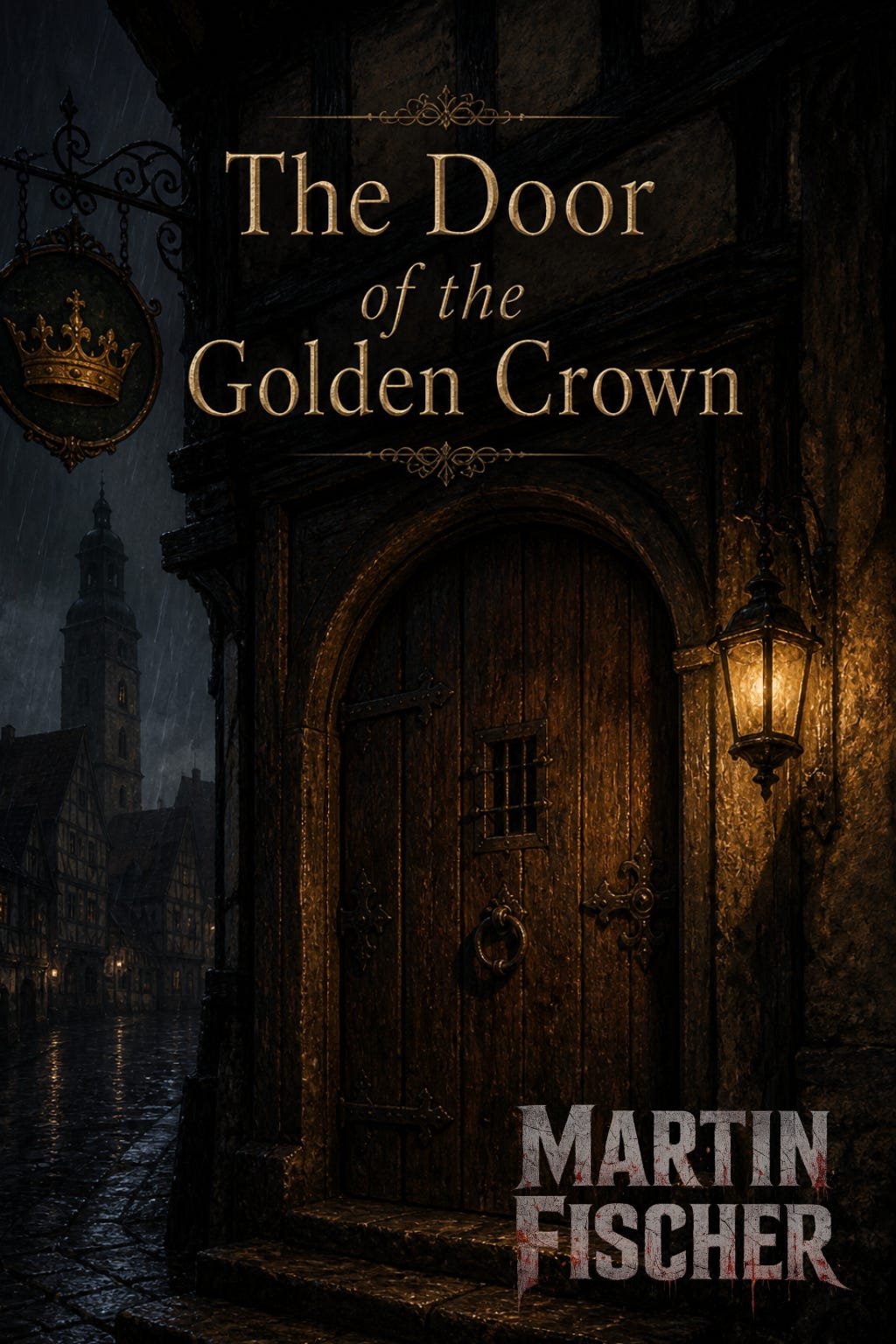
What follows is a literary reconstruction drawn from the recorded trial and later civic memory of Maria Holl of Nördlingen.
The first knock came after the house had gone quiet.
Maria Holl had just covered the last cup with a linen cloth. The fire in the hearth had sunk low and the beams of the Golden Crown held the day’s warmth the way old wood holds old voices. Beer, smoke, wet wool and yeast. All of it lived in the room even after the guests had gone.
Outside, the Weinmarkt lay under a skin of darkness.
The knock came again.
Three blows.
A pause.
One more.
Michael looked up from the table where the day’s coins lay in small, careful piles. His hand remained above them, fingers half-curled. He did not ask who it was. In a house like theirs one learned the sound of men. Hungry men struck differently from drunk ones. Angry men struck with the side of the fist. Men bringing trouble knocked as if the door already belonged to them.
Maria wiped her hands on her apron.
The third knock shook the latch.
She crossed the room. Her shadow moved ahead of her over the boards, long and dark, broken by the firelight. For a moment she felt the whole house listening: the barrels in the cellar, the cups on their shelves, the rooms upstairs where beds waited with cold sheets.
She lifted the latch.
Men stood beyond the threshold with lanterns.
Their faces seemed to float above their collars. Rain had darkened their hats and gathered at the ends of their noses. Behind them, the town was narrow and black. Water ran in the gutter. Somewhere under the eaves, a shutter trembled though there was no wind.
One of the men said her name.
Not Frau Holl.
Not Kronenwirtin.
Maria Holl.
Michael stood so fast his stool struck the floor.
She did not turn. She watched the lantern nearest her, the small yellow flame crouched inside its horn panes. The men kept their hands low. Not at their sides. Low, ready.
They told her she must come.
She asked where.
No one answered at once.
That was how she knew.
The Klösterle waited for people before it swallowed them. Everyone in Nördlingen knew that. Children were hurried past it. Women lowered their voices near it. Men leaving the council house sometimes looked toward it and then away, as if the white walls had eyes behind them.
Maria reached for her cloak.
Michael came to her then. He took her wrist, not hard, not enough to stop her. Only enough to remind her that she was still in a room where she was loved.
“Maria,” he said.
The men shifted in the doorway. Rain clicked on the lantern glass.
She looked at him and saw that fear had already entered him. It had entered his mouth and his eyes. It had found the place in him where her name lived.
“I will come back,” she said.
She had meant to comfort him.
Instead the words fell between them like something broken.
The men moved aside. She stepped into the night.
Nördlingen watched her pass.
No door opened. No one called from a window. Still she felt the town awake behind its shutters. The old stones gave back the sound of her steps. The lanterns swung. Rain ran beneath the hem of her cloak. Mud sucked at the edges of the street where the paving failed.
At an upper window, a child’s face appeared, pale as candle fat. A hand pulled it away.
They crossed the Weinmarkt.
The sign of the Golden Crown creaked behind her. Once. Twice. Then the sound was gone under the rain and the tread of boots.
At the Klösterle the key turned.
Maria heard it before the door moved. A heavy inner sound, iron answering iron. The door opened into a dark so stale it seemed to breathe out.
Down the corridor, someone was crying without strength. Not sobbing. Not weeping. Only letting out a thin thread of sound each time the body remembered to live.
The men took her inside.
The walls were damp. The air smelled of straw, old smoke, metal and fear. A lantern threw its light forward and made the passage seem longer than it was. Maria heard a bolt drawn somewhere behind her. The noise passed through her shoulders and settled in her teeth.
They brought a woman in while the night still pressed against the walls.
Ursula Klein.
Maria knew her. Not well. Well enough to know how she had once stood at a market stall choosing onions, pressing each one with her thumb. Well enough to know that she had a voice that carried in church.
That voice did not come with her now.
Two men held her upright. Her head hung forward. Her hair had slipped loose from its covering and stuck to her temples. When the lantern came close, she raised her eyes.
Maria saw recognition there.
Then terror.
“No,” Ursula whispered.
One of the men spoke sharply.
Ursula’s mouth moved. Nothing came out.
The man leaned in. Maria saw his lips near the woman’s ear. She did not hear the words. She did not need to. Ursula began to shake as if cold water had been poured down the back of her dress.
“She was there,” Ursula said.
The clerk at the table scratched at the page.
“Say the name.”
Ursula looked at Maria then. Her eyes begged for something no one in that room could give.
“Maria Holl.”
The sound did not belong to her. It had been dragged out.
At another hour they brought Anna Faul.
Anna did not beg with her eyes. She kept them fixed on the floor. Her hands opened and closed around nothing. When they asked, she nodded first, very quickly. Then she said the name too.
Maria felt the room lean toward her.
It was not the men alone. It was the table, the walls, the wet stones and the locked door. It was the town outside with its shutters closed. All of it waited for her to change. For her skin to reveal smoke beneath it. For her voice to turn black. For the woman from the Golden Crown to split open and show them the thing they had already feared.
Maria stood with her hands clenched in her cloak.
She said, “No.”
The clerk wrote.
A small sound.
A hungry sound.
He sanded the ink before it could blot, as if neatness mattered.
After that, the days no longer came cleanly.
They came as footsteps on the stair. They came as light under the cell door. They came as questions repeated until the words lost their human shape.
Had she known Maria Marb?
Had she gone where good Christians did not go?
Had she promised herself to the Evil One?
Had she eaten, drunk, spoken, stood, touched, dreamed?
Had she?
Had she?
Had she?
Maria answered until her throat scraped.
No.
Sometimes they let her sit alone long enough for hope to crawl near her. It came timidly. It stood just outside reach. Then the key turned and hope fled into the straw like a rat.
In the dark she heard other prisoners.
At night the Klösterle filled with small noises. Breath through swollen lips. A prayer stopped in the middle. A body turning carefully because pain had edges. Once, from somewhere above or below, she heard a woman laughing. It went on for too long. No one told her to stop. Perhaps no one wanted to go near it.
Maria pressed her forehead to the wall.
The stone was cold and wet.
On some mornings the bells reached her. Not the whole sound, only the underside of it, a dull pulse through masonry. Each time she heard them she saw the town without wishing to: women at the well, men crossing the market, Michael at the door of the Golden Crown with his face drawn tight and his hands smelling of beer because the work of life went on even when life itself had been taken away.
Then the men came again.
A chair.
A table.
A candle.
The clerk’s quill.
Their patience frightened her more than anger would have done. They did not rage. They waited. They had the time of men who believed the truth was buried in her body and that pain was only the spade.
At first she kept count.
Not of the tortures. Of the returns.
One.
Then another.
Then another.
After a while, even the returns lost their number.
There were screws for the thumbs. There was the boot they brought in like a piece of winter iron. There was the rope. There was the bench. The names of these things were spoken calmly by men who had eaten breakfast, men with ink on their fingers, men who would later walk home through rain and be called father or husband at the door.
Maria learned not to look at what they carried.
Her hands no longer belonged wholly to her. They waited, curled and useless, as if listening for iron.
She learned the sounds instead.
Wood set down.
Leather drawn tight.
A rope moving through a ring.
A man clearing his throat before he asked the question again.
The small pause before the body understood what the room intended.
The body learned before the mind did. It heard boots and began to tremble. It smelled tallow and iron and loosened its own strength. It betrayed her by trying to live.
When she gasped, they called it answer. When she fainted, they called it cunning.
Long after they left, her limbs still answered questions no one was asking.
They asked her whether she had known Maria Marb.
They asked whether she had gone where good Christians did not go.
They asked whether she had promised herself to the Evil One.
They asked until the words became weather in the room, until every question fell on her already bruised by the last.
No.
Then again.
No.
Then again.
Her voice grew smaller, but it did not vanish.
Once, when they left her, she tried to remember the smell of bread in her own house and could not.
That frightened her more than the pain.
She tried again. Yeast. Warm crust. Flour on her wrists. Michael’s hand passing behind her back as he reached for a cup. Morning light on the tables before the first guest came in.
Nothing held.
The room took even that and gave back stone.
This, too, they had taken: not only strength, but the small doors by which the world returned to her.
Once, after many days or weeks, when the candle flame had doubled and the men at the table seemed to sit very far away, she gave them words.
Small words.
Words broken off from sentences she did not believe.
They leaned forward. All of them. Even the clerk stopped breathing while his quill waited above the page.
The room grew warm with their wanting.
Maria heard herself say something that was not true enough to save her and not false enough to satisfy them.
Then one of the men asked another question.
And another.
Another name.
Another place.
Another night.
The room opened its mouth wider.
Maria saw then that it would not end with her.
She saw Ursula’s face. Anna’s. Maria Marb’s name passing from mouth to mouth until names were not names anymore but doorways. She saw the Golden Crown empty, then filled with strangers whispering. She saw Michael serving men who had looked away while she was carried through rain. She saw the town feeding one woman to the dark and finding the dark still hungry.
“No,” she said.
They told her to repeat what she had said before.
“No.”
They told her she had confessed.
“No.”
They told her the Devil had given her strength.
Maria lifted her head.
The candle stood between them. Its flame bent though no one moved. Behind the flame their faces blurred, white and watchful.
“No,” she said again.
After that, something like fear entered the room.
Not all at once. It came in with the cold. It sat beside them at the table and looked where they looked. They had expected the witch to appear under pressure, like sap from split wood. She did not. What appeared instead was a woman who could be hurt and not made into the shape they needed.
That was worse.
In town, the story changed by being whispered.
At the well, someone said she had endured what no one endured.
In a doorway, someone said she must be helped by dark powers.
In the market, someone crossed herself after speaking her name, then looked ashamed and crossed herself again.
At the Golden Crown, the sign swung above a quieter door. Michael kept the fire burning. He opened when he had to open. He answered when spoken to. Some men came in and drank too fast. Some stood outside and did not enter. Women passed the house with their baskets held close. More than one touched the wood of the doorframe as if the place itself had become a wound. Once he set two cups on the table by habit and stood looking at the second until the fire went low.
Snow came once and did not stay.
Rain came more often.
The fields beyond the wall turned black under it. Carts came in with wheels clotted thick with mud. At night the town smelled of wet straw and smoke. Dogs barked at nothing and were called indoors.
The Klösterle did not sleep.
It kept its own weather.
Cold above. Heat below. Damp in the walls. Straw gone sour. The slow drip of water into a corner Maria could not see.
The door opened.
Closed.
Opened.
Closed.
Her body became a place she visited only when forced.
Sometimes she woke and did not know whether she had spoken aloud. Once she woke with her hand over her own mouth and the taste of blood where she had bitten her tongue to keep from answering a dream.
In the dream a woman stood at the door of the Golden Crown.
She wore Maria’s face.
She knocked three times. Paused. Knocked once.
Inside the house, Michael went to open.
Maria tried to scream from the other side of the dream, but the dream had no room for her voice.
When she woke, the cell was black.
Someone was breathing in the corner.
She held still.
The breathing held still too.
“Who is there?” she whispered.
No answer.
Only darkness.
Only the remembered shape of her own name.
Near the end, the men from Ulm came into the talk like weather from another country.
She did not see them at first. She heard them through the corridor, through bolts and stone. New voices. Sharper. Less used to the prison smell. A chair overturned somewhere above. A man said that it had gone too far. Another told him to lower his voice.
Then silence.
Maria lay on the straw with her eyes open.
The next time they brought her out, there was no question waiting.
That frightened her too.
A man who had once leaned close to hear her break would not look at her. He stood beside the table with his hands folded. The clerk’s papers were stacked, not spread. The candle was new. Its wick had not yet bent under its own ash.
Maria waited.
Waiting had become its own instrument. Before any hand touched her, before any question was spoken, waiting had already begun its work.
Her knees trembled under her skirt. She hated them for it. She hated the men for seeing. She hated the room because it had learned the exact measure of her fear.
They gave her words to sign.
Not freedom. Not mercy. Words. Ink. A way for the town to open its hand without admitting what it had held.
Her fingers closed around the pen.
For a moment she could not remember how to write her name. The letters stood apart from one another, strange black shapes. The men waited. The clerk dipped the pen and offered it again.
Maria made the marks.
No one breathed.
On the eleventh day of October, they opened the outer door.
The air struck her like water.
She stood beneath a pale sky. The town looked too bright, though the day was grey. Roofs. Gables. The church tower. The stones of the street. The world had continued to have edges without her.
A few people had gathered.
Not close.
They looked at her as if she had come back from under the earth. A woman made a sound and covered her mouth. A man took off his hat too late, then put it back on, then took it off again. Someone behind them whispered her name and the crowd shifted away from the whisper as if it were flame.
Maria stepped forward.
The people stepped back.
Only a little.
Enough.
They had wanted her saved, perhaps. But not too near.
She heard a child begin to cry. The mother pulled him behind her skirt and whispered harshly for silence.
Maria stopped.
The street narrowed before her. At its end stood the Golden Crown. The sign hung still in the damp air.
She walked toward it.
No one touched her.
No one asked forgiveness.
Later, each of them would remember having done nothing. It was the name they could live with.
At the door she lifted her hand. Her palm hovered above the wood. She knew this door. She had opened it in summer heat and winter dark. She had stood behind it while men laughed, while travellers shook rain from their hats, while Michael counted coins and called to her from the hearth.
Now the wood seemed to wait.
She set her hand on it.
Inside, something moved.
The latch lifted.
Michael opened the door.
For one heartbeat they looked at one another across the threshold.
The town had made a witch out of her name. The prison had made a ruin of her body. The men had made papers and questions and silence. But here was the door. Here was the smell of beer and ash. Here was the room that had held the shape of her absence.
Michael reached for her.
She crossed the threshold.
Behind her, in the street, Nördlingen remained very still.
That night the Klösterle stood in the dark with its walls wet from rain. No one passing it looked up. No one listened for breathing behind the stones.
The last bell faded.
In the cooling lock, the iron gave one soft answer to itself.
Then nothing.
Only the room, holding the shape of every name it had been given.
Appendix: Documented Core and Civic Memory
1. The narrow documented core
Maria Holl was a historical person connected with a documented Nördlingen witch trial of 1593/94. The Deutsche Digitale Bibliothek catalogues Gloria Rüdel-Eschbaumer’s 1998 volume Der Hexenprozeß Maria Holl: mit Originalprotokollen aus dem Stadtarchiv Nördlingen vom Jahre 1593/94. It records the book as a 97-page publication on Maria Holl, the years 1593–1594 and a witch trial and notes that only the table of contents is digitally available there. This entry is therefore a bibliographic anchor, not direct access to the full trial material.
A separate Meta-Katalog record lists Rüdel-Eschbaumer’s 1983 source-text case study Bescheidenliche Tortur: der ehrbare Rat der Stadt Nördlingen im Hexenprozeß 1593/94 gegen die Kronenwirtin Maria Holl as a monograph, source text and case study concerning witch persecution, legal process and Maria Holl.
The shared biographical core is that Maria Holl was born around 1549, probably in Altenstadt, as the daughter of the Ulm official Jörg Löhlin. She married Michael Holl in Ulm Minster on 20 May 1586. After the marriage the couple moved to Nördlingen, where Michael Holl acquired the inn known as the Goldene Krone (Golden Crown) at Weinmarkt 8 and the couple ran it. The precise date of civic status appears in some retellings and summaries, but the story does not depend on it.
The trial core is this: Maria Holl was accused after being named by other accused women. The Geislingen Stadtarchiv account says Maria Marb had named her as early as 1590. Maria Holl was arrested on 2 November 1593, taken to the Klösterle, the city prison and confronted there with Ursula Klein and Anna Faul, who also accused her.
The strongest accessible summary says Maria Holl was tortured in 13 of 18 interrogations and that the torture was carried out 62 times in total. It also names the procedures: twice with Daumenschrauben (Thumb Screws), 26 times with the Spanischer Stiefel (Spanish Boot), 19 times drawn up by the rope and 15 times laid on the Streckbank (Stretching Rack). The story uses these documented categories sparingly and sensory rather than graphically.
A common simplification says Maria Holl “never confessed.” The more careful version is that she made smaller admissions under torture, then recanted when the torture continued and could not be brought to a further confession. This nuance is stated in the Geislingen Stadtarchiv summary, which is why the story does not present an absolute, uncomplicated refusal from the beginning.
Maria Holl was released from imprisonment on 11 October 1594 after an Urfehde, a formal document connected with her release. The Geislingen Stadtarchiv account describes the support of powerful people from Ulm as contributing to that release and refers to the surviving Urfehde document from the Stadtarchiv Nördlingen. For that reason, the story shows intervention from Ulm only as pressure heard from within the prison, not as a fully reconstructed legal scene.
2. Civic memory and transmitted interpretation
The transmitted civic memory is not a supernatural legend in the strict sense. It is the memory of the “standhafte Maria Holl”, the steadfast innkeeper whose endurance under torture became emblematic in Nördlingen’s remembrance of the witch persecutions. Nördlingen’s official Lauschtour material connects the city’s witch-trial sites with the house of the steadfast Maria Holl.
The broader context is Nördlingen’s witch persecution from 1589 to 1598. Current official Nördlingen material gives 34 women and one man as victims of the Nördlingen witch persecutions from 1589 to 1598. Nördlingen’s Lauschtour page phrases the same number more broadly as people executed for witchcraft in the sixteenth century. For the purposes of this story, the exact total is contextual rather than part of Maria Holl’s own trial sequence.
Later memory often presents Maria Holl’s resistance as helping to weaken or end the Nördlingen witch panic. The Geislingen Stadtarchiv gives the cautious version: she was not the last woman accused, but her resistance shook belief in the reliability of statements made by women burned as witches. Official and touristic memory sometimes uses stronger commemorative language. The cautious version is safer as history; the stronger version belongs to civic memory.
3. Later embellishments or uncertain additions
The motive of envy appears in public and touristic retellings, often alongside power and superstition. Some popular accounts connect that envy specifically with the success of the Goldene Krone (Golden Crown). It should not be treated as a securely documented cause of Maria Holl’s accusation unless tied to specific archival evidence. The story therefore uses fear, rumor and accusation without making envy the established motive.
The legal meaning of Maria Holl’s release should be handled carefully. Some later retellings call it an acquittal or Freispruch. The stricter formulation is that she was released from imprisonment after an Urfehde, a formal document connected with her release. The story therefore shows release and the signing of a document, but does not dramatize a clean modern acquittal.
Some popular accounts add specific terms to the Urfehde, such as restrictions on leaving the house or taking revenge. Because those terms are not part of the shared core of the accessible archival and memorial summaries used here, they remain uncertain in this appendix and are not used as fixed fact in the story.
Some details of atmosphere, bodily reaction, family memory, prison sound and communal fear are not documented specifically for Maria Holl. They are literary reconstruction within the documented Nördlingen witch-trial context. Comparable Nördlingen material, especially the Rebekka Lemp case, preserves interrogation records, evidence of torture, forced confession and personal prison letters; such material supports the atmosphere of fear and suffering, but it is not transferred as biographical fact about Maria Holl.
The weather, dialogue, knocking pattern, crowd reactions, dream scene, order and staging of the confrontations and Maria’s private perceptions in Part I are literary reconstruction. They are meant to intensify atmosphere without contradicting the documented scaffold: Maria Holl as innkeeper of the Goldene Krone (Golden Crown), accusation through other accused women, imprisonment in the Klösterle, confrontation with Ursula Klein and Anna Faul, repeated torture, smaller admissions followed by recantation, no final confession and release from imprisonment on 11 October 1594.
That was a great read. Really well written, you feel immersed only a short way in and it holds your attention all the way through.
I enjoyed this, well done!