

The Klogmuada
An old story from Pentling

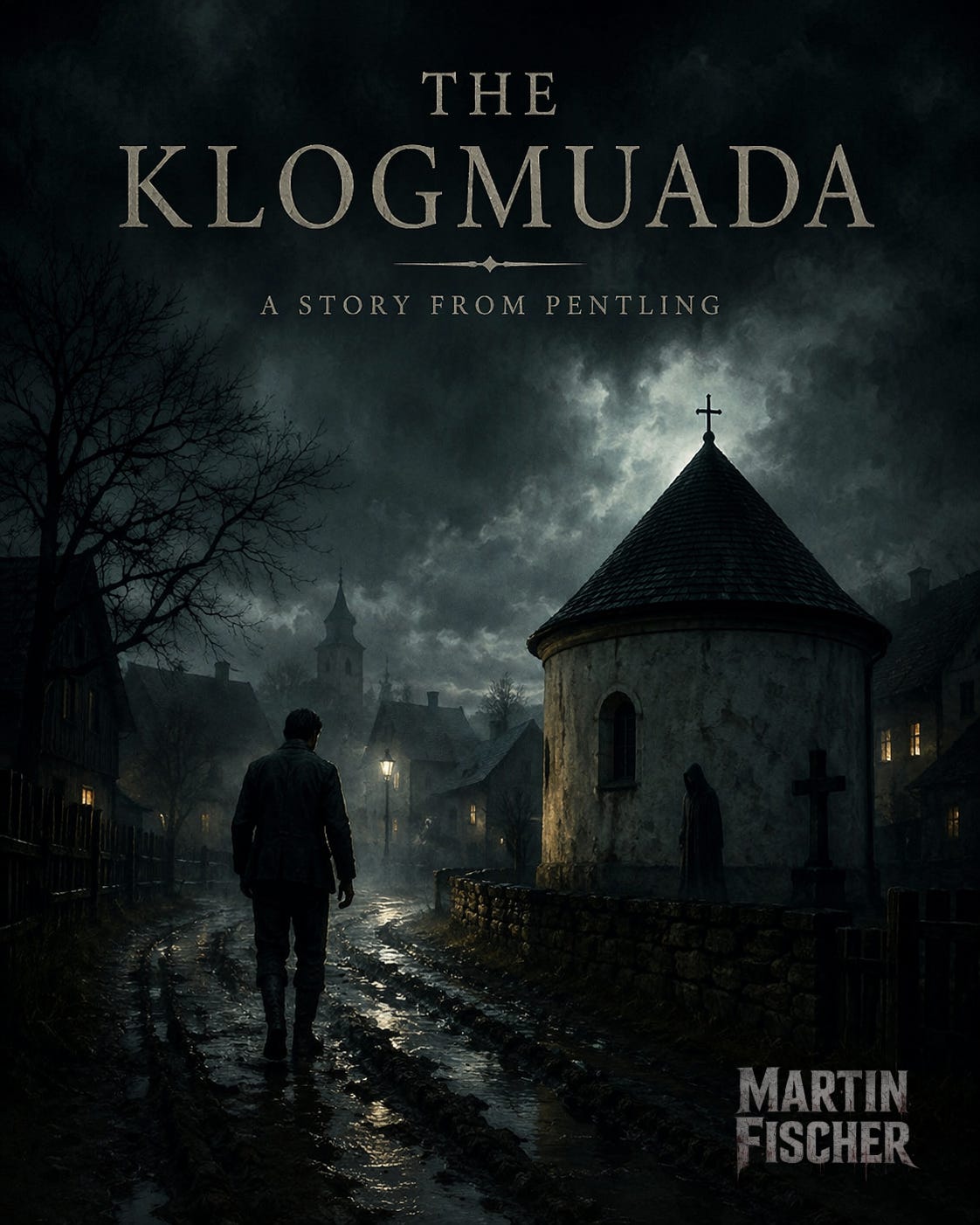
This is a dark retelling of an old story from Pentling and not my own.
The rain had passed on, but the village was still full of it.
Water still fell from the eaves. The wheel ruts were full of black mud. A few windows burned dim behind their glass, but most had gone dark and beyond the last houses the fields were only a deeper black under the night. The air smelled of wet earth, dung and cold stone.
Lorenz came up the road with wet boots and aching legs, thinking of nothing but sleep.
He had a habit of listening at doors before he opened them.
It had begun when he was a boy, after one wet night of knocking that his father had told them to ignore. No one ever said afterward who had stood outside or how long. Lorenz had lain awake listening to the sound stop and since then he had never been able to lift a latch without first standing still and listening for what might already be there.
He had stayed longer than he meant to that night.
Not drinking much. Only long enough to get the damp out of his clothes and the day’s work out of his shoulders. At the inn the talk had gone in the usual circles, weather, mud, a broken wheel, whose cow had taken ill, whether the road by the chapel would ever be worth the trouble it cost. Lorenz had not said much. He was tired and there were evenings when tiredness sat in him so deep that even other people’s voices seemed to come from a long way off.
When he rose to leave, the room had thinned already. Old Huber sat with his beer and his white eye turned nowhere. Someone near the stove told Lorenz not to break his neck in the mud. Someone else laughed. Lorenz pulled on his coat, nodded to no one in particular and stepped out into the wet dark.
For a little while nothing was wrong.
That was the thing he remembered later. The ordinary feel of the night. Water dropping from the roofs. A cart half-covered beside a wall. Light behind a curtain where some family had not gone to bed yet. The soft churn of mud under his boots. Once he passed a house where he knew the children were still awake because he heard one of them cough upstairs, followed by the low murmur of the mother’s voice.
It was Pentling as he had always known it. Tired. Close. Half asleep.
He went by habit more than thought, one hand brushing the damp fence boards as he walked. At his own gate he would stop, listen, lift the latch and go in. The thought of that small order, door and stillness and bed, pleased him more than he would have admitted.
Then he came to the round chapel.
When he reached it, he heard someone whispering.
He stopped where he was.
At first he thought a woman had stayed late at prayer. Then he listened again and felt something in him turn cold. Prayer has a shape to it, even when the words cannot be heard. This sound had none. It snagged and broke and started again, as if a mouth were trying to remember speech.
He looked toward the chapel wall.
Something stood there, small and bent, dark against the white curve of the stone.
For a moment he took it for a bundle of old cloth left in the wet. Then the head turned toward him.
“Who’s there?” he called.
No answer came. Only the whispering.
The figure left the wall and began to move toward him.
Its steps were short and dragging, yet it came faster than it should have. That was the first wrongness of it. Not the shape. Not the hour. The way it moved. A body that moved like that should have been slow. This one was not. Mud clung to what might have been the hem of a skirt. The hands hung low and pale. Lorenz caught a face then or enough of one. Sunken cheeks. A mouth that would not stop moving.
He stepped back.
It kept coming.
He stepped back again and the whispering came on over the mud with it, thin and steady, never rising, never falling, as if the thing had all night for this and had chosen him before he knew it.
Lorenz turned and ran.
He slipped once in the lane and caught himself on a fence post. His shoulder struck wood hard enough to numb his arm. Behind him came the soft wet drag of those steps. Not hurried. Not stumbling. Near. Too near.
He cut through Mühlbauer’s yard, splashed through the churned ground by the pig shed and reached his father’s barn with his heart knocking so hard he could feel it in his throat. His hand slid from the latch. Then again. The whispering had come close enough now that he could hear breath inside it.
For one blind second he believed the door would stay shut and the thing would lay its hands on him there in the dark.
Then the latch gave.
He stumbled inside, hauled the door after him and dropped the bar into place.
Darkness took him all at once.
The barn smelled of hay, dust, damp timber and harness leather. Lorenz stood with both hands flat against the door and listened, his mouth open, drawing no air he could feel.
For a little while there was nothing outside.
Then something touched the boards.
Not a knock.
Not claws.
A hand.
It moved slowly from plank to plank, feeling the seams, patient as a blind person reading for a latch that was not there. Lorenz shut his eyes and bit down on the inside of his cheek until he tasted blood.
The whispering came through the cracks.
Very low. Very near.
He could not make out a single word. That was worse than words would have been. It sounded as if something wanted badly to be understood and could not make its mouth obey.
Then it stopped.
The hand stopped too.
For a breath or two there was nothing outside and in that nothing Lorenz leaned without meaning to, as he had done all his life, listening at the seam.
At once he understood his mistake.
Something had come close on the other side as well. Not moving now. Listening.
He did not hear breath. He felt its attention in the boards, held exactly where his own face hovered. Then, gently, almost with curiosity, one fingertip touched the wood at the height of his ear.
Lorenz made a sound then, small and helpless and jerked back.
The whispering began again, lower now, travelling slowly along the crack as if searching for the place where his listening had been.
Lorenz remained there until grey morning showed in the gaps.
His mother asked why he looked sick. His father asked why the barn had been barred from inside.
Lorenz lied and did it badly.
By noon the village had heard that he had seen something near the chapel.
No one owned the telling. It moved the way such things move, from doorway to doorway, over fences, across a yard where washing hung damp and still, into kitchens where women stopped with flour on their hands to listen. At the inn that evening the talk stayed low and never strayed far from the road by the chapel.
Old Huber, who had one white eye and one sharp one, listened until Lorenz had done and then asked only, “What time?”
“Midnight.”
Huber nodded once.
That was enough to quiet the room.
After that Pentling changed, though not all at once.
Children were called in earlier. Men left the inn in pairs without saying why. Shutters were closed before the sky had fully darkened. Lamps stayed burning longer in kitchens. When the church clock neared midnight, a kind of listening settled over the village, though no one would have admitted to it.
Then other stories began to surface, each one told as if it were hardly worth the telling.
A farmhand who lodged near the edge of the fields said he had heard whispering below his window and seen no one there when he looked. A woman on the upper road said something had stood by her gate after dark, though she had watched only its shape, not its face. A boy sent to fetch kindling came back white about the mouth and would not go out again that night.
Lorenz said nothing about the hand on the barn door. Some things, once spoken, seemed to come nearer.
Three nights later he went out again.
He knew better. He went anyway.
The fear in him had become a hook. It pulled as much as it warned. He took the lane by the smithy and stood where the wall kept him in shadow and gave him sight of the chapel and the road before it.
The village clock began to strike.
By the last stroke she was there.
Lorenz never saw her come. One moment the road was empty. The next she stood before the chapel door, bent and still, her face lowered to the narrow crack where the wood met stone. The whispering passed into that crack as softly as breath into an ear.
She stood too close to the door. No living person would have stood so close.
Then she turned away from it and moved into the street.
She was not wandering. She went from house to house.
At the first gate she stopped and whispered there. At the next house she laid only her fingertips against the door, moving them slowly along the seam as if she knew exactly where wood gave way to dark. When she drew her hand away, Lorenz could still hear the whispering in the crack for a moment, as though the door itself had taken it up. At another house she stood below the shutter with her face tilted upward, as if listening to the breathing inside. The whole village seemed to hold itself still around her. No dog barked. No bolt was drawn. Once somewhere in the dark a child began to cry and was hushed so quickly it was as if a hand had been clapped over its mouth.
Lorenz watched her reach Schmidt’s house. She remained there a long while, one hand against the narrow dark line between door and frame. After a time he heard a small sound carry through the street. Not the bolt. Not the door. Only the latch giving once, then settling back.
Then her head lifted.
She turned slowly toward the smithy wall.
Toward him.
Lorenz did not wait. He broke from the shadow and ran.
The whispering changed behind him. It did not grow louder. It grew quicker, stumbling over itself now, eager. He heard the dragging steps after him and, beneath them, another sound like wet cloth striking wet ground.
He fled past the last houses and out toward the fields where the road widened and the dark seemed to open. Mud clutched at his boots. Cold air tore his throat. He looked back once and saw, with the kind of fear that leaves no room for thought, that she was much too near.
Bent. Dragging. Gaining.
He had time only to know that impossible thing before his foot went out from under him and he dropped hard to one knee in the mud. Pain shot up his leg. He twisted round.
She had crossed the dark between them almost without seeming to move.
Only a few paces lay between them now.
In the open field-path he saw her better than before and wished he had not. The face looked pinched and starved of daylight. The skin had a drawn, close-kept look, like something long shut away. The mouth worked without rest. Something wet shone at the chin. The eyes sat too deep, as if the head had been hollowed behind them.
One hand reached toward him.
The fingers opened slowly, almost gently, as though she meant to help him up.
The whispering thickened. For one sick moment Lorenz thought he heard the beginning of a word in it. Not a word. The wreck of one.
He scrambled backward through the mud, hands sinking to the wrist in it, his breath coming in ugly, broken pulls. She came nearer and with her came a smell of wet clay, cold rot and old cellars opened after years.
A lantern flared behind him in a yard by the road.
A man’s voice shouted, “Who’s there?”
The thing stopped.
Not with surprise. Not like a creature startled.
It stopped as if it had reached the edge of something it did not care to cross.
Lorenz saw the lantern light strike one side of that face. The skin there looked thin as paper. Then she drew back one pace, then another, still whispering and turned away from the light.
In another moment the dark took her.
After that, more stories came and none of them were told boldly.
A woman heard whispering under her shutter and lay still till dawn rather than wake her husband and hear it begin again. A boy saw something by the gate and would not say what it was, only that it was waiting. Old Huber said there were spots in villages where the ground remembered what people wanted forgotten.
By then most people had a name for her.
The Klogmuada.
They said it quietly.
Then the roadworks began in front of the chapel.
It should have been ordinary enough. Men with shovels. A cart for stone. Mud, cursing, hard work. But from the first morning people watched from their doors as if the ground before the chapel had no business being opened. Lorenz worked there among the others and disliked the place at once. The earth was stubborn. Too hard in one place, too soft in the next. The shovel struck where it should have sunk. Black roots came up with the wet soil.
The ground felt wrong under their boots. Too tight. Too closed.
That evening Lorenz stayed behind to help cover the tools.
The others went off toward the inn. Their voices dwindled. The chapel stood pale in the failing light and the trench before it lay black in the road. Lorenz bent over the wagon rope and felt, before he saw anything, that he was no longer alone.
She stood on the far side of the trench.
The Klogmuada.
Still as a post driven into the earth.
Her head was bowed toward the opened ground. The whispering went on, but softer now, hardly more than breath passing over a cracked lip. Lorenz could not move. He stood with the rope in one hand and watched.
Then she lifted one arm and pointed into the trench.
Cold ran down him from the back of the neck.
There was something in the gesture that held him where he was. It was not a warning and not a command.
The whispering stopped.
For the first time since he had seen her, there was no sound at all.
Then she turned her face to him.
What looked out of it was not anger. That would have been easier to bear. It was something hungrier than anger.
The mouth opened wider. What came from it was no whisper now but a thin torn cry, as though sound itself had to claw its way through earth.
She came around the trench at once.
Faster than before. Dragging, lurching, yet impossibly fast all the same, one hand thrust out before her. Mud swung from the dark hem of her skirt, if it was a skirt. Lorenz shouted and ran, hearing behind him the torn cry break back into that hurried whispering.
He did not stop until he reached the inn.
The men there rose cursing at the way he burst in. Then they saw his face and stopped.
The bones were found the next morning.
A shovel struck something that was not stone. Work halted. The men knelt and cleared the earth with their hands. Word spread before anyone meant it to. By the time the skull came clear of the mud, half the village had gathered at the road.
Lorenz stood among them and watched the soil loosen from a hollow eye socket, from a jaw, from ribs collapsed into the earth. An arm bone lay along one side. Bits of a person, long in the ground, coming slowly back to light.
No one said much.
Some crossed themselves. One of the workers spat and stepped back. Old Huber took off his cap and held it in both hands without speaking.
No one there knew anything for certain. That did not matter. Fear was already doing its work, joining one thing to the next with a steadier hand than proof ever had.
By evening every house in Pentling knew that bones had been found before the chapel.
That night no one put out the lights early.
Lamps burned in kitchens. Lanterns hung in yards. Men stayed awake without pretending there was any good reason for it. Lorenz sat on the side of his bed fully dressed with the shutter closed and a lamp on the table beside him.
Midnight came.
The church clock struck.
He listened.
Nothing answered.
No whispering at the road. No dragging steps in the mud. No hand feeling along the boards of a door in the dark. The village stayed still and for once the stillness belonged only to the night.
The next night passed the same way.
And the next.
After that things eased, though never in a way anyone could point to. One shutter left open a little later. A child lingering outside till the last of the light was gone. Men walking home alone again from the inn, though most of them glanced once toward the chapel road as they went.
Lorenz passed the round chapel many times after that, in rain, in frost, in the flat white dark of winter evenings.
Nothing stood there and nothing whispered.
Still, he did not like that stretch of road at midnight. If he had to take it, he went quickly and kept to the middle and did not look down at the ground before the chapel door where the earth had once been opened.
And after that year Lorenz never opened a door at once.
He would stand before it first, listening.
Not for footsteps.
For whatever might already be still on the other side.
And once, coming home late in rain much like that first rain, he stood before his own door and knew with sudden cold certainty that whatever was beyond it had fallen silent at the exact moment he began to listen.
He went in at once.
After that he never listened long enough to know.
Appendix: The Recorded Core of the Legend
1. The narrow documented core
The safest starting point is simply that the legend is not an internet invention. A Pentling legend called “Die Klogmuada” appears in the table of contents of Gustl Motyka’s Sagen und Legenden aus dem Land um Regensburg and a later regional uncanny collection by Julia Kathrin Knoll and Christian Greller includes “Die unheimliche ‘Klogmuada’ von Pentling.” Pentling’s associated chapel is also real and documented: the Bavarian monument list records Kapelle St. Maria near Hauptstraße as a round building with a conical roof from 1649 and the municipal site describes it as Pentling’s round wayside and votive chapel, likewise built in 1649.
2. The transmitted legend
Across the overlapping modern retellings I could verify directly, the stable legendary sequence is this: an uncanny female figure or apparition was said to appear in Pentling around midnight, in connection with the round chapel and the nearby village streets, during roadworks in front of the chapel in the 1970s, a skeleton was reportedly found. After that, the haunting was said to stop. That is the tightest shared narrative core that recurs across multiple accessible sources.
3. Later embellishments or uncertain additions
Several details circulate in later popular retellings, but I would not treat them as equally secure. These include the apparition being specifically a small old woman, explicitly hideous, whispering or lamenting and able to foretell deaths or misfortunes. So does the sharper claim that the skeleton found before the chapel was specifically that of an old woman who had fallen victim to a crime. In the sources I could verify directly, those details appear in later popular summaries, while the older printed record I could access was mainly visible through contents evidence rather than a full, critically established text of the legend itself. For that reason, those details should remain marked as transmitted or embellished legend, not upgraded into firm historical fact.
I also liked that, I could feel like watching the same scenes that Lorenz was seeing. Very good!
I love legends and stories like this. So, so fascinating! And your writing about them is really good.