

The Piano Door
A Quiet Story of What Was Not Opened

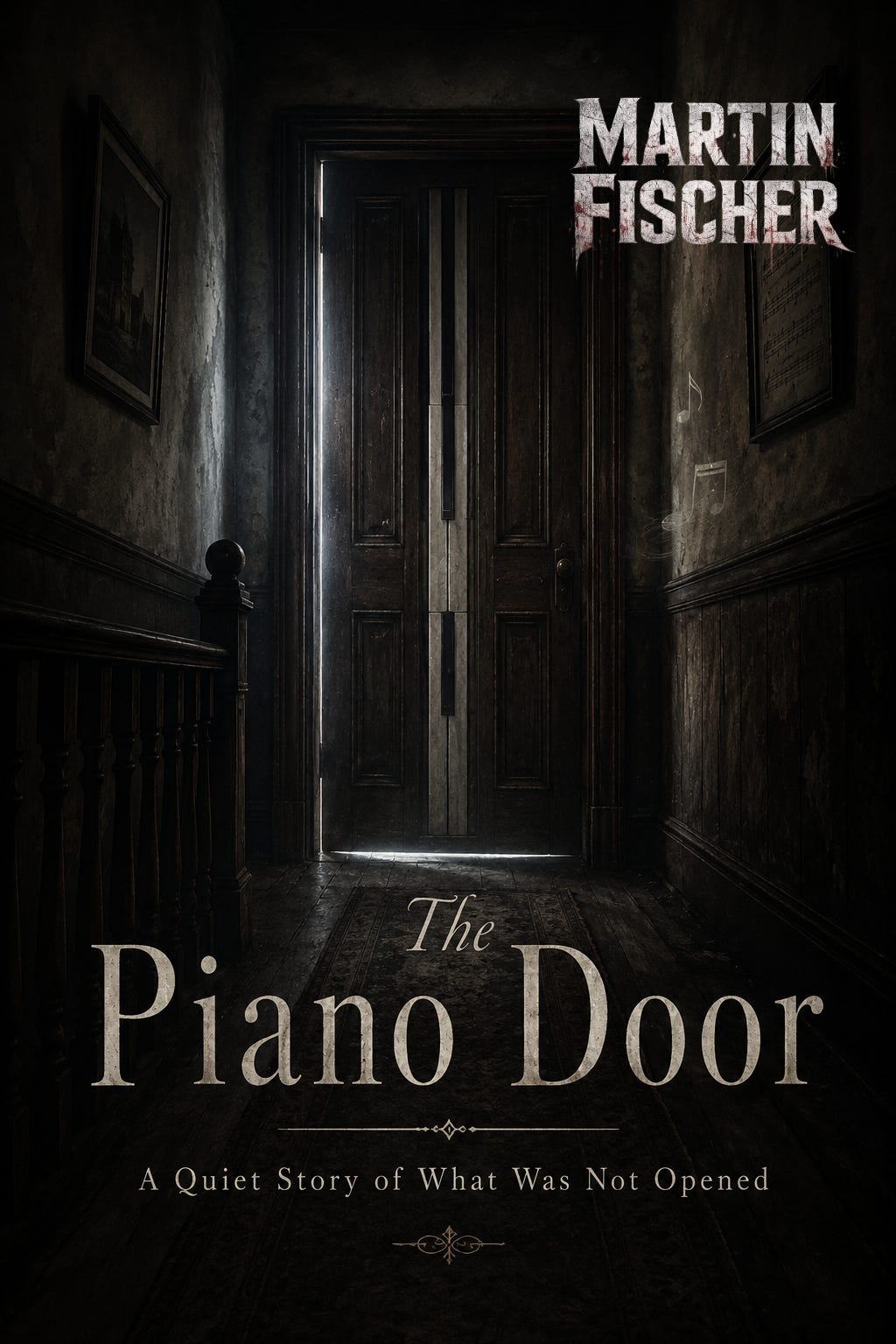
Content note: Sensitive themes are listed after the story.
The house stood at the edge of the village, where the last gardens gave way to open fields.
It was not a haunted house. Not a black shell with blind windows, not the kind of place children hurried past. In summer, it smelled of hay and sun-warmed stone; in winter, of smoke, damp wool and soup. People stopped by with eggs, firewood or news, sat in the kitchen, drank coffee and went home again.
Only upstairs, at the end of the narrow hallway, there was something people did not like to talk about.
The door to the music room.
It was made of dark wood, heavier than all the other doors in the house. Pale inlays ran through it, narrow and long, almost like keys. Whitish, yellowed, dulled by age. When a downstairs window was open and wind moved through the stairwell, the door sometimes shifted in its frame.
Then it let out a note.
Not loud.
Just a single, thin sound.
As if someone had touched a piano key with one finger and let go at once.
People laughed about it when they had to. They said old wood moved. Houses made noises. Not everything had to become a story.
But they never stayed long in the upstairs hallway.
Alma Hofacker had been sixteen when she came to Kreszenz Bruckner.
She had grown up in an orphanage, without even a picture anyone could have shown her. No one knew anything about where she came from. When asked, she smiled politely and spoke of something else.
Kreszenz had taken her in. At first, only to help around the house: water, wood, potatoes, laundry. But weeks became months and months became years.
Eventually, no one asked anymore why Alma was still there.
No one could have explained exactly what Kreszenz and Alma were to each other.
Kreszenz sometimes called her “my girl.”
Sometimes, when she was tired or ill, she even called Alma daughter.
Alma never called her mother.
The piano belonged to Kreszenz. It stood in the music room, close to the window, looking out over the fields. Alma played almost every evening. Not brilliantly, not in a way anyone in the city would have admired. But she played with a persistence that touched something in people they could not name.
People passing the house sometimes stopped outside.
Not because of the melody.
Because of the stillness inside it.
Alma played as though she were listening for something behind the notes.
Kreszenz no longer heard as well as she once had. When people spoke behind her, she sometimes asked them to repeat themselves. She nodded too soon. She smiled when she had not understood everything.
Veit Riedner came to the house often.
Later, people would say he had already been coming too often back then.
But at the time, no one noticed. Veit was one of those men who made themselves useful. He carried in firewood, fixed a warped shutter, hauled sacks of potatoes into the cellar, mended the fence after a storm. Once, when Kreszenz lay ill with fever for days, he left a bowl of soup outside her door every evening and went away without a word.
People liked men like him.
Quiet men. Reliable men.
Men no one thought to question.
He often sat in the music room while Alma played. At first on a chair near the door, later closer to the piano. He did not read. He did not carve. He did not even smoke.
He only sat there.
With folded hands.
And looked at Alma as though he needed to remember that she was still there.
One evening, after the last note had faded, Alma asked:
“Why do you always sit here?”
Veit did not lift his eyes at once. They remained on the piano keys.
“Because you’re disappearing.”
Alma gave a short laugh.
“I’m sitting right in front of you.”
Then he looked at her.
“No,” he said. “You’ve been disappearing for months.”
In autumn, Alma began going more often to the neighboring village.
Lorenz Weigand worked at the mill there. He was not a man of many words. When Alma came, he did not ask where she came from. He did not ask why she stayed silent for so long. Nor did he ask why she sometimes broke off in the middle of a sentence, as though she had forgotten how to continue.
For Alma, that was enough.
People in the village began to talk.
Quietly at first. Then more openly.
They saw Alma on the road to the mill. They saw Lorenz standing by the edge of the fields in the evening. They saw Alma coming home, her cheeks reddened by the wind.
Kreszenz heard the talk.
So did Veit.
Alma did not own much. Two dresses, some linen, a few coins she had saved over the years. And an old comb from the orphanage. One of its teeth was missing. She kept it wrapped in a piece of cloth, as if it were an heirloom.
One afternoon, Kreszenz found a small suitcase under Alma’s bed.
Inside were the two dresses, the money and the comb.
Nothing more.
When Alma came home that evening, the suitcase stood beside the kitchen door.
Kreszenz had put it there.
The two women looked at each other.
Neither asked anything.
Neither explained anything.
The next morning, the suitcase was back under the bed.
A few days later, while rain struck the windowpanes outside, Kreszenz said:
“Do you want to leave?”
Alma sat at the table, peeling an apple so slowly that the peel came down in one long strip.
She did not answer at once.
“Yes.”
Kreszenz pressed her lips together.
“Where?”
Alma put down the knife.
“I don’t know.”
“Then you might as well stay.”
Alma looked at her for a long time. There was no anger in her eyes. That made it worse.
“No,” she said. “That is exactly why I can’t.”
On her last evening, Alma played longer than usual.
She began a piece, broke off, began again. Several times. Downstairs in the kitchen, Kreszenz sat before an untouched cup of tea. She heard enough: every wrong note, every breath between the melodies.
Veit was in the house. No one had invited him in. No one had sent him away.
After a while, the piano fell silent.
Then Kreszenz heard the lid close.
Footsteps.
A voice.
Alma said upstairs, clearly and softly:
“Tomorrow.”
Only that one word.
Tomorrow.
That night, Kreszenz woke.
At first, she did not know why. The house was dark. The rain had stopped. Somewhere, a beam creaked.
Then she heard voices from upstairs.
She heard only fragments. Not loud, but sharp, broken off.
She sat up in bed.
Alma’s voice:
“You can’t keep me here…”
Then Veit:
“… only trying to help.”
Alma, harder now:
“No one asked you to.”
A dull blow.
Then silence.
Kreszenz got up. She went out into the hallway, barefoot, her dressing gown over her shoulders. At the foot of the stairs, she stopped.
One hand settled on the rail.
Upstairs, everything was dark.
Then, in the draft, the door to the music room shifted.
A note moved through the house.
Bright and thin. Almost beautiful.
Kreszenz stood there and listened.
She could have gone upstairs.
She could have called Alma’s name.
But as long as she stayed below, as long as no door was opened, everything was still possible.
Kreszenz turned around.
She went back to her room.
And lay down again.
The next morning, Alma was gone.
Her old coat still hung by the door. Her house shoes stood beneath the bench. A hair floated in the wash jug. On the kitchen table lay a strip of apple peel, browned at the edges.
Only the suitcase was missing.
Kreszenz held on to that.
The suitcase was missing.
So Alma had gone.
Veit said the same.
He stood in the kitchen, pale and worn out, his eyes red, as though he had been crying or had not slept.
“She’s gone,” he said.
Kreszenz asked:
“Where?”
“I don’t know.”
“Did you see her?”
“No.”
“Then how do you know?”
Veit looked at her.
Too long.
Then he said:
“The key to the music room is gone too.”
Lorenz Weigand said Alma had never arrived.
They searched the neighboring village, the mill, the railway station, the roads between the fields. They asked the postman, the innkeeper, the driver who sometimes took travelers along. No one had seen Alma.
Days passed.
Then a week.
Then two.
In the first few days, Kreszenz did not go upstairs. After that, only rarely.
Sometimes she stood at the foot of the stairs and tilted her head.
“Did you hear something?” she asked once.
Veit looked toward the stairs.
Then shook his head.
Veit stayed in the house.
Kreszenz could have sent him away. She did not. His presence was unbearable. His absence would have been worse.
She asked him questions.
He gave answers.
Always.
Never the same one twice.
Winter came early.
The music room was rarely heated. No one had a key. No one wanted to break the door open as long as it was still possible to believe Alma had taken it with her.
In the third week, the smell began.
At first, it was faint. A sweet heaviness upstairs in the hallway. Kreszenz told herself some animal must have died somewhere in the house. A mouse in the wall. A marten under the floorboards.
By the second day, she no longer believed it.
On the third day, she opened all the windows.
The smell remained.
Then she went to Severin Krail.
He was a broad-shouldered man with a gray beard, the one people fetched when a tree had fallen, an animal had to be slaughtered or something was too heavy to carry alone.
Kreszenz stood at his door and said only:
“I think I know where she is.”
They went upstairs together.
Kreszenz.
Severin.
Three neighbors.
And Veit.
He had come of his own accord, as though he had been waiting for it. Before anyone even touched the door, he began to cry.
Dust lay along the lower edge of the piano door.
Not evenly.
It was disturbed, scratched, shifted into narrow lines.
As though someone on the other side had scraped against the wood again and again.
Severin looked at the floor.
Then at Veit.
“What happened here?”
Veit opened his mouth.
No sound came out.
Severin lifted the axe.
At the first blow, the door trembled.
At the second, the wood splintered at the lock.
At the third, it broke.
For a moment, the door still hung in the frame.
Then it slowly swung open.
No one stepped inside at once.
The smell reached them before the room did.
Alma lay at the piano.
Half on the stool, half slumped against the instrument. Her head rested near the keys. One arm hung down, the other was bent, as if she had tried to hold on to something until the end.
The windows were closed. Only now did Kreszenz see how tightly the warped frames were wedged. Not one casement would have opened.
For a single moment, Kreszenz did not understand what she was seeing.
For a single moment, she thought Alma was playing.
Then she saw the hands.
Then the face.
Then she understood.
In Alma’s right fist was a narrow piece of pale wood.
A splinter.
Broken from the inlay of the door.
Full of fibers.
Full of blood.
Severin stepped closer. He looked at Alma’s hand. Then at the inside of the door.
One of the pale strips was missing.
Around the place where it had been, the wood was scratched.
Deeply.
Over and over.
Some of the marks were dark.
No one spoke.
Not Kreszenz.
Not Severin.
Not the neighbors.
Only Veit slid down the wall until he was sitting on the floor.
His face was wet.
“I only wanted her to stay,” he whispered.
No one answered.
He said it again.
“I only wanted her to stay.”
Later, Kreszenz remembered many things.
The suitcase under the bed.
Alma’s look in the kitchen.
The voices in the night.
The dull blow.
Her own hand on the stair rail.
Most of all that.
That hand.
How it had lain there.
Warm on cold wood.
Alma was buried.
Veit never truly confessed. They took him away and no one in the village ever saw him again.
Lorenz left the mill.
Kreszenz moved away in spring. She took almost everything with her.
The piano remained.
The door remained.
Years later, the house was demolished. When the workers lifted the door from its frame, they still found the scratches on the inside.
Deeper than people had told it.
Some ran so low that Alma must have been on her knees.
After that, people in the village spoke of the piano door.
That was easier.
A door could be shown, removed, even burned.
Not a night, a staircase and a hand on the rail.
And when wind moved through old wood and a single bright note sounded, some people still looked up.
Content note: Contains themes of confinement, coercive control, death and psychological guilt.
Really amazing dark story! Loved it! 🥰
Thanks, will there be a part two for this story?