

The Road Below the Weir
A Rural Noir Tragedy

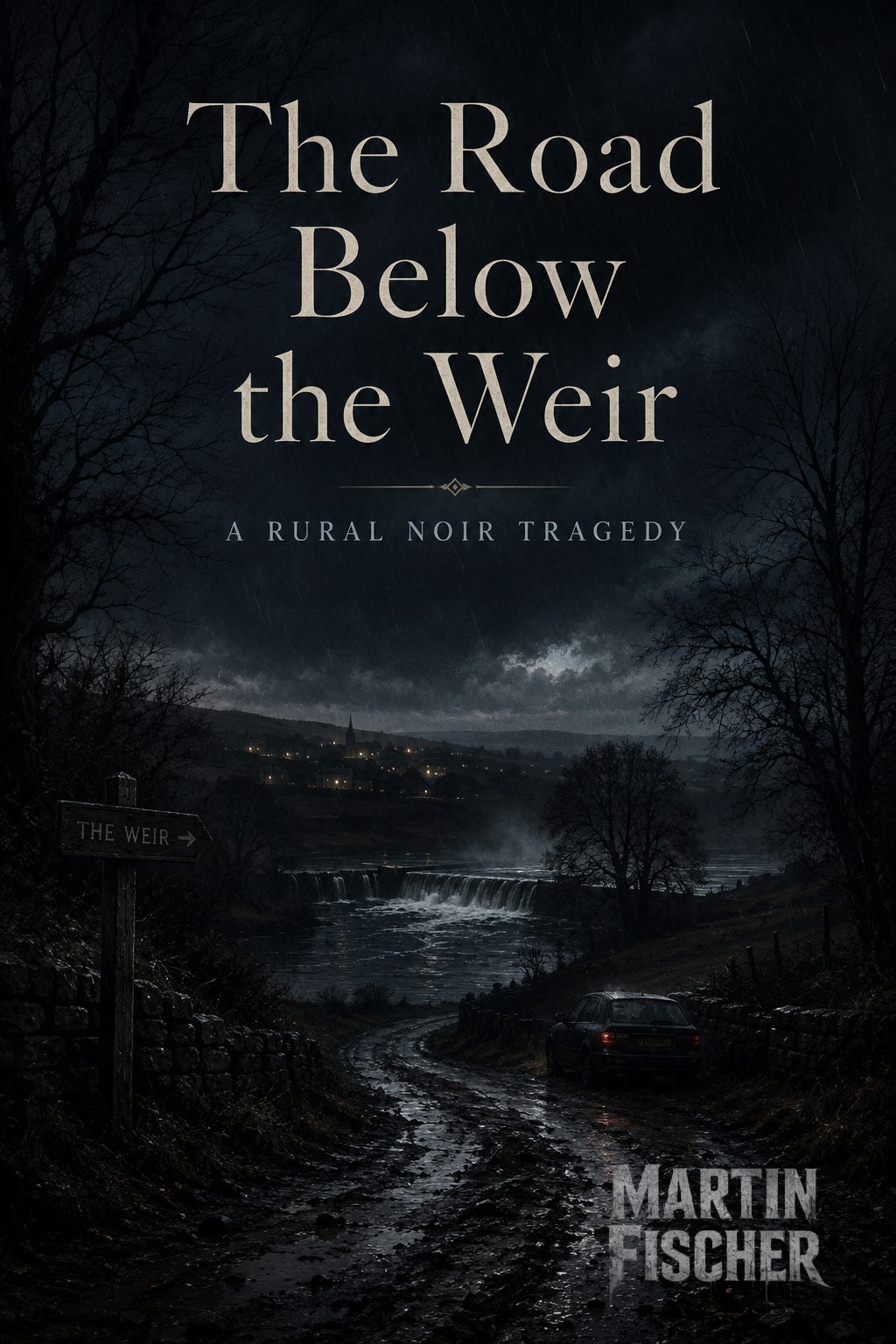
Content note: Sensitive themes are listed after the story.
Later people said they had driven to the river that night because they were young and stupid and in love.
That was not true.
They drove because they could no longer breathe at home.
Back then the town was not dead yet. But it was rehearsing.
The machinery factory closed early on Fridays. At the bakery the day-old rolls were no longer given away, only counted. Men stood outside the unemployment office with wet collars and did not look up when someone passed.
His name was Andreas.
Her name was Laura.
He was twenty, with concrete dust in the cracks of his hands and had been speaking less for weeks. She was nineteen, holding her coat shut with one hand and pretending exhaustion was a kind of courage.
That evening rain fell on old snow.
“Keep driving,” she said.
He drove past the abandoned mill, past the sawmill, past the last house with light in the windows. At the edge of the woods a man stood beside a parked forestry truck, smoking under the bare branches.
Andreas knew him by sight.
Reiter.
The forester.
Laura turned her face toward the window until they had passed him.
Andreas saw that.
He said nothing.
Then came the road to the river.
In summer they had been happy there. Or thought they had been. Beer in the grass, music from a car radio, their feet in the water. Back then the future had smelled of hay and gasoline.
Now everything smelled of mud.
A rusted chain hung from the old dock. The wind knocked it softly against the wood.
Andreas killed the engine. It ticked in the silence afterward.
They stepped out.
The river lay black between the trees. Not evil. Just there.
“My father says you lost your job,” Laura said.
Andreas looked at the water.
“Maybe your father talks too much.”
She said nothing.
“I’ll fix it,” he said.
Laura nodded. Not because she believed him, but because she still did not know how to stop loving someone.
Somewhere behind them a branch cracked.
Laura flinched.
Andreas looked toward the trees.
Nothing moved.
Far up the valley a freight train moved through the night.
They stood there until the cold drove them back to the car.
When they reached her parents’ house the kitchen light was still on.
Rolf stood in the doorway.
Laura knew that doorway. She knew the shadow it threw across the hall. She knew his footsteps on the stairs, from the years when she was small and the radio downstairs in the kitchen kept playing.
Rolf was a big man with broad hands. A man who had worked all his life and never learned how to be careful with anyone.
“Where were you?”
Laura tried to move past him.
He grabbed her arm.
“You stay here.”
Andreas stepped closer.
“Let her go.”
Rolf laughed once. Ugly and short.
“You don’t even have a job anymore.”
That was how Laura learned it was true.
She looked at Andreas.
He looked away.
“Today,” he said quietly. “They told me today.”
Rainwater slid from the porch roof.
Rolf looked at Laura’s stomach.
Laura pulled her coat tighter. Not because of the cold.
“You’re nineteen,” he said. “Nineteen.”
“Dad.”
Then he jerked his chin toward Andreas.
“That boy can’t even take care of himself.”
Andreas shoved him.
Not hard.
Just enough to make him stop.
That was how Laura told it later, if she spoke of it at all.
Rolf stumbled backward. His foot missed the wet step. For a second he reached for the railing.
Then he fell.
The sound his head made on the stones was small and dull.
Then everything was quiet.
Laura knelt beside him. Rainwater ran through his gray hair.
“Dad?”
The word came automatically.
It meant nothing.
Andreas stood above her breathing as though he had run a great distance.
The telephone sat in the hallway.
Laura saw it through the open door. Black. Glossy. Harmless.
Neither of them went to it.
They sat in the garage for a long time.
Laura on an old crate. Andreas on the floor beside the jack. Between them lay the tarp.
Rolf was behind it. Beneath blankets. Beside the summer tires.
“It was an accident,” she said.
Andreas nodded.
“Then we have to tell someone.”
Somewhere outside a dog barked.
Inside the house the kitchen clock ticked.
Laura thought of her mother asleep upstairs, of the pills on the nightstand, of Rolf’s boots beside the back door. And of how long people in that house had learned not to hear things.
Neither of them moved.
Later the bleeding started.
At first only a little. Then more.
Laura bent forward on the crate with both hands pressed between her legs. Andreas knelt in front of her saying her name over and over as though that could stop anything.
He woke her mother.
Not because of Rolf.
Because of Laura.
“He went out again,” Andreas said when her mother asked about her husband. “Early shift. He wanted to stop by the factory first.”
It was the middle of the night.
Her mother looked at him as though she had forgotten the meaning of the words early shift.
Then she fetched Laura’s coat.
At the hospital no one asked about Rolf. Not that night. They asked about bleeding, about pain, about how many weeks. Andreas sat in the hallway with wet shoes, hiding his hands beneath his thighs because dirt still clung to them.
The doctor spoke softly.
The nurse avoided Laura’s eyes.
The next morning her mother carried the small crib out of the storage room without a word.
After that Laura stopped touching her stomach.
Rolf was still in the garage. On the first night after the hospital Andreas went outside three times and returned each time without the tarp.
Later Laura once saw her mother standing in front of the garage door.
Just standing there.
For a moment Laura hoped she would open it.
Then she hoped she would not.
Sometimes afterward Laura wondered whether her mother had felt fear that night.
Or hope.
Maybe her mother had never needed to ask.
When Laura said her name, her mother went back inside.
When Andreas opened the garage on the second night, the smell that came out was oil, damp cloth and something Laura did not want to name.
They brought Rolf to the river.
The body had become heavy.
At the dock the rusted chain knocked softly against the wood.
Once.
Then again.
The river took him slowly. For a moment his body drifted near the bank, turning a little in the black water.
Then he was gone.
Laura stood there until Andreas touched her arm.
Something cracked in the woods.
A flashlight snapped on.
Reiter stood between the trees.
A thin man with thinning hair and an old wound above his lip. Whenever he spoke he licked that spot first, as though checking whether it was still there.
Now he said nothing.
The beam of light rested on Laura’s skirt, on Andreas’s shoes, on the wet tarp.
Then Reiter switched the flashlight off.
And walked away.
The morning after the river Laura’s mother only asked whether Rolf was working early shift again. Her voice was flat.
Laura said yes.
She said it too quickly.
Her mother looked at her but said nothing. Maybe in houses like that everybody always knew something and stayed silent out of habit.
Three days later Reiter came.
He did not knock at the front door. He waited behind the shed.
“Terrible thing,” he said.
Andreas went pale.
Reiter did not ask for money immediately.
He owed more people in town than he ever admitted, especially a man from Ansbach who came on Sundays and stayed sitting in his car.
The first time Reiter only took gasoline. The second time he stood in the kitchen for a long while before saying what he wanted.
First two new tires. Then Andreas’s help unloading timber at night without receipts and without questions.
Once he brought a wounded dog and told Laura to bandage it. She did. The dog trembled on the kitchen table while Reiter stood beside her chewing the skin near his thumb.
Later he asked for money.
Then he started coming more often.
Laura learned to recognize his footsteps.
A dragging sound on the left side. Then the hard step on the right.
Whenever she heard him she laid both hands flat on the table so they would not move toward her stomach.
When the snow melted, Rolf was officially reported missing.
There was a small article in the newspaper. The police asked for information. Laura cut the clipping out without knowing why and hid it behind the bedroom mirror.
Once she stood with the clipping in her hand outside her mother’s kitchen door.
Then she went back upstairs and hid it again.
A week later a police officer came to speak with Laura’s mother. He drank coffee from a mug with a crack in the handle and wrote in a small notebook.
Had Rolf been worried lately.
Had he been drinking.
Had there been arguments.
Was it true Laura had gone to the hospital that night.
Laura stood in the hallway gripping the banister until her fingers turned white.
The officer did not leave right away afterward. He paused briefly in front of the garage.
Then he drove away.
Andreas found temporary work. Demolition sites. Carrying rubble. Tearing apart things people once needed.
At night he stayed awake.
Since losing his job he washed his hands longer than before. The concrete dust still would not come out.
Laura lay beside him listening to the sound of him not sleeping.
One evening Reiter said that the river always gave things back if you knew where the water slowed down.
Below the old weir, he said, the river kept whatever it did not want to carry farther.
He said it in their kitchen while eating bread that did not belong to him.
Laura asked no questions.
Neither did Andreas.
In June flies stuck to the strips of paper hanging above the bakery counter.
Then Reiter came drunk.
Laura was alone.
He stood in the kitchen smelling of schnapps and wet forest and rested one hand on the table as though the house belonged to him.
“Your father,” he said, “never knew when to keep quiet either.”
Then he came around the table.
Laura stepped back.
He smiled at that.
Not kindly.
Her hip struck the counter. His hand closed around her wrist.
Laura picked up the bread knife.
Her hand found it before she knew why.
At that moment Andreas came through the door.
He looked first at Laura.
Then at the knife.
Then at Reiter.
Reiter laughed.
“There he is.”
Afterward Laura lost the order of things and several seconds besides.
Andreas grabbed Reiter by the collar.
Reiter struck him with the flashlight.
The knife fell to the floor.
A chair overturned.
Reiter tore himself free and ran outside.
Not toward the woods this time.
Toward the road.
Andreas ran after him.
Laura remained in the kitchen for one second longer. The knife lay beneath the table.
Then she followed them.
By the time Laura reached the yard, Reiter was past the shed, one hand pressed to his side.
“The weir,” he shouted.
His voice broke in the rain.
“Ask them about the weir.”
A light came on in the neighbor’s house. Then another.
Somewhere below, a siren rose.
Andreas stopped running.
He turned back.
“Get in the car,” he said.
“Andreas.”
“Now.”
They reached the upper forest road before the second siren came.
Blue light moved not at the house but through the trees, down by the river.
Andreas stood beside the car and looked down.
Two police cars had stopped near the old weir.
At the water’s edge, an officer held his flashlight on something caught in the reeds.
A single boot.
Rolf’s boot.
Someone shouted Andreas’s name.
Then Laura’s name.
Then they ran.
The car started on the third try.
Andreas drove too fast for the wet road.
The trees stood close at the edges. Behind them the sirens rose and fell with every bend.
Laura gripped the handle above the door.
“Andreas.”
He did not answer.
“Andreas, slow down.”
Ahead of them the forest road widened enough for a car to stop.
Andreas lifted his foot from the gas.
For a moment the inside of the car grew quieter.
Then the forest road met the main road and blue lights filled the rearview mirror.
Andreas looked at her.
Only briefly.
There was nothing left in his face but exhaustion.
“I just wanted you to stop being afraid in the mornings,” he said.
Laura saw her father again on the wet stones. The blood beneath her dress. The empty crib. And behind all of it the nights when the radio downstairs had kept playing.
Andreas reached for her hand.
This time she did not pull away.
They kissed, just as they had in their happiest days.
The guardrail came white out of the darkness.
Metal tore open.
Then the road was gone.
She did not die immediately.
People preferred the story about two lovers, the river and the night everything was lost.
But Laura woke once more.
In the cold water.
The car lay tilted between stones. Andreas hung beside her in his seatbelt with his head against the window. His hand was no longer holding hers.
That was the first thing she understood.
Not the pain.
Not the blood.
Only the absence of his hand.
The seatbelt cut into her chest. Her legs were trapped beneath the dashboard.
The river slowly filled the car.
Laura thought of the telephone in the hallway. Black. Glossy. Harmless.
Outside, the water carried branches and mud.
And this time nothing inside her answered.
Content note: domestic violence, pregnancy loss, coercion, death, drowning.
Great story! And the way you write brings more tension, more suspense and boils the mind of so much imagination. I imagined each scene happening right in front of me, especially for the way it was written.
Wonderful story. I enjoy your sparse style of writing. A moment that stayed with me: when he brings the dog and asks her to bandage it. Rural noir is a exciting genre. I write small town folk horror.