

The Stone by the Road to Limbach
A dark retelling from the recorded core of the Schäfergrab legend

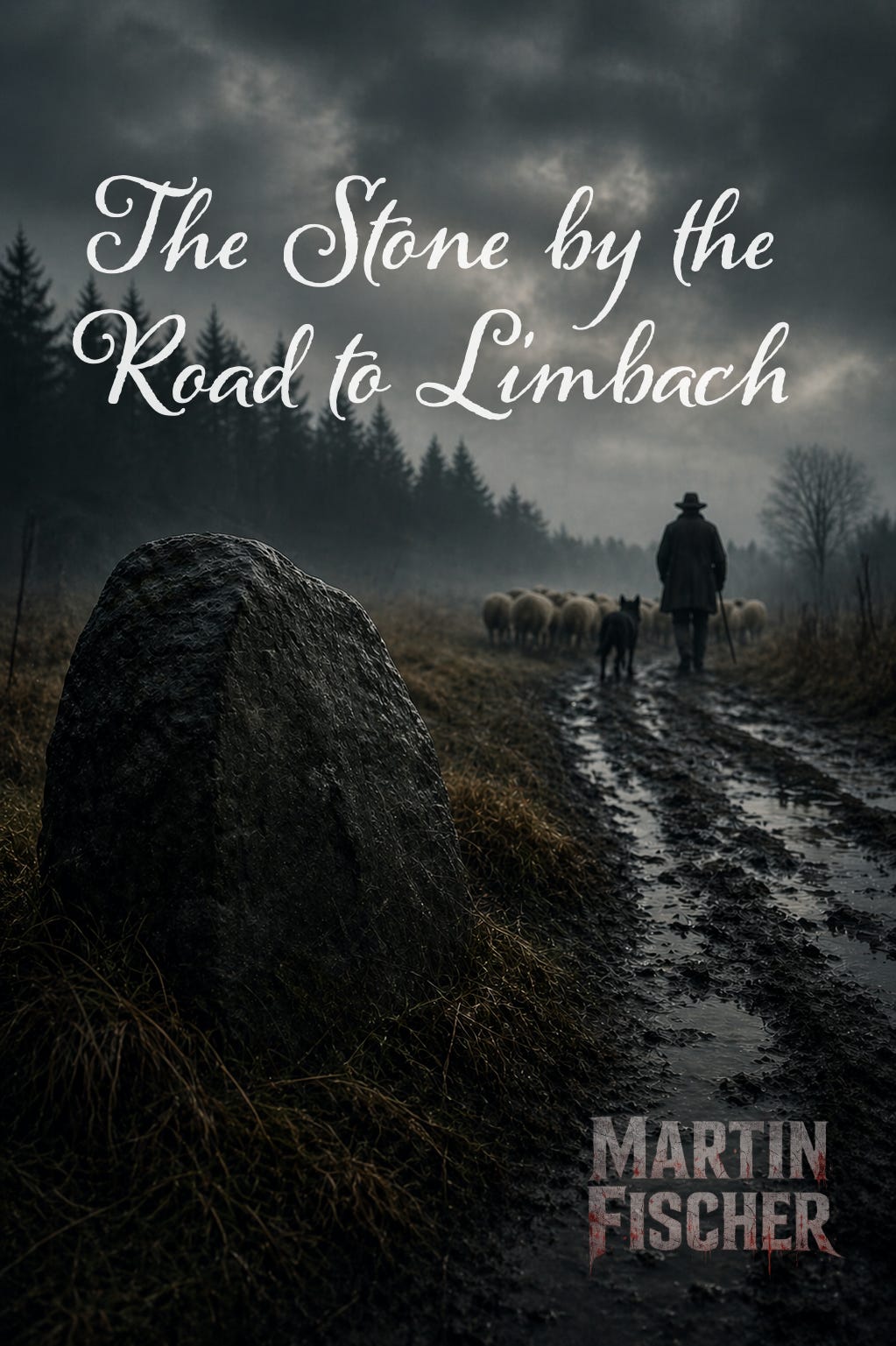
That’s just another old legend and not my own invention.
By the time the sheep strayed onto the Pfaffengrün side again, the shepherd had told himself three different things and believed each of them in turn.
First: that to sheep, grass was just grass and borders meant nothing except to people.
Second: that they would threaten again, as they always did and leave it at that.
Third: that no one would come near him while the dog was with him.
The dog was enough to give a man courage he had not earned. The shepherd knew that and used it. The animal was broad through the chest, gray along the back, scarred at one ear and quiet in the way that makes people step away. He did not waste himself on barking. He watched.
From the rise where the shepherd stood, he could see the wet land falling away in strips: rough grass, darker furrows, a belt of fir, then the road that went on toward Limbach. The morning had begun clear enough, but by afternoon the sky had lowered and the damp had come up from the ground. By evening his coat sleeves were wet to the elbows from pushing through brush and the wool at his neck smelled of rain and old lanolin. So did everything else. Sheep, dog, leather, his own body under the coat.
He clicked his tongue and the flock turned in a soft uneven drift.
“Come on,” he muttered. “You’ve had enough of their sainted grass.”
He was from Christgrün. That mattered. Not because Christgrün was far off - it was not - but because closeness breeds a sharper kind of grievance than distance. Men from one place can hate men from the next place over for a ditch, a strip of pasture, a woman married the wrong way, a pig that rooted under the wrong fence ten winters ago. He had not started any of that. He had inherited it, along with the flock and the habit of answering a warning with a joke half a shade too late.
He had heard the warnings often enough.
Not from strangers. From men whose names he knew, whose wives he could place by sight at the well, whose fathers had stood in exactly the same spots saying much the same things.
Keep your animals on Christgrün land.
Tell that cur off before someone puts iron in him.
The next time you cross here, there’ll be trouble.
He had laughed more than once. Sometimes because he meant it. Sometimes because the dog was standing near his knee and laughter was easier than letting them see he had counted the number of men against the number of teeth.
That evening he was later than he liked.
The sheep had spread badly in the damp. Two ewes with lamb had broken toward a lower patch where the grass was sweeter and the rest had followed in the stupid faithful way sheep do, not because one place is better than another, but because no sheep wants to be the one left alone. He had spent the better part of an hour cursing them back into something like order.
By the time he got them moving properly, the light had thinned.
Across the field, near the road, he saw a figure standing still.
At first he took it for a stump or a post. Then the figure shifted its shawl. An old woman.
He knew her by sight, though not well. From Pfaffengrün. Small, dried-looking, always seeming to be headed somewhere on necessary business. He had once seen her at market strike a goose with a switch so calmly that the men nearby had laughed and then stopped laughing.
She stood and watched him gather the flock.
He pretended not to notice.
People watched him often enough from that side. Most times, watching was all it came to.
He was tired in the dull, mean way a man gets after a day in the open. His boots were heavy. One heel had been rubbing raw for two days. His lower back felt needled. He wanted the road, the fold, bread, heat, silence. Not another quarrel at the edge of a field with people who acted as though he had grazed his sheep over their graves.
“Come on,” he said again, harsher now.
The dog moved where he moved, cutting the edge of the flock cleanly, showing teeth once to a stubborn ram, then settling again into that unnerving quiet of his. The old woman watched him too. The shepherd could feel it.
When at last he brought the sheep toward the road, she had not gone.
She stood a little off from the ditch with something under her arm wrapped in sacking.
He saw that and thought first of bread. Then of grain. Then, because he was tired and wanted only to pass, of nothing at all.
“Evening,” he called, because there comes a point when silence is more dangerous than speech.
She said, “You’re late.”
“So are you.”
Her mouth twitched, though not in a smile. “You’ve no business here.”
“That’s between me and the grass.”
“Is it.”
He stopped a few paces short of her. The dog stopped too.
The dog did not growl. He only fixed his eyes on her. The shepherd felt the old pleasure in that, mean and childish and comforting. He was ashamed of it even while he felt it.
“You’d best go home,” the woman said.
“I’m doing that.”
“Not by here.”
He spat into the weeds. “The road is the road.”
For a second he thought she might answer in anger. He almost preferred that. Anger is common. You know where it begins and where to stand against it. But the old woman only shifted the sack under her arm and looked past him, not at his face, not at the flock, but toward the fields behind him.
That small glance was enough to set something moving in his chest.
He turned.
Nothing there but sheep, wet grass and the gray beginning of dusk. Yet the feeling did not go.
The dog stepped forward.
The woman loosened her grip on the sack.
Something scratched inside it.
The shepherd looked down sharply.
Before he could make sense of that, she bent, opened the cloth and let the thing out.
A cat burst free.
Not a barn cat strolling, not any easy beast. This one came out in a frenzy of claws and back and spit, hit the ground running and went through the grass like a shot loosed low.
The dog moved.
“Stay,” the shepherd snapped.
For a fraction of a second the dog did stay. The shepherd saw the struggle in the set of his body. Then instinct took him. He lunged after the cat in a long gray flash and was gone into the grass.
The shepherd shouted after him.
Too late.
The field stood up around him.
Men rose from places he had taken for furrows, hummocks, broken ground. One ahead, one to the left, two more farther back. Caps dark with damp. Coat sleeves black at the wrists. Sticks, staffs, one fork handle cut short. Not boys. Not drunks. Men who had gone out intending to do exactly this.
For an instant he did not move.
Then he ran for the road.
He had nearly reached it when one of them struck him across the shoulders from behind. Not a sharp pain at first. A flat crashing force that drove the breath from him and dropped him to one knee in the mud.
He got up at once, half falling and turned. “You bastards!”
Another blow caught him high on the arm. The hand he raised to ward it off went numb at once. He slipped, found mud instead of ground and saw a boot coming at his face before it hit him.
After that there was no order.
Dark coats. Wet breath. Sheep bursting and shoving past him in blind panic. Someone yelling at them to mind the dog. Someone else saying the dog was gone, hit him now. He got his feet under him once and drove his shoulder into a man’s chest hard enough to send both of them sideways. He heard himself making an animal noise and hated it. He tasted dirt. He swung blindly and felt his fist strike cheek or jaw, something soft over bone. A staff slammed into his ribs. He folded. A boot took him in the thigh. Another in the side.
He crawled a yard through the mud before hands caught his coat and dragged him back.
The old woman had not moved far. He saw her standing near the ditch, breathing hard from the crouch she had made, empty sack in one hand. Not helping. Not shrinking either. Watching. Her face had the shut look of someone seeing work done that she had already agreed must be done.
“Tell them….” he began.
A blow to the back of the head turned the rest to black sparks.
He heard the sheep before he saw anything again. The flock had broken and was streaming across the field in confused clumps, their bodies striking each other, bells knocking, hooves tearing the wet surface open. Through them, at a distance he could not judge, came the dog.
For one wild second he thought the animal had come back.
He had. But not to save him. Not yet. The dog was still locked on the chase, quartering through the field after the cat, blind to everything else, answering only the movement in front of him. The cat shot through a break in the firs. The dog followed.
A man near him laughed once. A shocked laugh, ugly and breathless, as if he himself had not quite believed the trick would work.
That laugh chilled the shepherd more than the blows.
It was the sound of relief.
They had feared the dog. Not him. Never him. What they had waited for, planned for, hidden for, was the moment the dog would leave.
He got one knee under himself again. The pain in his side made the world pulse white, but he got up halfway, enough to stagger. He saw the road. He saw the stone beyond it, low and black in the wet grass. He saw that if he could reach the road, perhaps shout, perhaps run, perhaps do anything except lie where they wanted him.
Someone caught him by the back of the coat and drove him down.
His cheek struck stone or frozen clod. His mouth filled with blood so quickly he thought at first a tooth had gone clean through his lip. He tried to twist over and could not. Boots pinned his coat. Blows kept falling until he could no longer tell one from the next.
He stopped trying to call for help. There was no help in men who already knew who you were.
He turned his face in the mud and saw the old woman’s shoe near the ditch edge. Mud had climbed the hem of her skirt. A shred of sacking dragged from her hand and darkened in the wet.
“Enough,” somebody said.
Nobody stopped.
The blows had changed. Less fury now. More the heavy continuation of something once begun and not yet properly finished.
Then a new sound came from the field.
Not the cat. Not the sheep.
The dog.
The animal was coming back.
One of the men heard it too and stepped away at once. Another cursed and looked over his shoulder. The shepherd tried to rise on that opening, but his arms gave out under him. All he managed was to lift his head enough to see the dog bursting through the grass, chest low, eyes fixed, mouth black and open.
“Kill it!” someone shouted.
No one did.
There was a beat, no longer than a dropped breath, in which the whole field lost its shape. Men backing wrong-footed. Sheep crossing. The dog coming hard. The shepherd half up and half down in the mud.
Then a staff struck him again, not meant for the dog, meant to end it before the dog arrived.
Something failed in him at once.
Not pain first.
Shock.
The field tilted.
He heard the dog at last, not barking but making a sound deep in the chest. Men were shouting now in earnest. Feet slipping. Someone had fallen. The old woman moved back for the first time, her skirt snatched by briars. Sheep pushed past her in a white rush.
He could not draw air the right way.
He rolled onto his side and found the stone again at the edge of his sight, black with rain, fixed and close and useless. All around him the field had broken apart into pieces. Wool, boots, staff, ditch water, a hand in mud, the dog’s shoulder striking a man’s thigh, the old woman clutching her empty sack to her chest.
He thought, absurdly and with sudden bitterness, of bread.
Not heaven. Not his mother. Not God.
Bread. A heel of yesterday’s loaf, cut thick, salted, eaten standing by the fold door while the dog waited for his share.
He tried to swallow and could not.
Above him the sky had gone a dirty, lightless gray.
By the time the men beat the dog back with poles and stones, the shepherd was no longer fighting them or anyone.
The dog came back to him anyway, limping now, one foreleg struck bad and stood over the body with his head low and his teeth wet. They tried stones first. When that did not move it quickly enough, they went in with poles. It gave ground once, came back once and then they closed around it.
After that nobody spoke for a while.
Rain tapped at the lantern tops when the others came. Breath smoked. The road shone black. Somewhere beyond the field the scattered sheep were still moving, bells giving small lost sounds in the dark.
They buried the shepherd and the dog near where they had fallen. Or so the story was later told. Men say many things after a killing, some to hide themselves, some to remember better than they deserve. But all versions kept the place. The place could not be denied. The road from Pfaffengrün toward Limbach. The low ground. The wet field. The stones that remained after the bodies were taken out of sight. People pointed there long after the names had worn thin.
Years passed. Children were warned away from the spot. Men who had not been there told the story with confidence. Men who had been there told it less.
What stayed in the village was not the quarrel about pasture. Not for long. Not even the beating itself.
What stayed was the trick.
The old woman crossing the wet field with the sack under her arm.
The cat loosed low to the ground.
The dog leaving his master because he was made to answer what ran.
And the calm of someone bringing the bait.
Appendix: The Recorded Core of the Legend
The earliest written version I directly verified and the strongest source for the legend’s recorded core, is an 1859 local-historical printed account. That text says that near Pfaffengrün people still pointed out two stones in memory of the killing of a shepherd and his dog. It also gives the central action: a shepherd from Christgrün repeatedly grazes his flock on the fields of Pfaffengrün and Liebau despite prohibition, he relies on the vigilance of his dog, “to which none of the injured parties dared approach”, an old woman from Pfaffengrün devises a trick, carries a cat toward him, releases it, the dog rushes after it and the farmers hidden nearby break from cover and beat the shepherd to death. The same source adds that a legal case supposedly followed and is said to have ended favorably for those involved. What this proves securely is that such a version of the legend was in written circulation by 1859, it does not independently prove the historical event in every detail.
The transmitted legend, across later retellings, keeps the same basic frame: a shepherd is killed in connection with disputed grazing, the shepherd’s dog is the obstacle, the dog is neutralized by means of a cat, the killing is remembered through a stone-marked place near Pfaffengrün and the site is commonly associated with the road toward Limbach and with the names Schäfergrab and Schäferstein. A modern local retelling preserves those same core elements and places the legend explicitly on the way from Pfaffengrün to Limbach.
A few points should be kept clearly distinguished. First, the 1859 source speaks of stones in the plural. Later retellings often compress the site-memory into a single stone. Second, the 1859 source presents the murder narrative as local tradition already known to its readers, not as a verified court-historical reconstruction. Third, later supernatural and antiquarian additions (for example, hauntings, voices, punishments for mockery, symbolic readings of marks on the stone or attempts to tie the legend to a specific later-dated dispute) belong to the legend’s later growth, not to its narrowest securely recorded core.
The safest formulation, therefore, is this: by 1859, a written local account already recorded a legend of a Christgrün shepherd killed near Pfaffengrün after repeatedly grazing on land he was forbidden to use, the decisive trick involved a watchful dog being drawn away by a cat and the event was remembered locally through commemorative stones at or near the site. Beyond that, the tradition expands in different directions and those additions should be treated as transmitted legend rather than secure fact.
Both the original narrative and your retelling are excellent. I felt immersed while reading through it in one go. The most captivating and harrowing part is that the murder is simply remembered; not glorified, nor damned, but just drily remembered.
As for the story itself, do you think this tale might be related to the historical trauma of the 17th century, with the disastrous Thirty Years' War and the Little Ice Age-related famine? In times of scarcity, human nature tends to turn hostile and paranoid.
Nothing much changes with humans, does it? You present this sad, infuriating story very well.