

The Thing in the Drying House
A Căpcăun Story

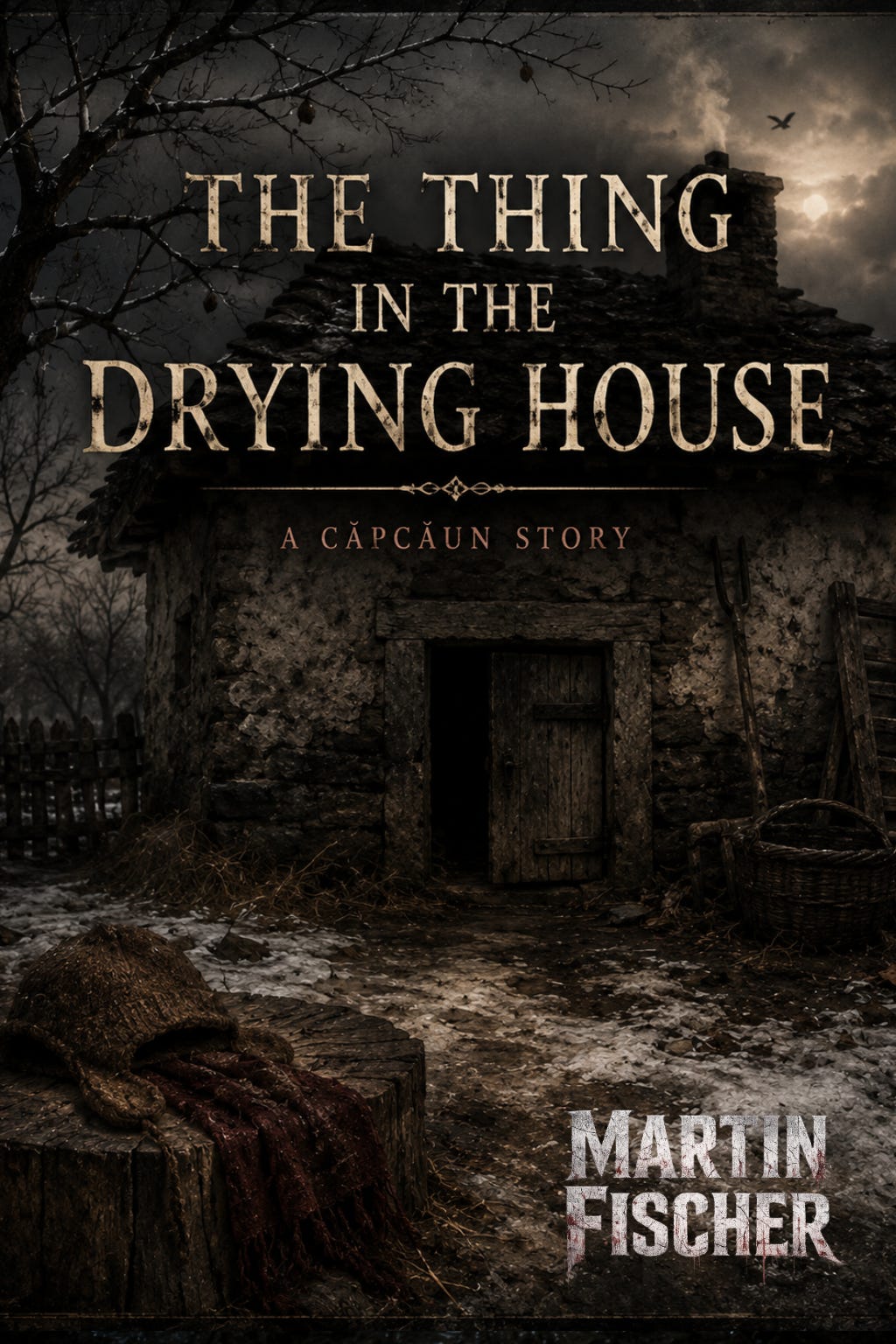
Content warning: child disappearance, violence, threat, folk-horror imagery.
The first child vanished before the geese were shut in.
His name was Ilie. He was six years old, had a split thumbnail and sang softly to himself when he thought no one could hear him. His mother had sent him to the shed for kindling. The shed stood behind the house, close enough that she could usually hear him when the door was open.
That evening he did not sing.
She waited until the pot boiled over. Then she took it from the hook, wiped her hands on her apron and went outside.
The shed door stood open.
Three logs lay in the mud. One had been broken under a heel. The chopping block had gone dark with the afternoon thaw. Under the wall, a hen that had slipped out was scratching.
“Ilie,” his mother said.
The hen stopped.
She went into the shed. It smelled of bark, rot and mouse droppings. On a nail hung a small mitten that had been there since autumn.
She came back out and called again.
This time the men heard her.
First they searched the yard. In the shed, under the cart, behind the pigsty, in the ditch beside the lane. Ilie’s uncle went down on his knees and lifted the nettles with a stick. The priest came with his coat misbuttoned.
At the edge of the yard, where the mud passed into the road, they found the track.
It was not clear. Mud never has clean edges. But it was large, deep at the heel, pressed firmly in. Beside it was the smaller print of a bare child’s foot.
Ilie had not been barefoot when his mother sent him out.
The men looked at one another. One spat. One crossed himself.
Old Petru said, “Don’t call now.”
Ilie’s mother turned on him.
“He is my son.”
Petru kept his eyes on the road. “Then don’t let it hear your voice.”
She slapped him across the face with her open hand.
He did not strike back.
They took lamps and went past the last houses. The dogs would not come. Ion, the miller, dragged his by the collar until the dog twisted free and crawled under a cart, whining like a beaten child.
The road led down to the lower field. Beyond it lay the forest. By day the women gathered fallen wood there. Boys set traps for birds. Men cut straight poles there and lied afterward about how deep they had gone in.
At night the forest did not belong to them.
They found Ilie’s scarf in the ditch.
His mother picked it up. There was mud inside.
After that no one touched her.
The lamps helped little. The men saw wet grass, black trunks, their hands yellow in the lamplight. Somewhere water ran under leaves. A branch cracked and three men turned at once, axes raised.
Nothing came.
They reached the first trees.
Petru stayed on the road.
Ion said, “Old man.”
Petru shook his head. His lip was bleeding where Ilie’s mother had struck him. “I said what I said.”
The priest noticed that everyone was looking at him and stepped beneath the trees.
Men slipped. Lamps knocked against branches. Boots sank into the black earth and came up again with a sucking sound. At first they called Ilie’s name. Then they stopped. Between the trees their voices sounded as if they belonged to other men.
Near the old charcoal pit, Ilie’s mother made a sound.
Only a short breath.
They all looked down.
Something stood below them in the hollow.
Its back was turned to them. At first it might have been a man bending over the ground. A poor man. A sick man. One with a heavy coat over his shoulders.
Then it raised its head.
The shape was wrong. Too long from the back of the skull to the mouth. Too narrow at the temples. The lamps trembled. Someone whispered a prayer and lost the second half.
The thing turned around.
It had the body of a man. Broad in the chest, its legs dirty up to the knees.
The head was the head of a dog.
Not wolf. Not bear. Dog. Something almost familiar. The long black muzzle. The ears tight to the skull, torn. The wet nose lifting to test the air.
Its mouth opened.
Steam came out.
Ilie’s mother stepped forward.
Ion caught her arm.
The thing looked at him.
He let go.
Water fell from a branch and struck the priest’s sleeve.
Then the thing took one step up the slope.
Their line broke.
One man turned. Another stumbled into him. A lamp fell and went out in the leaves. Ion raised his axe, but did not throw it. The priest held his cross up with both hands.
Ilie’s mother did not run.
She stood there, pressing the scarf to her chest.
The Căpcăun came up the slope. Its feet sank deep. Its arms hung almost straight down. Mud clung to its jaw. Something dark hung in the hair beneath its mouth.
Ion pulled Ilie’s mother back so hard that she fell.
The thing struck where she had been standing.
Ion did not even manage to raise the axe properly.
It took him.
Later they argued about it. One said it had taken him by the shoulder. Another said by the throat. The priest said nothing. He had seen Ion’s boots leave the ground.
Ion screamed once.
After that they heard only branches breaking.
The men ran until they reached the road. They did not stop at the ditch. They did not stop for Petru, who stood there weeping without wiping his face. They stopped only between the houses, when the dogs under carts, steps and locked doors began to bark.
Ilie’s mother came last, with one shoe gone.
In the morning they found Ion’s axe near the charcoal pit.
They did not find Ion.
For two days the village was like a house after a death. The women went about their work without speaking. Children were kept indoors and slapped if they looked toward the forest. The priest went from yard to yard with a small brass cross and cracked lips.
At first no one said Căpcăun.
Then Petru said it at the well.
After that they all said it, but not loudly.
On the third evening Ana vanished.
She was seventeen and had been sent with milk to her grandmother, who lived in the last house before the lower path. Ana had strong wrists from carrying water and a scar under her chin from falling out of a plum tree when she was nine. That morning she had laughed at something the blacksmith’s son had said, then turned away so he would not see.
Her grandmother saw her through the little window.
Ana came up the step with the pail in her hand. The old woman heard the latch lift.
Then it fell back.
“Come in,” the grandmother called. “You’re letting in the cold.”
No answer.
The old woman made her way across the room. Her knees had troubled her since the harvest. When she opened the door, the milk pail stood on the step. It had tipped a little. Milk ran over the stone.
Ana was already in the lane.
Something was holding her mouth shut.
The grandmother saw the girl’s eyes. That was what she remembered later. Not the thing behind her. Not at first. Ana’s eyes, open and dry, fixed straight on the door.
Then the thing turned its head.
The old woman slammed the door.
She did not mean to.
Her hands did it.
Then she screamed.
Men came out with tools in their hands. The blacksmith’s son came barefoot. His father tried to hold him back and failed.
They found the drag marks where the lane turned to mud. Ana had fought. There were finger marks, a broken hair comb and a small spot of blood where her knee had struck a stone.
The tracks did not lead to the forest.
After that no one spoke.
They led to the old drying house behind the orchards.
The women had once dried plums there, when every autumn smelled of smoke, sweetness and burnt pits. Now the low building stood empty. Grass grew from the short chimney. The stones inside were so black that no whitewash would hold to them. Children avoided it by day and claimed at night they did not know where it stood.
The door was low.
Too low for a man.
Now it was pulled shut from the inside.
Before the threshold were the marks of Ana’s knees.
From inside came her breathing.
The men gathered before the drying house. No one gave orders. The priest came late, panting, with mud on the front of his cassock. He had forgotten his hat.
“Ana,” said the blacksmith’s son.
Inside, something scraped over stone.
Ana made a sound through her nose.
The young man bent and seized the handle. The door stuck. Three men helped him. Wood grated over stone. Then it suddenly gave.
The smell came out.
Old ash. Rotten fruit. Wet animal. A slaughter bucket left too long beside the stove.
They had to stoop to look inside.
Ana lay before the cold oven mouth. Her dress was torn at the shoulder. Four red marks stood on her throat. A hand was pressed over her mouth. The fingers trembled.
Behind her lay the dark opening where the trays of fruit had once been slid in.
Something moved inside it.
Not behind it.
Inside it.
The Căpcăun came out of the oven on hands and knees.
Its shoulders scraped against the black stones. Soot fell onto its back. The dog’s head pushed first from the opening, slowly, with closed mouth and wet nose. Then came the hands, long and pale at the knuckles.
One of the men retched.
The blacksmith’s son went in anyway.
He did not get far. The drying house was narrow. Two men could hardly stand beside each other in it. Ana saw him and began to crawl. Not quickly. Her legs would not obey her. Her fingers found no earth, only stone dust and cold ash.
The thing looked from Ana to the door and back.
The young man swung the hammer.
The blow struck the creature high on the arm. It sounded dull, like flesh on wood. The Căpcăun recoiled against the oven mouth.
Then it struck him.
Not with claws. Not with teeth.
With the flat of a long hand.
The blacksmith’s son was thrown against the wall. His head hit stone. His teeth clacked together. He sank down and remained half sitting.
Then the others pushed in.
It was not a fight. It was crowding, breath and no room to swing. One man stabbed with the pitchfork and hit the wall. Another slipped in ash. A scythe could not be raised high enough to cut. Lamps knocked against shoulders. Someone stepped on Ana’s hand and cried out himself in fright.
Ana crawled toward the doorway.
Her grandmother stood there, though later no one remembered seeing her go there. One hand on the stone. The other reaching in.
She seized the girl by the hair and collar and pulled.
Then Ana screamed.
The men drew back. Not far. There was no farther to go. Just enough not to trample Ana. Outside in the mud, the priest knelt and said the same line of a prayer over and over.
The Căpcăun withdrew into the oven.
Then they heard stone break.
At the back of the drying house, where the oven passed into the old smoke chamber, a black crack opened. Cold air came out.
One man threw his pitchfork. It stuck in the thing’s back below the shoulder.
The Căpcăun reached behind itself and pulled it out.
It looked at the pitchfork in its hand.
Then it looked at them.
It crawled backward through the crack.
Too large for it.
Still it went through.
They heard it under the stones. Not for long. A scraping. A dull blow. Then steps outside, behind the drying house, on the frozen earth between the fruit trees. Heavy steps. Then lighter ones.
Then nothing.
It took a while before anyone ran around the house.
They found the earth broken open where there must have been an old smoke duct or drain. No one had known of it. Or no one said they had known of it.
At daybreak they searched the orchards, the ditch and the first reeds beyond. Where the ground rose again toward the forest, they found enough of Ion to bury.
Ana lived.
For three days she did not speak. Her grandmother fed her broth with a spoon and slept sitting against the door. The blacksmith’s son lived too, though his jaw healed crooked and he never said Ana’s name again in a way anyone could hear.
On the fourth day Ana asked whether Ilie had been found.
No one answered.
She turned her face to the wall.
After that winter came properly. The mud hardened. The well rope froze fast at night. The hens stopped laying. Smoke rose straight from the chimneys and stayed there before thinning into the gray air.
No one vanished anymore.
No one took comfort from it.
The village made new habits for itself. Men went behind the houses in pairs. Women carried knives under their aprons. Children were brought in before dusk and counted at the table. The priest slept for a week in the church porch. Then he stopped, because he could not bear the sounds the beams made after midnight.
Ilie’s mother set his bowl on the shelf.
No one touched it.
One morning she went to the shed.
The door had been bolted since the night he disappeared. The bolt still lay in place. The snow in the yard was clean. Her own footprints were the first in it.
She stood there a long time. A neighbor saw her from the window and set down the dough she was kneading.
Ilie’s mother lifted the bolt.
The shed smelled as it had before. Bark. Damp. Mice.
Something lay on the chopping block.
Ilie’s cap.
Brown wool. The torn seam above the ear. The one he had been wearing when she sent him out.
It was clean.
It was dry.
The bolt had been on the outside.
The neighbor reached the yard in time to catch her.
After that morning the men did not go first to the forest.
They went to the drying house.
By daylight it looked smaller. Uglier. Only damp stones and soot. On the floor lay ash into which their own boots had trodden. In the oven mouth, soot clung in thick scales.
The crack at the back was there.
They broke it wider.
Behind it there was no passage, as some later said. No walled tunnel. Only an old, collapsed smoke duct that led beneath the stones out to the bank. Too narrow for a man. Too narrow for a dog.
Petru sat down in the wet frost and wept.
Then they went to the forest after all. All of them. Even Petru, though they had to help him over the ditch. They took axes, hooks, spades, rope and the priest’s small brass cross.
They found no house. No cave. No fire. No bones they could give a name to.
Near the charcoal pit they found a place where the earth had been scraped flat, as if something large had turned there in its sleep again and again.
At the edge of that place lay the tooth of a child.
Ilie’s mother never saw it.
The men buried it under the church wall without telling her. The priest spoke words. Some of the men kept their hats on. No one corrected them.
Years passed. Children born after that winter were kept away from the orchards and the lower forest before they knew why. Ana married no one. Petru died in his bed and called at the end for his mother. The blacksmith’s son left before spring and came back once, with a beard and the eyes of a stranger.
The drying house was walled up.
Not at once. Not until the third spring. Until then everyone said it had to be done and no one brought mortar.
When they finally did it, they walled up the oven first. Then the door. The short chimney stayed open, because no one wanted to climb up.
The shed behind Ilie’s house rotted around the iron bolt.
But on some nights, when frost cracked in the fruit trees, people still heard something beyond the last yard.
Not much.
One foot in the snow.
A soft sliding behind the wall.
The dogs under the benches refusing meat.
In the morning there might be tracks. Sometimes like feet. Sometimes like paws. Sometimes blurred by the dew before anyone could say anything.
The women swept them away.
Not because they did not believe.
Because the children were waking.
Exactly the kind of folklore-inspired horror I love reading. Beautifully atmospheric, unsettling, and impossible to stop reading.
This is super creepy.