

The Wolf of Ansbach
An old Franconian legend of a wolf near Neuses and the fear that would not stay buried.

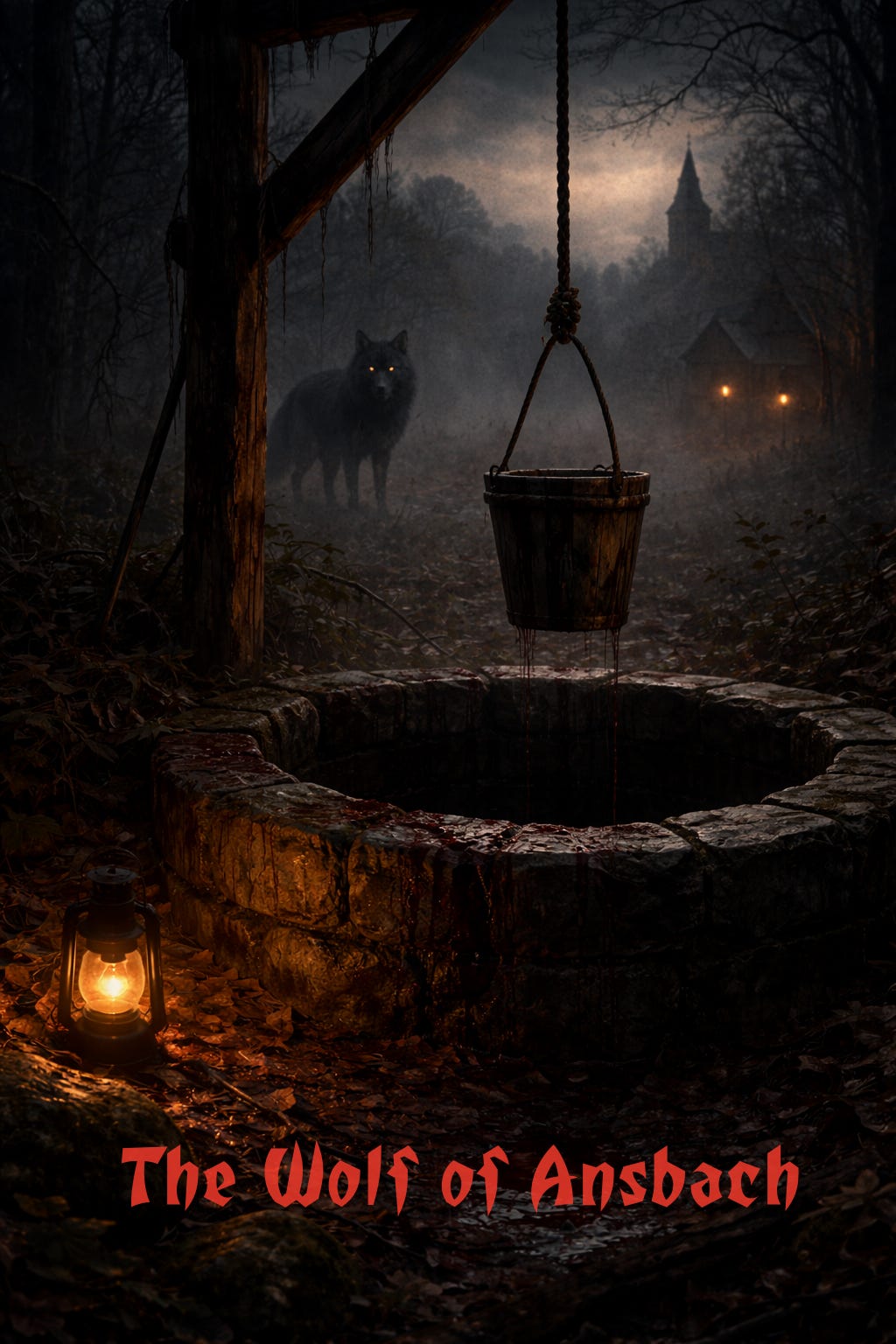
This story is loosely based on an old Franconian legend, not one of my own making. First comes the literary retelling. The traditional version of the legend can be found at the end.
In the autumn of 1685, when the fields around Ansbach had already been cut down to stubble and the light left early from the land near Neuses by Eschenbach, a wolf began to trouble the villages.
At first it was only livestock.
A sheep lay opened in a pasture. A calf had been mauled near the edge of the trees. Hens vanished from a yard in the night, leaving feathers in the mud. Such things still belonged to the world. Wolves had always lived in the outer dark. Men cursed them, checked their fences, brought the animals in sooner and went on.
No one yet needed anything more.
Then the wolf came closer.
It was seen where it should not have been seen. Not deep in the timber. Not on some far ridge at dawn. It slipped past low walls, moved along the backs of sheds, crossed the mouths of lanes where children had been playing moments before. A woman drawing water caught movement by the hedge and looked up to find a grey body standing at the far end of the yard.
It was not feeding.
It was not running.
It was only standing there.
The head was low. The shoulders were high. Its eyes held the last of the evening light without giving any back. For one instant it seemed to her that the thing was not merely watching the house, but waiting for something. By the time she cried out it was gone.
That was how it entered the houses.
Not the size of it.
Not even the teeth.
The nearness.
After that the evenings changed.
Doors were barred earlier. A lantern carried from one house to the next no longer looked companionable. Mothers called the children in before the last light had failed, then counted them once at the table and again before bed. Men crossing a yard after dark took a hook or a stave in the hand without knowing they had done so. Dogs barked from hidden places and then fell silent with a sound almost worse than barking, as if they had backed away from something at the gate.
Then the children began to be counted twice in every house.
The wolf was blamed now for more than livestock. Fear had moved from the pasture to the village itself. It sat in kitchens, church porches, barns and at the wells. It changed the look of ordinary things.
A lane walked a hundred times grew too long after sunset.
A hedge became a boundary.
An open field became a place no one wished to cross alone.
For a while, nobody named what they were beginning to suspect.
They only spoke around it.
A bold beast.
A cursed season.
A thing that did not keep to the woods.
Then one evening a man met it in the lane outside the village.
He had been coming home late, later than he should have, with the last of the light leaking out over the fields and the hedges already gone black. The road was wet underfoot. Somewhere far off a dog barked once and stopped. He had nearly reached the turning toward his house when something moved ahead of him and came out into the lane.
Not quickly.
That was the first wrong thing.
A wolf should have flashed across and vanished. This one stepped into the road and stayed there. Its body was low in front and high at the shoulder. Its fur looked black in the failing light, blacker than it should have. Its head hung a little forward, as if listening.
The man stopped.
The beast stood not twenty paces from him.
He could hear his own breath. He could hear water ticking from the hedge. He could hear or thought he could hear, the wet pull of the animal’s breathing.
Then it took one step toward him.
He ran.
Later he would never remember turning. Only the panic in the body. One instant the thing was in front of him and the next he was stumbling back the way he had come, slipping in the ruts, one hand thrown out against the dark as if the night itself might catch him. Behind him he heard it. Not the full cry of a hunting beast. Worse than that. The quick, soft thud of feet in the mud, gaining.
He tried to shout and got no more than a torn sound out.
Something struck the back of his coat.
He lurched forward, nearly went down, felt claws drag once across the cloth and tear free. Then he was running blind, with the lane breaking under him, his breath sawing in his chest, the ditch somewhere to one side and the hedge to the other. He knew only that if he fell, it would be on him before he had time to rise.
A gate stood open ahead. He did not remember whose. He flung himself through it, hit the yard hard, scrambled up and screamed then, screamed until a door flew open and lantern light leapt out across the ground.
The thing had stopped at the threshold.
That was what he swore to afterward.
It had not fled at the light. It had not bolted like a frightened animal. It stood beyond the open gate with its body half in shadow and its head lifted toward the yard, as if it had run him there on purpose. The lantern shook in the hand above the steps. Someone shouted. The wolf did not move. It only looked in.
Then it turned away.
Not in fear.
Not in haste.
It went back into the dark at the same measured pace with which it had first stepped into the lane.
The man could not speak properly for some time. When words came, they came in pieces. The beast had not looked right. It had watched him too closely. And when it paused at the gate and turned its head in the swinging lantern light, something in the face had come together for an instant.
Not fully.
Not plainly.
But enough to leave him shaking.
He swore there had been a look in it he had seen before in another face, years earlier, indoors, across a room, when bad news had pleased the man hearing it.
By morning he was saying the name.
By evening others were saying it for him.
Michael Leicht.
The dead man had held office in the Ansbach territory. He had died not long before. He was not remembered kindly. Some men are mourned. Others are spoken of with relief when the earth has been laid over them.
Leicht, it seemed, was one of those.
After that, the fear found a face.
A woman in one house said she had known it already, though she had not dared to speak. A farmhand swore the beast had the same way of turning its head that Leicht had when hearing a plea he meant to refuse. An old man said he had seen the wolf standing at the edge of a field and felt, before he knew why, the sick certainty that the thing was not searching for prey but for people who knew its name.
And so the saying settled in.
Michael Leicht had come back.
Or something in him had.
His spirit had not gone where it should. It had entered the wolf. It had taken fur and hunger for a body and come back to the roads and fields of the living. Before long the villagers were no longer speaking merely of a dead man’s ghost in an animal. They said what by then felt truest to them.
Michael Leicht had returned as a werewolf.
After that, every sighting deepened the certainty.
A man crossing a field at dusk saw the beast standing between two bare apple trees with a dead hen in its mouth. He shouted and waved his arms, meaning only to drive it off. Instead the wolf let the bird drop and began to come toward him, slowly, almost lazily, its muzzle dark with blood. The man backed away. The beast kept coming, slow as thought. He turned and ran for the stone wall at the edge of the field, hearing it behind him in the grass. When he hauled himself over and dropped hard on the other side, he looked back and saw it standing where he had been, not snarling, not rushing, simply watching him with a patience that made his bladder loosen in his clothes.
A girl sent to fetch in washing reached the line at the edge of the yard and saw the sheets lifting and falling in the wind. At first she thought the movement behind them was only more wind. Then one hanging cloth drew tight around a shape that was too tall, too broad, too still. For a heartbeat it looked like a man standing under the linen with his head bent. The fabric dropped. The wolf was there. So close she heard the rasp in its throat. It came at her in two quick bounds. She snatched the basket to her chest without meaning to and when it struck her the wicker burst and wet linen flew into the mud. She fell screaming. By the time the others reached her the beast was already over the wall and gone, leaving the cloth trampled and one sleeve torn clean away.
One widow woke in the hour before dawn to the sound of claws on stone outside her house. Not scratching. Walking. One slow step after another. She lay without moving, the blanket pulled to her mouth and listened to the steps pass her door, stop beneath the window and remain there. Minutes went by. She could hear nothing now but her own blood and, once, a breath so close to the wall it seemed to come from inside the room. When morning came, she found the mud below the window pressed with tracks. In one place, where the ground had been softer, something like the mark of a hand showed beside the tracks. By the time she found her voice, rainwater had begun to take it away.
A wolf could be hunted.
A beast could be trapped.
But a dead man returned in another form belonged to different thoughts.
Still, the men went after it.
They took dogs, hooks, old muskets, pikes, whatever lay to hand. They crossed the wet ground at dawn with frost whitening the grass by the ditches. They searched hedgerows, hollows, the edges of the woods. The dogs would strain and bark toward a wall of brush or some tumbled place beside the road, then suddenly recoil, whining and pulling backward as if something in the dark ahead had shown its teeth without showing its body. The men would go in shouting only to find cold earth, dead leaves and nothing else.
Then another yard would be struck.
Another carcass found.
Another story added.
By October the country around Neuses lay bare to the eye. The hedges had thinned. The fields were flat and pale under a weak sky. Even the woods had lost much of their cover. You could see farther than before and trust your sight less. At dusk a tree trunk might look like a standing figure. A dog at the end of a lane could seem for half a second like something worse. A patch of shadow near a shed might seem to breathe.
The fear did not come like a blow. It soaked in. It got into the timber and stayed there.
Then came the day near Neuses by Eschenbach.
The wolf was driven. Dogs were on it. Men were after it. The chase closed in near the village and the beast broke into open ground after barnyard prey, blind with hunger or panic. Wings beat up out of the yard. Shouting followed. The animal lunged forward and the earth gave way beneath it.
There was an old well there. One moment the beast was loose before them. The next it had vanished into the dark.
The dogs rushed the rim, barking madly, then skittered back from the stone mouth with their hackles up. Men came up behind them and stopped short, looking down into the shaft. Below, in the black, the wolf turned and struck against stone, scrambling and failing, its body echoing in that narrow place.
The sound of it came up out of the well in savage bursts. Claws screeching on stone. Water thrashing below or mud torn apart under its weight. A choking, furious breath forced up through the dark. Men at the rim flinched back in spite of themselves. One of the dogs broke and ran.
Then the wolf sprang upward in the shaft, higher than any of them thought it could and for an instant its face rose into the mouth of the well, teeth bared, eyes lit in the dark below. One man cried out and stumbled backward, swearing afterward that it had not looked wild at all in that moment. It had looked knowing. As if it had marked every face above it.
No one climbed down after it.
They killed it from above.
That should have been enough.
A dangerous animal had been cornered and dispatched. The villages might have let the matter end there, with relief and winter coming on.
They did not.
The carcass was taken to Ansbach. Then it was altered. A human likeness was fitted to the head or something near enough to one. A wig was set upon it. Clothes were put on the body so that it would resemble the dead Michael Leicht, the man already bound to it in the minds of the people. Thus arrayed, the wolf was hanged publicly near the city for all who wished to come and see.
And they came.
From Ansbach and the surrounding country they came, to stand beneath that thing and look up at it against the autumn sky. The pelt in human clothes. The false face. The dead jaws parted a little. The wind moving the sleeves.
By then the road beneath the gibbet had begun to darken toward evening. Someone hurried a child past without stopping. Someone else stood too long.
Those who stood beneath it said little.
The false face swung a little above the road.
The jaws hung open.
The sleeves moved in the wind.
No one looking up at it needed the name spoken again.
Appendix: The Recorded Core of the Legend
The firmest documented core is narrower than the full legend that later grew around it. A contemporary broadside reports that, in 1685, in the Margraviate of Onolzbach or Ansbach, a wolf carried off and ate several children and was finally captured and killed on 9 October 1685 in a well at Neuses near Eschenbach. The same source also states that the animal was afterward hanged in altered form.
A second layer belongs to the transmitted legend rather than to the smallest directly documented core. In later retellings and in scholarly discussion of the case, the wolf is identified with the recently deceased Michael Leicht. The sources are not fully uniform about his exact office, but they agree on the central point that people believed the wolf was Michael Leicht returned or that his spirit had entered the animal. Modern source criticism treats this as part of the legend’s reception and development, not as a historically verifiable transformation.
Another stable element in the transmission is the wolf’s death near Neuses and its public display afterward. Later summaries describe the animal as having fallen into a wolf pit or a brush-covered well while being pursued and they consistently preserve the detail that the carcass was altered to resemble a human figure before being publicly hanged near Ansbach. Many later accounts add specifics such as a cardboard face or mask, a wig and clothing. Those details are widely repeated, but they belong more securely to the later transmitted form of the story than to the narrowest contemporary core.
A few points should remain explicitly open. The exact number of children killed is not fixed with certainty in later retellings, even though the early broadside clearly speaks of several children. In the same way, details such as Michael Leicht attending his own funeral, appearing by night in a white covering or being seen in specifically supernatural ways belong to later legendary elaboration and should not be stated as part of the smallest secure historical core.
Diving into all these stories has been amazing. I am happy I found folks such as yourself collecting and sharing!!
This story reminded me of a French film called "Brotherhood of the Wolf" released in 2001. I believe that was based on a true story too. This was fascinating and very well-written!