


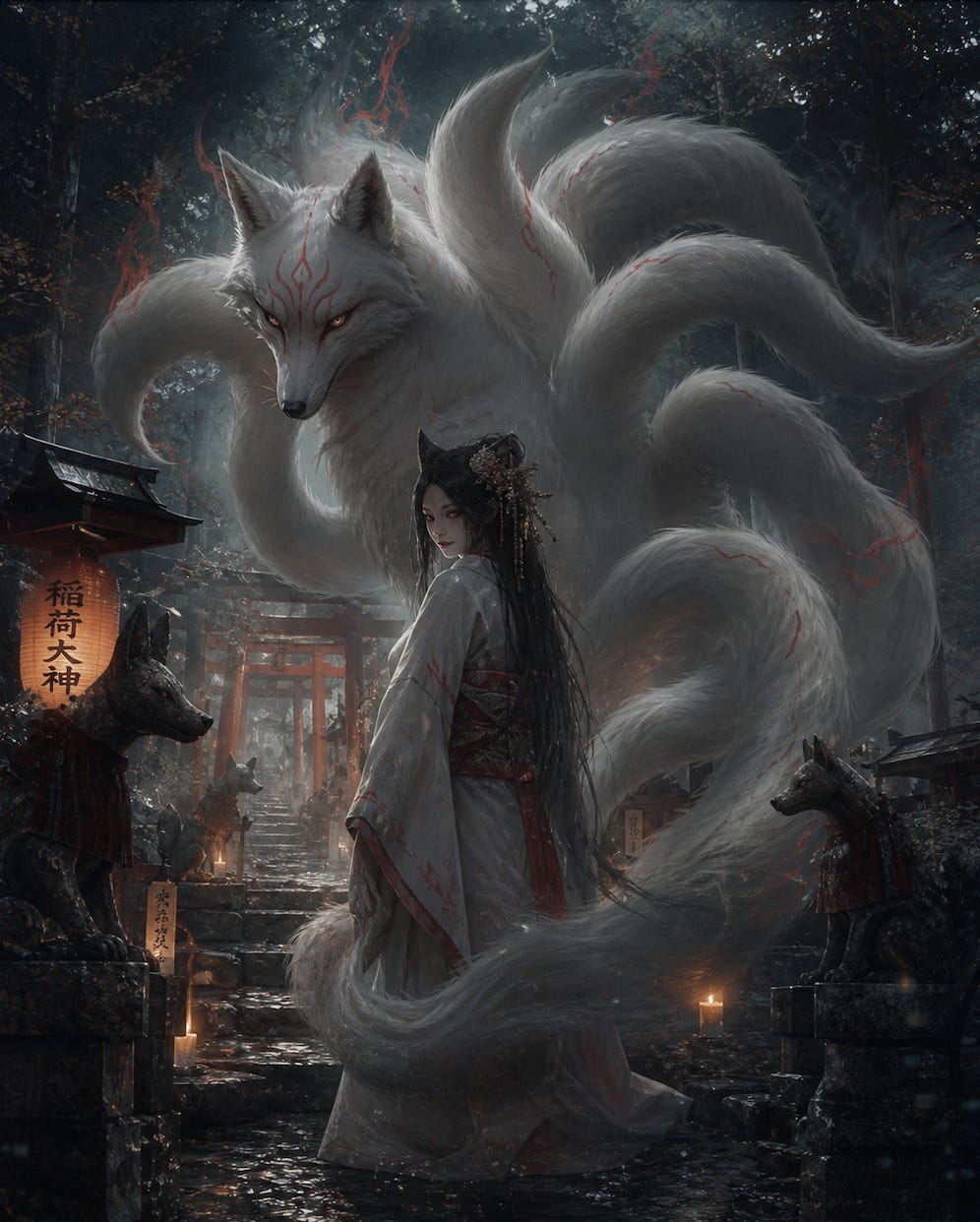
Some animals seem to notice the border before we do.
A fox at the edge of a field. A white shape near a shrine. A narrow face turned once toward the road, then gone into grass. Nothing has happened. No one has been harmed. Still, the place feels altered.
The fox has always been good at that.
In Japan, the creature called kitsune is not one thing. It is an animal, a messenger, a deceiver, a wife, a possessing spirit, a sign near rice fields and shrines. The word means fox, but the stories around it do not stay inside the animal.
They move from one meaning to another before the eye can settle.
Some of the oldest Japanese fox-wife tales appear in the Nihon Ryōiki, a Buddhist collection compiled in the early ninth century. In one famous story, a man marries a woman who is later revealed to be a fox. A dog frightens her. Her form cannot hold. She leaves him in daylight, but returns at night.
The story is strange because it is not only a warning.
The fox-wife is not simply exposed and destroyed. She has borne a child. She has shared a house. After the revelation, she still comes back. The human world has discovered what she is, but discovery does not erase attachment.
The unsettling part is that the fox-wife may not be lying about love.
Later collections and regional tales return to this unease. A fox takes human form. A person marries, sleeps beside, trusts someone who is not what they appear to be. Sometimes the fox is dangerous. Sometimes she is faithful. Sometimes the tale refuses to decide.
Kitsune are also tied closely to Inari worship. At Inari shrines across Japan, fox statues sit in pairs: white, narrow-faced, alert. Some hold keys, jewels, scrolls or sheaves of rice in their mouths. At Fushimi Inari Taisha, where red torii climb the mountain in long corridors, the shrine explains that these foxes are not ordinary mountain foxes and that Inari Ōkami is not a fox. They are messengers, attendants, unseen beings made visible in stone.
The kitsune of shrine tradition is not always the same as the fox of ghost stories. Yet the two are never fully separate. Folklore does not keep clean files. A sacred messenger can stand very close to a trickster. A guardian can share a face with a deceiver.
The fox sits calmly in both places.
Another tradition speaks of kitsunetsuki: fox possession. The word names a condition in which a fox spirit was believed to enter or attach itself to a human being, causing illness, strange behavior, altered speech, appetite changes or distress. Such beliefs are documented from early Japanese sources and become especially visible in medieval and early modern accounts.
Today, it is impossible to read these records without caution.
Some cases likely describe mental illness, social pressure, family conflict, religious experience or physical disease interpreted through the language of possession. But to reduce the matter too quickly is also to lose the historical fear. People believed a fox could enter a life and make it no longer wholly one’s own.
In some accounts, the possessed person was not the only one marked. Suspicion could spread to a household. A family thought to command fox spirits might be feared, avoided or accused of gaining wealth through hidden means. The monster did not need a body in the road. It could live in diagnosis, gossip, household reputation and the quiet calculations of neighbors.
Possession is intimacy without consent. The body becomes a disputed house.
There is also kitsunebi, foxfire: small lights seen at night, sometimes described as lines of flame or lantern-like glows moving where no bearers can be seen. Old accounts do not settle the matter. They leave the lights outside, in the dark, behaving almost like a procession.
The detail connects, in some traditions, to kitsune no yomeiri — the fox’s wedding. The phrase can refer to sunshower weather, when rain falls from a bright sky. It also belongs to stories of hidden fox processions: lines of lights crossing fields or mountainsides at night, as if a wedding party were passing where no human invitation had been sent.
The same phrase holds two impossibilities.
Rain from a clear sky.
Lanterns with no hands.
The strangest detail, though, may be the tails.
Kitsune are often said to grow more powerful with age, acquiring additional tails. The nine-tailed fox is the most famous form, but the motif has older roots beyond Japan, especially in Chinese fox-spirit traditions. In Japan it becomes part of the long grammar of the creature: age means power and power becomes visible as excess.
One later and famous example is Tamamo-no-Mae, the beautiful woman at court who is revealed, in legend and literature, to be a fox spirit. Her story changes across tellings and it belongs more to medieval and later literary tradition than to a single stable folk belief. Still, she shows what the nine-tailed fox could become in Japanese imagination: not merely an animal with extra tails, but beauty with an older mind behind it, a courtly brightness that casts the wrong kind of shadow.
One animal.
Too many tails.
Time has gathered behind it.
Compared with the European werewolf, the kitsune is quieter. It does not wait for the moon. It is not bound to one violent change. It need not tear the body apart to become other. Its transformations are smoother, more domestic, more troubling. A fox may become a woman. A wife may become a fox. A light may become a procession. A shrine statue may become a reminder that something unseen has always been standing there.
The fear is not that the monster will break down the door.
The fear is that it has already been invited in.
Kitsune stories often turn on small failures of concealment. A dog notices. A tail appears. A reflection betrays something. The world does not erupt. It gives a small sign and after that sign, nothing can return to its former arrangement.
It holds a very old anxiety: that appearances are not false exactly, only incomplete. The person beside you may be a person and also not. The animal in the field may be only an animal and also a messenger. The light in the distance may be weather, spirit, deception, memory.
The tradition rarely chooses one answer.
It lets the fox keep moving.
That restraint is part of the dread. Kitsune tales do not always punish curiosity, but they make knowledge expensive. Once the fox is known, something is lost: a marriage, a household, an illusion, a way of standing safely in the world.
At the shrine, the stone foxes remain.
Their mouths are closed. Their eyes are carved open. They do not threaten. They do not explain. They face the path as if they have been expecting people for centuries and will go on expecting them after the last offering has dried.
A fox does not have to vanish quickly.
Sometimes it is enough that it was seen at all.
Notes on the Tradition
This article draws on Japanese fox folklore and religious tradition, especially:
Nihon Ryōiki / Nihonkoku Genpō Zen’aku Ryōiki, compiled in the early ninth century, including early fox-wife material
Konjaku Monogatari-shū, a twelfth-century collection of Buddhist and secular tales that preserves later setsuwa material
Fushimi Inari Taisha’s shrine tradition, especially the distinction between Inari Ōkami and the fox messengers
Historical beliefs around kitsunetsuki or fox possession, documented across Japanese religious, medical and folkloric sources
Folkloric accounts of kitsunebi, foxfire and kitsune no yomeiri, the fox’s wedding
The legend of Tamamo-no-Mae and wider East Asian fox-spirit traditions, especially Chinese material connected to the nine-tailed fox motif
Some details vary by region and period. The exact origins of several motifs, especially the nine-tailed fox, are not certain.
Field Notes
Name
Kitsune
Origin:
Japan
Category
Yōkai
Shapeshifting being
Fox spirit
Spirit-associated animal
Forms
Fox
Human, often female in tales
Occasionally indistinct or partial transformations
Key Traits
Shape-shifting
Ambiguity
Intelligence
Association with thresholds, deception and hidden identity
Increasing power with age, often marked by multiple tails
Affiliations
Inari worship as messenger figures
Regional folklore traditions
Wider East Asian fox-spirit traditions
Behaviors
May deceive, protect, marry, possess or observe
Often moves between roles without clear moral alignment
Signs of Presence
Unexplained lights or kitsunebi
Uncanny encounters
Inconsistencies in appearance
Animal reactions, especially dogs
Rain falling from a bright sky
Known Exposures
Dogs
Reflections
Visible tails
Small failures in disguise
Associated Motifs
Fox-wife tales
Kitsunetsuki or fox possession
Kitsunebi or foxfire
Kitsune no yomeiri or the fox’s wedding
Nine-tailed fox traditions
Risks
Emotional attachment under false assumptions
Social disruption through possession beliefs or suspicion
Loss of certainty about identity or reality
Typical Pattern
Initial normality
Subtle anomaly
Delayed recognition
Irreversible shift in understanding
Cultural Note
Not simply a monster. In Inari contexts, the fox is a messenger or attendant, not Inari Ōkami itself.
Classification Status
Unstable. Resists fixed categorization as animal, spirit, messenger, trickster, lover, possessing force or “monster”.
Thank you for sharing this very well-researched article!
An interesting fact: the very first written account of the nine-tailed fox, appearing in ancient text Shanhaijing ("The Classic of Mountains and Seas"), the nine-tailed fox is supposed to be a monster native to Korean peninsula (or 靑丘, "Blue-Hill"). Even in this brief, ancient text entry, the two fundamental characteristics of Korean and Chinese nine-tailed fox (Gumiho/Jiuweihu) are already established: emulation of humanity, and harm against humans, while Japanese Kitsune (likely a product of the Gumiho/Jiuweihu tradition fusing over Japanese native animism) can be more multi-faceted as you have aptly noted.
I've just found out that my latest comment didn't get through. It's no surprise as I am navigationally challenged. I'm not sure how to make the most basic substack manuevers and that hurts my performance. I cann use all the help that I can get.