


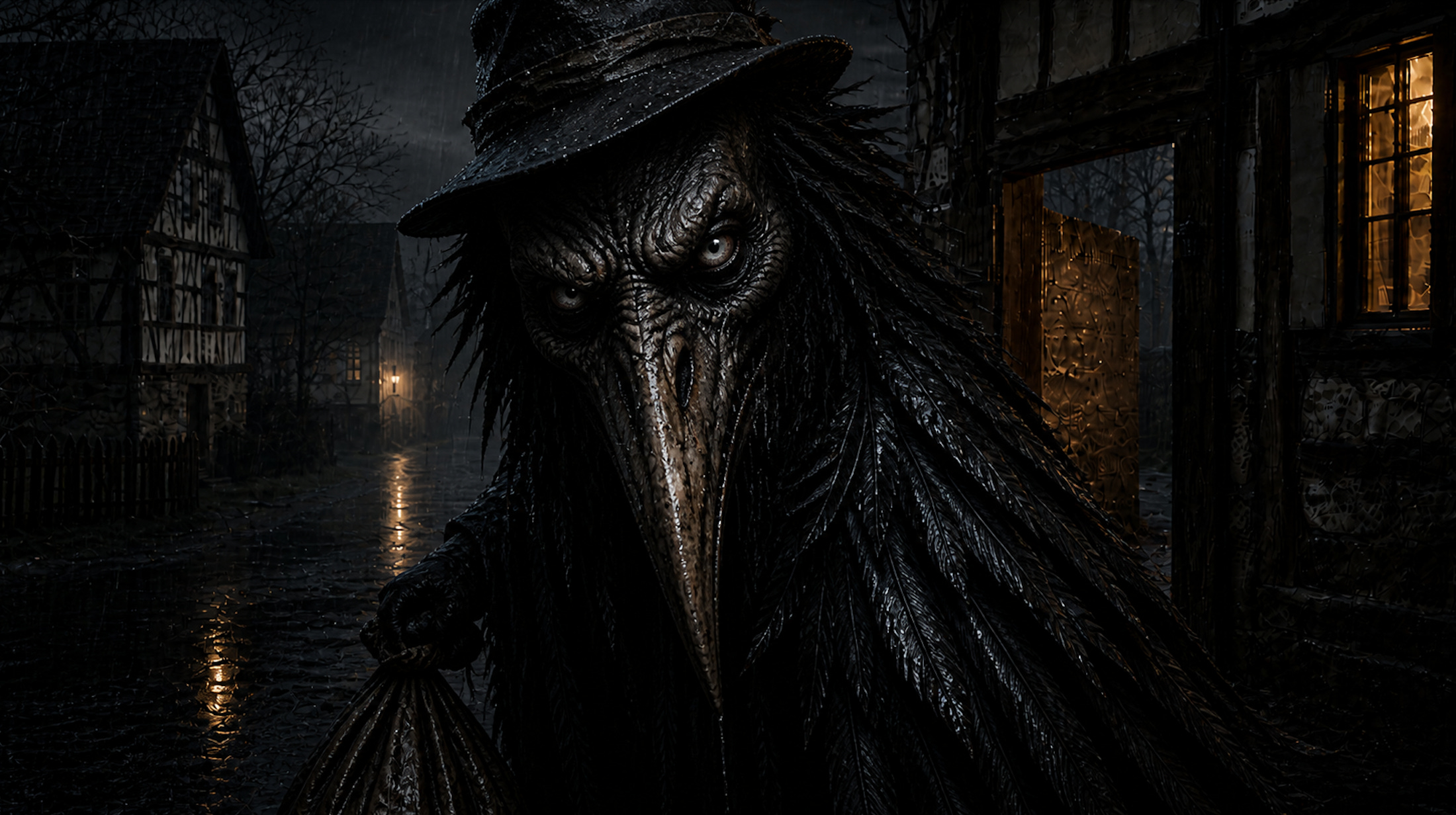
The bird is not seen first.
First there is the road after rain, the wet boards by the shed, the ditch at the edge of the lane. A child has stayed outside too long. The useful light has gone. The hens are quiet. Somewhere a door is open and from that door comes a name.
The name is not always the same.
Nachtrapp. Nachtkrapp. Nachtkrabb. Nachtrabe.
It belongs to southern Germany and Austria, though not evenly and not as a single finished creature. In the safest sense, it is a Kinderschreck, a child-scarer: one of those figures used to call children away from danger before danger has to explain itself.
Across later summaries and regional references, the warning is simple. Children who remain outdoors after nightfall may be taken. The being is often imagined as black, birdlike, ravenlike or attached to the old raven-word field. Some later summaries of South Swabian tradition give the figure a sack. In some modern summaries, especially of Austrian tradition, the warning grows harsher: the bird does not only carry children away, but devours them.
That detail is memorable, but it should be kept at the edge of the tradition rather than made its center.
The older center is quieter and, in a way, worse. A child who remains outside after dark may be carried so far from home that home cannot be found again.
The tradition is not stable. There is no single early text in which the Nachtrapp arrives complete, with a fixed shape and a fixed story. It survives through dialect, local memory, folklore reference works, later summaries, carnival figures and the long European discomfort around birds that call in the dark.
Before it is a monster, it is a name that will not stay still.
The older word Nachtrabe helps explain the trouble. Early dictionaries did not use it for one neat species. In the Frühneuhochdeutsches Wörterbuch, the Nachtrabe is a night-raven or night-owl, an ornithologically uncertain bird to which ghostly nocturnal activity is attributed. The same entry also gives figurative meanings: a ghost story, a nurse’s tale, a night-roaming person, a nocturnal specter.
A bird. A story told to children. A person wandering at night. A ghost.
The word already contains the whole weather.
Adelung, in the eighteenth century, is just as unsettled. Nacht-Rabe may refer to several birds that fly at night and have an unpleasant voice: an owl, a night-heron, a dark swallow-like night bird, the Caprimulgus, the bird later associated with the name Ziegenmelker. The old tale attached to that bird says it sucks milk from goats.
This does not mean the Nachtrapp is a goat-sucker. It means that night birds were not always allowed to remain birds.
A cry at the wrong hour could become a rumor. A rumor could become a warning. A warning could grow wings.
The child-scarer has a practical office. It belongs to the kind of fear a household can use. The Roggenmuhme keeps children from the grain. Water figures keep them from ponds and wells. The Butzemann, the Popelmann, the sack-bearer and the dark thing behind the stove all do some local version of the same work.
They make a rule memorable.
The Nachtrapp makes dusk memorable.
Its territory is not the whole forest. It is the interval before the door closes. The lane, the yard, the field-path, the town ditch, the place where adult sight thins out. In this sense the Nachtrapp is not interested in adventure. It has almost no plot. A child remains outside. A name is spoken. The child returns or does not.
That is enough.
One small trace gives the figure a place to stand. A bibliographic note to Johannes Künzig’s Schwarzwaldsagen, preserved through the Handwörterbuch des deutschen Aberglaubens tradition, mentions the Nachtkrabb, also under related names such as Nachtwolf or Nachteule, as the Dorftier of Laufenburg, with its dwelling in the town ditch.
The detail is narrow. It should not be made into a grand legend.
But it is hard to improve.
A town has a ditch. The ditch has a local animal. The animal has several names. The names are all night.
In Murrhardt (Germany), the Nachtkrabb belongs to a living regional layer. The local Narrenzunft calls it the best-known single and symbolic figure of the guild and also names it as a Kinderschreck. There, the figure is connected with the Waldrapp, the northern bald ibis: dark feathers, bare reddish face, long curved beak.
Here, too, the source must be handled carefully. A carnival figure is not the same thing as an old belief. A mask may preserve, transform or invent emphasis. It may be faithful to a memory and still not prove the origin of the memory.
Still, the Waldrapp is not imaginary. Conrad Gessner’s sixteenth-century natural history is one of the reliable early modern witnesses for the bird in Central Europe. Modern conservation work confirms that the northern bald ibis once occurred in Switzerland, Austria and southern Germany, before disappearing from Europe for centuries.
So one line of the Nachtrapp may belong not only to fear, but to misremembered natural history.
A real bird goes away. A black bird remains.
The strangest documented detail is not that the Nachtrapp takes children. Many beings do that.
The strangest detail is that the older Nachtrabe can mean both a night bird and a tale told to frighten or quiet the household. The creature and the telling are almost the same thing. It is not only an animal in the story. It is also the story itself, already understood as something passed through the mouth at night.
A nurse’s tale with feathers.
That makes the Nachtrapp unusually honest. It does not hide its function. It is what adults say when the world outside has become too large to explain in full. There are roads, ditches, animals, strangers, water, cold, disobedience, accident. There is the simple fact that a child can leave the circle of the house and fail to return.
The Nachtrapp gathers those fears into one shape.
Not a theology. Not a demonology. A boundary.
What is feared underneath is not only the bird. It is the child’s vanishing from ordinary order. The missed call. The empty yard. The mother or father at the door, angry first, then listening. The road that looked familiar a moment ago and now belongs to rain, mud, hedges and things that know how to move without lamps.
The Nachtrapp is sometimes compared to the Sandman and the comparison helps only a little. Both belong to children and sleep. Both come at the hour when the day is being shut down. But the Sandman is intimate. He reaches the eyes. He belongs near the bed.
The Nachtrapp waits before that.
It is the figure that gets the child to the bed at all.
Its form changes because the need changes from village to village. Nachtkrabb in one place. Nachtkrapp in another. A raven, an owl, a night-heron, a bad voice in a hedge, a town-ditch animal, a black Fastnacht mask with a red beak. Sometimes only the sentence remains.
Come inside.
That is the whole spell.
The door is still open. The yard is no longer bright enough to be trusted. Somewhere beyond the last useful light, a bird moves or does not move. The child looks once toward the ditch, once toward the road, once toward the house.
Then the name has done its work.
And the door closes.
Notes on the Tradition
This article draws on the southern German and Austrian Nachtrapp, Nachtkrapp, Nachtkrabb and Nachtrabe tradition, especially as it appears in child-warning folklore, dialectal bird-names and later regional custom.
The strongest older evidence is lexical rather than narrative. The Frühneuhochdeutsches Wörterbuch defines Nachtrabe as an uncertain nocturnal bird associated with ghostly night activity and also records figurative meanings such as ghost story, nurse’s tale, night-roaming person and nocturnal specter. Its cited attestations include late medieval and early modern material, including Konrad von Megenberg, Hans Sachs and sixteenth-century lexicography.
Adelung’s eighteenth-century dictionary likewise treats Nacht-Rabe as a name given to several nocturnal birds, including owls, night-herons and Caprimulgus. It also records the old tale that the Ziegenmelker was believed to suck milk from goats.
The child-scarer material is best treated as regional and unstable. Later summaries commonly describe the Nachtkrabb or Nachtkrapp as a southern German or Austrian figure that takes children who remain outdoors after dark. The sack motif, the devouring motif and the “good” Nachtkrapp should be treated as regional, late or weakly grounded unless tied to a specific collection.
A narrow Laufenburg trace appears through an internet discussion citing the Handwörterbuch des deutschen Aberglaubens and Johannes Künzig’s Schwarzwaldsagen, where Nachtkrabb, Nachtwolf or Nachteule is described as the name of a Dorftier dwelling in the town ditch. This is useful as a local bibliographic trace, not as a full narrative cycle.
The Murrhardt material belongs to living regional custom and Fastnacht, not necessarily to the oldest layer of belief. The Narrenzunft Murreder Henderwäldler calls the Nachtkrabb its best-known single and symbolic figure, links it to the Waldrapp and preserves the local child-scarer account in which children outside after dark are taken so far away that they never find home again.
The Waldrapp connection is plausible as a later local embodiment, but not proof of the whole creature’s origin. Modern Waldrapp conservation material identifies Conrad Gessner as a key historical witness for the northern bald ibis in Switzerland, Austria and southern Germany.
Some details vary by region and period. The exact origin of the Nachtrapp motif is not certain. Later literary, online and carnival versions may have shaped the better-known form.
Field Notes
Name
Nachtrapp
Nachtkrapp
Nachtkrabb
Nachtrabe
Origin
Southern Germany
Austria
Upper German dialect regions
Category
Kinderschreck
Night-bird figure
Raven-associated warning figure
Forms
Large black bird
Ravenlike shape
Black child-taking figure in some accounts
Fastnacht figure in Murrhardt, Germany
Key Traits
Appears after dusk
Warns children indoors
Connected with night-bird names
Unstable by region
Affiliations
Southern German folklore
Austrian folklore
Raven and night-bird belief
Murrhardt Fastnacht tradition
Behaviors
Takes children who remain outside after dark
Carries children away in the more stable warning form
Appears with a sack in some later South Swabian summaries
Devours children in some harsher modern summaries
Signs of Presence
Dusk
A spoken warning
Nocturnal bird-call
Roads, yards, ditches and thresholds
Known Exposures
No stable exposure tradition
Recognized through name and timing
Sometimes linked to real night-birds
Sometimes locally attached to the Waldrapp
Associated Motifs
Child-stealing
Night-raven
Threshold at dusk
Pedagogical fear
Uncertain bird identity
Risks
Being taken from home
Losing the way back
Being devoured in harsher later summaries
Fear used as discipline
The ordinary world becoming unsafe after dark
Typical Pattern
Child remains outside
Adult gives warning
Night-bird name is spoken
Child returns indoors or is threatened with removal
Cultural Note
The Nachtrapp is not a single fixed monster. It is a regional warning figure shaped by dialect, night-bird lore, child-rearing, raven symbolism and later local custom.
Classification Status
Unstable
Regional
Pedagogical
Folkloric
Partly lexical
Partly carnival accretion
Nice.
I love these kind of stories. I'm a big fan of myths and folklore.