

The Chains Beneath Büchel
The hot water remembers

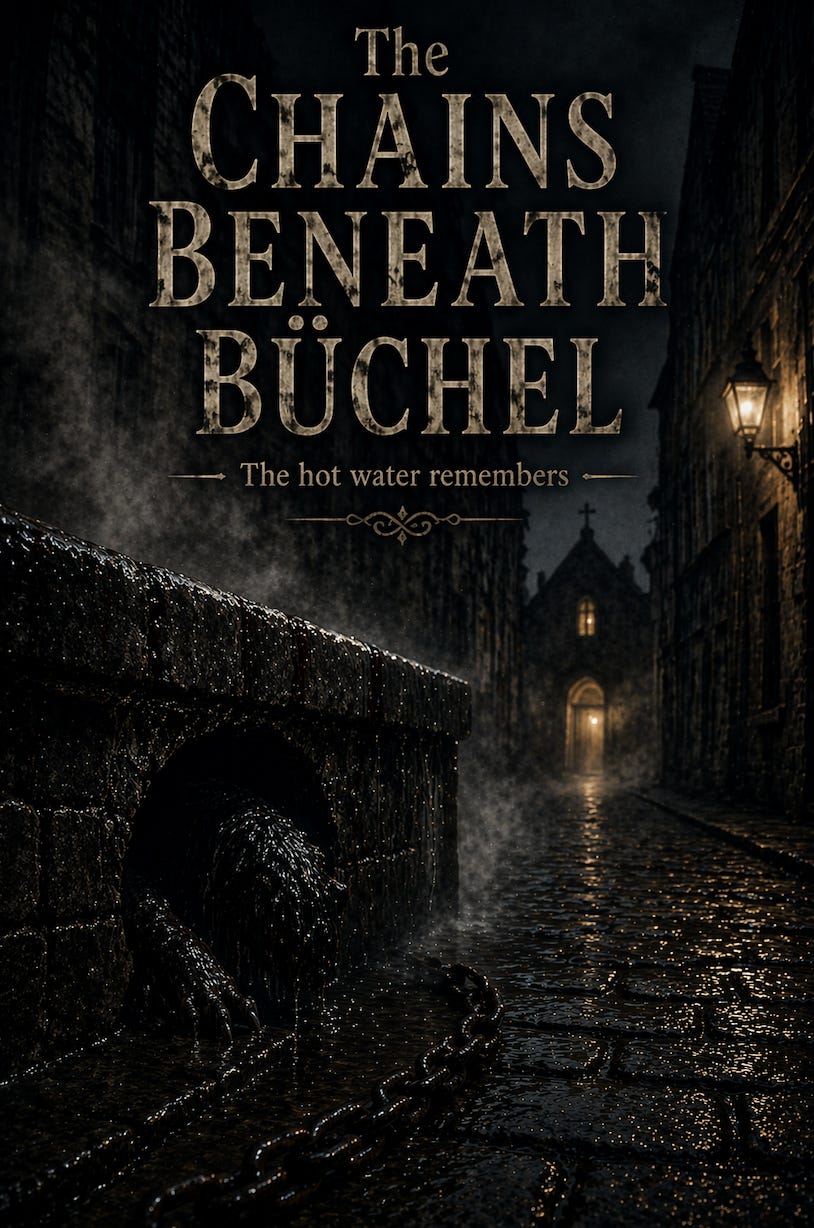
This is a dark retelling of an old Aachen legend from the city’s hot-water quarter and not my invention.
In Aachen people knew that some parts of town had their own air.
Even in cold months there were streets where the ground seemed to breathe warmth. The air could turn sour there without warning. Windowpanes filmed over. Linen took on the smell of minerals and old cellars. Strangers noticed it first and asked questions. The people who lived there did not. They only shut their doors a little earlier when evening came and learned which corners to cross quickly after dark.
The worst of it was around the Büchel.
By day it was only a quarter of narrow houses, wet stones and steaming runnels where the hot spring water passed through the town and out again. Women worked there. Children played there. Traders argued in the street. Nothing in the place announced itself as cursed. Yet in that part of Aachen people spoke more quietly late at night. A lane could be empty there in a way that did not feel empty at all.
And beneath the Büchel ran the Kolbert.
If spoken of plainly, it was only a channel: a dark outflow under the paving where hot water and filth slid away below the houses. Men cursed when it flooded. Boys dared one another to look into it. In daylight it was a thing of masonry, runoff and stink. But at night its name was said a little differently, with that slight flattening of the voice people use when they do not want a word to travel farther than the table.
One heard things.
Not from everyone. Never in the same way twice. But the stories had the stubbornness of damp. A man came home gray at dawn with his coat torn through at the shoulder and would not say what had happened until drink loosened him again a week later. A carter swore he had heard chain over stone where no horse could pass. A widow in an upper room by the Büchel said she had seen something low and black move along the lane beneath her window and thought at first it was a calf, until it stopped and looked up at her.
No one gave its shape securely.
That was part of what made the talk cling. Some said it was no bigger than a yearling. Some swore it was larger in the dark than it could ever have been by day. Some spoke of hide, some of hair, some of a wet shine like scales. People disagreed about the shape. They agreed more easily about the fear.
So the quarter learned its habits.
Doors were latched. Shutters were drawn. Those who had business late took the brighter streets if they could. Those who had no business at all stayed home. Every now and then someone would say the old talk was dying out. Then a bell would ring over the roofs and from somewhere below the stones there would come that small, ugly sound of iron touching stone.
One such night concerned Leon Baur.
By day the Kolbert gave off only warmth and steam.
Warm water slid below the stones and carried up its smell into the street, sulfur and rot and that sick mineral damp that got into cloth and hair and bread. Women washed at the runnels in the pale hours. Boys threw pebbles where the dark water went under the paving and vanished. Every now and then the channel gave a little sound from below. Not a splash. Not quite. Something lower than that. A drag. A knock. Iron touching stone where no iron should have been.
People heard it and went on.
By night the Büchel changed.
The heat stayed between the houses after sunset. Mist clung low over the stones. Doors were barred early. Windows went black one by one. The town seemed to draw inward, leaving the street to the hot breath rising from underneath it.
Leon Baur came out too late.
He was not staggering blind. That would have been kinder. He had drunk enough to feel warm and careless, not enough to lose the road. He could still think. He could still notice the hour. He could still feel, with that ugly little stab sober fear gives a man who has stayed too long, that the town had already shut itself against him.
The tavern door closed behind him.
Silence.
Not true silence. A gutter running somewhere. A shutter tapping once in the damp wind. Far off, bells. But around him there was that emptied kind of quiet in which every small sound looks at you.
Leon pulled his coat close and started down the lane beside the Büchel. The stones were wet. Steam lay along the ground so thin he could have believed it was only his drink, only his eyes.
Then something moved below him.
He stopped.
The sound came again. Not footsteps. Not water. A slow chain-drag under the street, then a jolt as if something caught on stone and pulled free.
Leon turned toward the mouth of the Kolbert.
It was hardly more than a black opening where the runoff vanished under the houses. He had walked past it all his life. Children spat into it. Men emptied buckets there. In daylight it was filth and masonry. Now it looked deeper than the street should have allowed. The dark in it had weight.
The chain sounded once more.
Too close.
Leon stepped back. His heel slipped a little on the wet cobbles. He looked down into the opening and saw nothing.
Then the chain rattled again from above his shoulder.
He spun around and there was still nothing there. The lane was empty. The doors were shut. No cart. No dog. No man.
When he turned back, it was coming out.
Not all at once. A head first, broad and low and slick with black water. Then a shoulder. Then something that should have been a foreleg and was not right. For the length of a blink it planted on the stone beside its own neck, as if the joint had chosen the wrong place to be. Then it shifted and became almost animal again.
Leon made a noise in his throat.
The thing kept climbing.
It was roughly the size of a calf, yes. Then even that failed. Its back was too long. Its head seemed too close to him even while half its body was still in the drain. Wet hair clung to parts of it. Other parts caught the little light with a hard, blind shine. A chain hung from its neck or shoulder or somewhere that would not hold still long enough to name. Another length dragged after it from the dark. Its mouth opened once. Leon saw teeth. Too many in front, not enough at the sides, as if they had been put in by guesswork.
It did not snarl.
It watched him and breathed.
The breath was worse than the teeth. Fast. Shallow. Human with panic, only not afraid.
Leon backed away another step, then another. “No,” he said, though nothing had touched him yet. “No.”
The thing bent.
Slowly. Carefully.
Leon turned and ran.
He heard it come after him in a rush of claws and chain and that wet dragging scrape.
Then it was on him.
No warning. No clean impact. One moment he was running. The next something hit between his shoulders and wrapped him. His breath went out. His knees nearly folded. Claws punched through coat and shirt and skin. One hooked under his collarbone. Another bit high into the meat of his shoulder. Not evenly. Not like paws. It gripped him the way hands try to learn how to be paws.
Leon screamed.
The scream bounced off the houses and came back small.
The thing clamped tighter. Its chest, if it had a chest, pressed to his back. Its weight settled on him in little adjustments. Not dead weight. Riding weight. Choosing where to sit. Finding the spine.
“Oh God,” Leon said.
At once it grew heavier.
Not by a little. Not enough to explain away. Heavy in a way that made his body feel insulted, as if a millstone had decided to become flesh. His back bowed. Pain shot from his shoulders to his teeth. He staggered and almost went down.
The mouth touched his ear.
It did not breathe into him.
It drew breath in.
Leon felt the pull of it, a sick little inward taking, as though it were smelling not his skin but the prayer trying to get out of his mouth.
He began another one anyway because terror digs old words out of a man whether he wants them or not. A fragment. A plea. The name of God.
The claws went deeper.
Weight came down and down. His boots slid on the cobbles. Something in his lower back gave a hot, bright warning that felt very near breaking. He cried out and the thing shifted again, carefully, almost expertly, placing itself so that every step jarred him where he was weakest.
Leon lurched on, half running, half carrying, his hands snatching uselessly at the hooked limbs across his chest. They felt wrong under his fingers. Hair in one place. Bare slickness in another. A seam of cold hardness. A twitch beneath the surface like muscle turning over under water.
He tried to shout for help. What came out was a ragged animal sound.
An upstairs shutter opened a crack. A pale face appeared. It saw him and vanished.
“Help me,” Leon croaked.
No one answered.
The thing’s chain struck against his ribs in a filthy little rhythm. Its teeth clicked once near his ear.
Leon spat the first obscenity he could find.
The weight changed.
Not mercy. It did not lift to spare him. It lifted the way a listener lifts his head. The claws held. The thing stayed wrapped around him. But now its breath quickened with a kind of attention. Its mouth hovered by his ear.
Leon cursed again. Worse. Stable-talk. Tavern filth. Words he would not have used before his mother’s grave. Every foul thing he had ever heard from men with bad teeth and black nails came spilling out of him into the wet dark.
The burden lightened just enough for him to keep moving.
Enough to keep him under it.
He went on like that through the lane, bent almost double, carrying it, feeding it foulness so it would not crush him flat. He beat once at a door and the door did not open. He struck a wall with his shoulder and lost feeling in one hand. Above him the bells sounded the hour. The thing twitched at the sound but did not loosen.
Ahead, at the turn, he saw the chapel.
Only a slice of it at first. A black wall. A narrow doorway standing ajar. Inside, a dull red wick before the altar and the small gold line of candlelight catching the edge of a cross.
Leon almost sobbed with relief.
The thing went still on his back.
Then it drove him sideways.
Not down. Sideways. A brutal wrench of its weight that sent him crashing into the wall. His temple struck stone. White light burst through his skull. Before he could fall, the claws hauled him upright again. He staggered, trying to twist toward the door.
The thing clamped down so hard he felt warm blood run under his shirt.
The little red light of the chapel shook in his sight. So near.
He lurched toward it again, swearing now through tears and spit and pain. The burden eased a little because of the blasphemy. He gained half a step.
The cross above the doorway came into view.
At that, the thing rose on him.
Not heavier for a moment but higher, as if standing to see over his shoulder. The chain lashed against his chest. A sound came from it then, low and raw and furious, dragged through a throat not made for speech. Its claws opened and shut once. Leon felt the points of them ticking against his bones through meat and cloth.
He gave himself to the doorway.
One last stumble. One blind forward heave.
The weight vanished.
It did not jump down like an animal. It left him all at once. Leon pitched onto both hands and his face nearly struck the stones. Pain burst through his palms. He rolled, choking and saw it in the lane.
For a heartbeat it stood clear.
The head hung too low. One limb was braced in the wrong place again, bent like an arm that had forgotten itself. Black water dripped from its belly. Its chain trailed in a loop that kept moving after it had stopped. In its mouth, between the teeth, something pale fluttered.
A strip of linen from inside his collar, sucked white by its teeth until it looked like paper.
Its eyes found him.
Then it moved backward.
Not turning. Not breaking its stare. It drew itself away from the chapel mouth in a sliding, joint-wrong motion that made Leon’s stomach wrench. The chain screamed over stone. Then the thing twisted, dropped low and fled into the dark in a rush of claws and water and iron.
The sound went down the lane.
Then under it.
Then below the street again, running beneath the stones like something searching for the next place to rise.
The sacristan found Leon at dawn half across the chapel threshold, his hands skinned bloody, his face gray, his coat torn through at both shoulders. When they got him into the light and tried to lift the coat away, he cried out so sharply that one of the women began to weep.
There were wounds on him, but the priest looked only once before his mouth shut hard.
On the left shoulder four punctures. On the right three and below them a dark round bruise deep as a thumbprint, as if something had steadied itself there while it rode him.
When they stripped the shirt off, warm black mud slid from the inside of the cloth.
Leon saw that and began to shake so hard the bed creaked.
He slept through the day and woke after sunset with his own hands at his throat.
They told him later he had not screamed first. He had begun to pray in his sleep. Then his back arched as if something had landed on him. Then the screaming came.
He stopped drinking. That did not help.
After that he would curse when the bells rang and cross himself only in daylight. Twice he tried to kneel in church. Twice he pitched forward to the floor as though a great weight had been laid between his shoulders. No one laughed at him a third time.
He slept badly and worst toward evening.
And when fear forced a prayer out of him before he could stop it, he felt the mattress sink very slightly behind his back.
Appendix: The Recorded Core of the Legend
1. The narrow documented core
What is securely documented is the transmission of the legend, not the existence of the creature. The Bahkauv is a recorded Aachen legend tied to the Büchel and the Kolbert, the outflow channel of the hot springs there. Joseph Müller printed a prose version in Aachens Sagen und Legenden in 1858. Grässe included an Aachen Bachkalb/Bahkauv entry in Sagenbuch des Preußischen Staates (1871).
2. The transmitted legend
The stable overlap across the commonly cited record is narrower than many later retellings. The Bahkauv is a calf-like nocturnal being associated with Aachen’s hot-water quarter, especially the Büchel/Kolbert area. It comes out at night and attacks late passers-by, above all drunken men, by jumping onto their backs and forcing them to carry it. Müller’s printed version and the Grässe version preserve that central pattern.
Müller’s prose version also includes the motifs that later became the best-known parts of the legend: chain-rattling, a grotesque hybrid appearance, the burden becoming heavier when the victim prays, some relief when he curses and the creature being checked by a cross or an open church. Those details belong to the received legend, but the broadest multi-source core remains the nocturnal calf-creature from the Kolbert that mounts frightened late-night walkers.
3. Later embellishments or uncertain additions
Beyond that core, details become less secure. Descriptions of the body vary across retellings and should be treated as legendary styling rather than historical data. Some later official local summaries also add that the Bahkauv robbed drunken men of their last coins or “last penny.” Because that detail appears in later local retellings and is not necessary to define the narrowest shared core used here, it is safer to treat it as a later embellishment or at least a less stable element of the tradition. Modern rationalizations of the legend are interpretations, not documentation.
I appreciate your ability to build momentum and intrigue through varied sentence lengths, repetition, and dark metaphor.
Very interesting monster. I'd say that hitting up the tavern there is a bad idea anytime. Hehe. Maybe it led him to rethink his life a bit, though. Cool story, Martin.