

The River Under the Snow
A Tale Told at the Edge of Snow

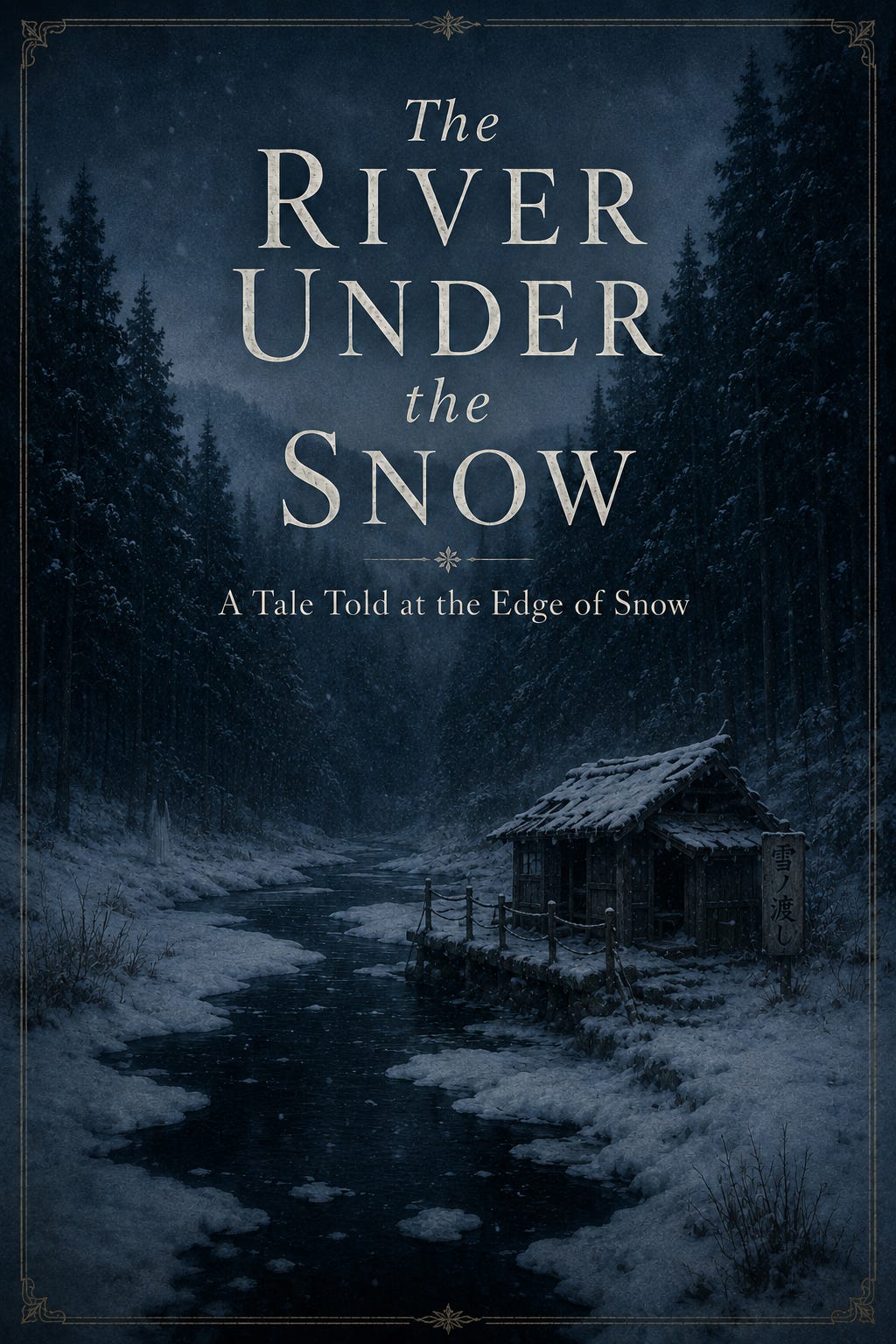
In the villages along the upper Tama River, old people once spoke of things seen in snowstorms, though nobody could later agree whether they belonged to the mountains, the dead or the weather itself.
Maren first noticed something was wrong when the sound of the river disappeared.
It had been with them all morning. A dark, hidden thing below the trail, moving under ice and snow, sometimes near enough to hear stones clicking beneath the current. Jonas had liked that sound. He said it made the forest feel alive.
Now there was only wind.
Not strong yet. Only a low, steady movement among the cedars, shifting snow from branch to branch.
Maren stopped.
Her breath fogged the inside of her scarf. The damp wool had begun to freeze where it touched her mouth.
“Jonas.”
He was ten steps ahead, bent slightly under his pack. Snow clung to the back of his jacket and to the black cap pulled low over his ears.
He turned.
“What?”
“I can’t hear the river.”
He listened. She watched his face change only a little. A tightening near the eyes.
“It bends away here,” he said.
“Does it?”
He took out the folded map from the plastic sleeve. The paper was already soft at the creases. The phone had lost signal an hour before. Back then he had joked about it. Something about German tourists and romantic wilderness.
Now he did not joke.
Snow fell thicker between them.
They had flown from Frankfurt nine days earlier. Gunzenhausen had been wet and flat under a winter that never became winter. Brown fields. Bare poplars. The Altmühl swollen beneath a low sky. Jonas had stood at their kitchen window one evening and said, “I need real cold again.”
He said it lightly.
But Maren had heard the other thing inside it.
His mother had died in January seven years before, during one of those rare hard Franconian winters when snow stayed on the roofs for weeks. After the funeral he had spent hours walking alone along the frozen lakeshore, coming home with red hands and no words.
Since then, whenever winter failed to arrive, something in him became restless.
Real cold.
Real mountains.
Real silence.
Maren had agreed because she loved him and because a part of her wanted distance too. A place where grief could not find the language.
In the village that morning, the innkeeper had looked at their boots, then at the sky.
“Snow later,” he had said.
Jonas had bowed with both hands around his coffee cup. “We come back before dark.”
The old man had not smiled.
“There is an old crossing house near the river,” he said. “If snow becomes heavy, stay. Do not continue.”
He marked it on the map with a blunt pencil.
Now Jonas folded that same map badly and pushed it back inside his jacket.
“We keep moving,” he said. “The crossing house should be ahead.”
“How far?”
“Maybe twenty minutes.”
“You said the trail looped back before the river.”
“I said maybe.”
“No. You said it did.”
He looked at her then, irritated because she was right and because fear had made her voice sharp.
“Maren, not now.”
She wanted to answer but the wind took the warmth from her mouth.
So she walked.
Their boots broke the crust with a tired, repetitive sound. Snow squeaked beneath the pressure, dry on top, wet underneath. Once Maren sank to her shin and icy water flooded over the top of her boot. She grabbed a cedar trunk. Bark cut through her glove.
Jonas came back at once.
“Let me see.”
“It’s fine.”
“Let me see.”
“It’s fine, Jonas.”
It was not fine. Her sock was wet. The cold found the place immediately and held it.
He knew. She saw that he knew.
But he only nodded.
After that they stopped speaking.
The trail markers became harder to find. Red strips tied to branches. A wooden sign half-buried in snow. A small stone figure by the path with a white cap on its head and a face worn almost blank.
Maren paused in front of it.
Its eyes were gone.
Jonas was already moving.
“Come on.”
The sky lowered. Afternoon thinned into blue-gray dusk though her watch said it was not yet three. Snow tapped against her hood, her sleeves, the plastic cover of her pack. She kept her eyes on Jonas’s footprints. They filled almost as soon as he made them.
Then the river returned.
Not where it should have been.
It sounded close, then far, then close again. Under ice. Under ground. Under her feet.
“Jonas.”
He stopped.
The trees ahead were fewer. Beyond them was a paleness that might have been an opening or only more snow.
They went toward it.
The river appeared all at once below them.
Black water. Broken ice. White banks. It moved fast through a narrow cut in the land, not wide but strong, with flat plates of ice turning slowly at the edges.
Beside the bank stood the crossing house.
Not much of a house. A low wooden hut raised on old posts, the roof bowed under snow, one shutter hanging crooked. A rope post leaned near the water. There was no ferry, only a half-buried length of rope frozen into the mud.
Jonas let out a breath.
“There.”
Maren could not answer. Relief came through her body as weakness. Her knees trembled and she had to put a hand on his arm.
He looked at her.
“We’re okay.”
She nodded because he needed her to.
They reached the hut just as the wind rose.
The door faced the river. Inside, directly opposite, the rear wall was split by several narrow gaps between the boards. A low window sat to the left, shuttered from outside. The old fire pit lay in the center, ringed with black stones. To the right were two rolled reed mats, damp and curling. There was no second door.
Jonas drove his shoulder against the swollen wood twice before it opened.
Darkness waited inside.
The hut smelled of wet straw, old smoke, mud and something sour that might have been animal. Snow lay in fine lines along the floor where it had sifted through the roof.
Maren stepped in and turned immediately.
“Shut it.”
Jonas forced the door closed. Wind pressed from the other side as if something large had leaned against it. The latch was only a wooden peg. He set it down, then dragged the broken stool beneath the handle.
It would not hold much.
But it held the thought of being held.
For a while they stood there, breathing loudly.
Their headlamps made small cones of light.
Maren checked her phone.
No signal.
Jonas checked his.
Nothing.
He held the phone a moment too long, staring at the dead bars. Then he put it away.
“We wait it out.”
“Till morning?”
“Maybe the storm passes.”
“And if it doesn’t?”
He looked toward the door.
“It has to.”
They unpacked with automatic care. Emergency blankets. Dry gloves. Protein bars. Small stove. Matches in a waterproof case. Headlamps. First-aid kit.
Jonas tried the stove first.
His fingers were clumsy.
Click.
Click.
Click.
“Come on,” he whispered.
On the sixth try a small blue flame appeared.
Maren almost cried.
They shared the last hot water from a metal cup, burning their lips, grateful for pain that belonged to life.
Outside, the storm built itself around the hut.
Wind first.
Then snow.
Then the river under everything.
The loose shutter struck the wall at uneven intervals.
Bang.
Pause.
Bang.
Bang.
Maren sat with her back against the rear wall and pulled off her wet sock. Her foot was white and numb. Jonas knelt in front of her and took it between his hands.
“Can you feel this?”
“A little.”
“This?”
“Yes.”
He rubbed gently. Too gently.
“Don’t look like that,” she said.
“Like what?”
“Like you’re already deciding whether I lose toes.”
He smiled faintly.
“You always go dramatic first.”
“You dragged me into a Japanese snowstorm.”
“You agreed.”
“I married you. That was my first mistake.”
He laughed then, softly.
For a few minutes the hut became almost bearable.
Then the stove went out.
The flame fluttered once and vanished.
Jonas adjusted the canister. Tried again.
Click.
Click.
Nothing.
He used a match.
The match flared orange, lit his face from below, then bent sideways though there was no clear draft. He shielded it with his hand. The flame shrank to blue and died.
Maren watched the smoke vanish into the dark roof.
“Try another.”
He did.
The same thing happened.
Neither of them spoke.
Cold returned quickly, as if it had only been waiting outside the circle of light.
They put on everything they had. Extra shirts. Insulation layers. Emergency blankets that made thin metallic sounds whenever they moved. Jonas checked the door again. Maren checked the walls.
No back door.
Only boards.
Cracks.
Snow.
By five it was night.
Complete night.
Their headlamps lit wood, straw, the dead fire pit, their own knees. Nothing else.
Maren dozed and woke, dozed and woke. Each time the cold had moved closer. It was inside her sleeves now. Between her shoulder blades. Along her scalp.
At some point Jonas began talking about home.
Not loudly. Not sentimentally. Just small things.
The bakery near the Marktplatz. The church bells arriving late through fog. Their neighbor cutting his hedge as if it had insulted him. The summer smell from the lake when the wind came wrong.
Maren listened with her eyes closed.
“Don’t,” she said after a while.
“What?”
“Make home sound like something we won’t see again.”
He was silent.
Then his hand found hers beneath the blanket.
“We’ll see it.”
She gripped his fingers.
They were cold.
Later, she woke because his hand was gone.
The hut was black except for a gray blur at the cracks.
“Jonas?”
No answer.
For one confused second she thought she was in their bedroom in Gunzenhausen and he had gone to the bathroom. Then the smell of mud and old straw returned. The cold. The river.
“Jonas.”
She turned on her headlamp.
He stood at the door.
Not opening it.
Just standing there, one hand near the latch.
“What are you doing?”
He did not turn around.
“I heard someone.”
Her body tightened.
“No.”
“Yes.”
“There’s nobody.”
He leaned closer to the wood.
Maren heard only storm.
Then something else.
A scrape along the outer planks.
Slow.
Careful.
As if someone were feeling the grain with fingernails.
Jonas whispered, “Hello?”
Maren pushed herself upright. The emergency blanket slid off her shoulders with a dry metallic hiss.
“Don’t.”
He glanced back at her. His face looked strange in the headlamp glare. Ashen, eyes too bright.
“It could be someone lost.”
“In this?”
“Yes, in this. We’re in this.”
The scrape came again.
Lower now.
Near the latch.
Maren stood too quickly and nearly fell. Her numb foot struck the floor and pain flashed up her leg.
“Jonas, please.”
He put his hand on the peg.
Outside, through the storm, came a voice.
Not a cry.
Not help.
A woman’s voice, soft and near the door.
Maren did not understand the word. Maybe there had been no word at all. Only the shape of one.
Jonas lifted the peg.
The door opened six inches before the wind caught it.
Snow blasted into the hut.
Maren threw an arm over her face.
“Close it!”
Jonas stood in the doorway, blocking part of the storm with his body.
Beyond him was white movement, black trees, darkness.
And someone standing there.
At first Maren thought it was a hiker.
Her mind reached for the ordinary first.
A hiker.
A woman.
Lost.
Freezing.
She stood a few steps from the threshold, partly veiled by snow. No pack. No poles. No headlamp. No gloves. White clothing hung straight from her shoulders, too light for weather, not modern, not anything Maren could name. Her black hair lay loose against it.
She did not shiver.
Jonas said something in English.
The woman did not answer.
Then he tried Japanese, one of the phrases he had practiced badly in hotel rooms.
“Daijōbu desu ka?”
The woman lifted her face.
Maren saw it in pieces.
A pale cheek.
Dark hair.
A mouth almost without color.
Eyes that caught no light.
Jonas took one step out.
Maren grabbed the back of his jacket.
“No.”
He pulled away.
Not violently. Almost gently.
“She’ll die.”
Something in Maren broke open then. Not courage exactly. She caught his sleeve with both hands.
“Look at her feet.”
He froze.
The woman stood barefoot in the snow.
Her feet were bare and clean: no blood, no mud, no trembling.
Jonas saw it.
Maren felt him see it.
For one second he was himself again.
Then the woman smiled.
Not wide.
Only a small change in the mouth, intimate and terrible.
Jonas stepped backward into the hut.
The woman moved forward.
The storm did not touch her hair.
Maren screamed.
Jonas slammed the door. It struck the frame, bounced open, struck again. He fought the wind. Maren threw her weight beside him. Together they forced it shut. Jonas dropped the peg. The stool fell. He lifted it with shaking hands and jammed it back under the handle.
They stood pressed against the door.
Neither breathed.
Outside there was only wind.
Then the scraping began again.
Higher now.
Slowly across the wood.
Once.
Twice.
Then silence.
Jonas whispered, “What was that?”
Maren wanted to say: You saw.
Instead she said, “We don’t open it again.”
He nodded.
They backed away from the door and sat against the rear wall, facing it. Jonas had lost one glove near the threshold. His right hand was bare. Maren tried to give him hers but he shook his head.
“Take it.”
“No.”
“Jonas.”
“No.”
His voice had gone flat.
They sat with the flashlight aimed at the door.
Minutes passed.
Maybe more.
The cold changed. It was no longer only temperature. It had direction.
Frost spread from the door in delicate branching lines. Across the handle. Along the boards. Over the stones of the fire pit.
Maren watched it reach Jonas’s boot.
“Move,” she whispered.
He kicked his foot back.
The frost stopped.
From outside came the voice again.
This time it said his name.
“Jonas.”
Maren’s mouth went dry.
He closed his eyes.
“No,” she said.
The voice came again.
“Jonas.”
Not loud. Not pleading. Almost tender.
Maren gripped his arm.
“She doesn’t know your name.”
But even as she said it, she knew the words were useless.
Jonas stared at the door with a look she had seen before only once, in the hospital room where his mother had stopped breathing. The look of a man hearing something meant for him alone.
“What do you hear?” she asked.
He shook his head.
“What do you hear?”
“My mother.”
The answer came like a wound.
“No,” Maren whispered. “No, you don’t.”
He began to cry. Silently. Tears freezing at once in the stubble along his cheeks.
The door creaked.
The peg lifted.
Maren watched it rise by itself from the notch and fall to the floor.
The stool slid backward.
Jonas lunged at the door.
Maren lunged after him, thinking he meant to hold it shut.
But he opened it.
The wind tore it from his hand.
Snow filled the room.
The woman stood at the threshold.
Not outside now.
At the threshold.
Close enough for Maren to see that no snow melted in her hair. Close enough to see that her robe was dry. Close enough to see her skin, smooth and faintly blue, as if moonlight had been pressed beneath it.
Jonas stood between them.
“Don’t look at her,” Maren said.
But he was already looking.
The woman raised one hand and touched his face.
He made a small shocked sound, almost like shame.
Maren grabbed the ice axe from beside her pack.
She swung it hard.
The axe passed through the white sleeve and struck the doorframe with a crack that hurt her wrists.
The woman turned her head.
For the first time, she looked fully at Maren.
There was no rage in her face.
Rage would have made her human.
Jonas exhaled.
The sound was wrong.
Too long.
Too empty.
The woman leaned toward him. Her lips parted. A pale vapor moved from her mouth into his. It did not drift like breath in cold air. It poured. It entered him.
His body stiffened.
Maren struck again. The axe bit into the wooden wall. Splinters flew.
The woman did not move.
Frost burst across Jonas’s eyelashes.
His hands opened.
He sagged.
Maren caught him under the arms. His weight drove her to the floor. The woman bent lower, still breathing that whiteness into him and Maren dragged him backward inch by inch, screaming his name until her throat tore.
“Jonas! Jonas, look at me!”
His eyes moved once.
Maybe toward her.
Maybe not.
The woman stopped.
The white vapor thinned.
Jonas lay in Maren’s lap, his face turned sideways, snow melting and freezing again on his cheek. His lips were blue. His beard was full of frost. His eyes remained half open.
Maren pressed both hands to his chest.
“No.”
The woman stepped inside.
The door swung slowly shut behind her though the wind still screamed outside.
The hut became quiet.
Maren could hear the river under the ice.
She could hear her own teeth striking.
She could hear Jonas not breathing.
The woman approached.
Maren tried to pull Jonas with her, but his body had become impossibly heavy. She slipped on frost and fell backward against the rear wall.
The woman crouched before her.
A loose strand of black hair fell forward. Tiny crystals shone along it.
She spoke.
Maren did not know the language and understood anyway.
“You are young.”
Maren shook her head because there was nothing else to do.
“I should take you too.”
The woman’s fingers touched Maren’s throat.
Pain vanished first.
Then sound.
Then the edges of the hut.
Maren saw Gunzenhausen with impossible clarity. Their kitchen window. Jonas’s mug with the chipped rim. Wet chestnut leaves outside their apartment building. His hand on her back in the airport queue.
All of it very small.
All of it already gone.
Her heart slowed.
The woman’s face filled her vision.
Beautiful.
Empty.
Patient.
Then something outside cracked.
A branch, perhaps.
Or ice in the river.
The woman paused.
Her fingers loosened.
She looked past Maren toward Jonas.
Then back.
Her expression changed only slightly. A thought passing through something that was not human thought.
“You will remain,” she whispered.
Maren gasped as air returned, brutal and burning.
The woman leaned closer.
Her mouth was beside Maren’s ear.
“Do not speak of me.”
Maren tried to nod.
“If you speak, I will know.”
The door opened behind the woman.
Snow rushed in.
The flashlight flickered, dimmed, came back.
The woman stepped backward into the storm.
For one instant she stood framed by the doorway, white against white, black hair moving slowly though the wind went another way.
Then she was gone.
Maren crawled to the door on hands and knees and shoved it shut.
She set the peg, lifted the stool and pressed her forehead to the wood.
Outside, nothing scraped or called. Nothing moved except the storm.
Only then did she turn back to Jonas.
He lay where she had left him, one arm bent beneath his body, his face calm in a way it had never been calm in life.
She crawled to him and put her ear to his mouth.
Nothing.
She pressed her fingers to his neck.
Nothing.
She began CPR because she knew she had to. Because in every course, every mountain safety training, every bright room with coffee and laminated cards, they had said you continue until help comes or you physically cannot.
So she continued.
Thirty compressions.
Two breaths.
His lips were ice.
Again.
Again.
Again.
The hut filled with the sounds of her effort. Her palms striking his sternum. Her breath breaking. Her voice counting wrong, then not counting at all.
Outside, the storm leaned against the walls.
Inside, Jonas did not return.
After some time she stopped.
Not because she accepted it.
Because her arms failed.
She curled beside him under both emergency blankets and held one of his hands between hers. His wedding ring had a rim of frost around it.
She stayed awake.
She believed with the simple certainty of a child that sleep would let the woman back in.
Once, near dawn, she heard the scrape again.
Very faint.
Not at the door.
At the wall behind her.
She put both hands over her mouth and made no sound.
Morning came without sunrise.
Only a gradual lightening of the cracks between the boards. The wind fell away in pieces. The river grew louder.
Maren’s thoughts no longer moved properly.
She knew she had to leave.
She knew she could not leave Jonas.
Both truths sat inside her without touching.
The innkeeper had called before dawn, when they had not returned. When the rescue team found the hut late that morning, she was outside on the riverbank in one boot and one sock, trying to wave with arms that did not seem attached to her.
The first man to reach her smelled of wool, sweat and cigarettes.
Human smells.
Living smells.
Behind him others entered the hut.
She knew the moment they found Jonas because all their voices changed.
Someone wrapped her in a heated blanket.
Someone asked her name.
Someone asked how long they had been there.
Someone asked whether her husband had left the shelter during the night.
Maren looked past them at the trees.
The snow lay perfect between the trunks.
No footprints led away from the hut except those of the rescuers.
“Storm,” she said.
The man leaned closer.
“What?”
“Storm,” she repeated.
It was the only word she trusted.
Later there was a clinic. Warm lights. Needles. A doctor pressing her fingers, looking into her eyes. Police. Translators. Forms. Condolences spoken carefully in two languages.
Hypothermia.
Exposure.
Disorientation.
A tragic accident.
She nodded when they said these things.
She did not correct them.
On the flight home, Jonas traveled below her in the hold.
Maren sat by the window and watched cloud fields pass beneath the wing. A flight attendant asked if she wanted tea. Maren said yes because the woman was kind and because refusing kindness seemed suddenly dangerous.
When the cup came, steam rose from it.
For one terrible second it looked white.
Alive.
She spilled it into her lap and did not feel the burn until much later.
In Gunzenhausen, people were gentle with her.
That was one of the hardest things.
They brought soup, bread, flowers, folded cards with mountains printed on them because they did not know what else to choose. They stood in her hallway and lowered their voices. They said Jonas had died doing what he loved. They said at least she had survived. They said weather could turn so quickly in the mountains.
Maren learned to nod.
She learned how grief becomes paperwork.
Death certificate.
Insurance.
Cremation.
Return of belongings.
His pack arrived weeks later, smelling faintly of damp nylon and smoke from places where they had burned nothing. Inside were his gloves, one stiff from dried meltwater, his cap, the map in its plastic sleeve and the metal cup they had shared in the hut.
At the bottom, folded into a side pocket, was the innkeeper’s marked map.
The pencil circle around the crossing house had blurred with moisture.
Beside it, in a hand she did not recognize, someone had written one small word in Japanese.
Maren did not translate it.
She put the map in a drawer and locked it.
Winter in Franconia remained mild that year.
Rain on roofs.
Mud on fields.
Fog over the Altmühl.
No snow.
And still, some mornings, frost covered the inside of her bedroom window.
Not outside.
Inside.
Thin branching lines starting at the lower frame and reaching upward like pale fingers.
Maren wiped them away with a towel.
They returned the next day.
At night she began to hear things in the house.
Boards settling.
The radiator ticking.
Rain at the window.
Once, very late, a soft scrape along the front door.
She sat upright in bed.
The house was dark.
The scrape came again.
Slow.
Patient.
She did not move.
The third time, it stopped halfway across the wood.
As if whatever stood outside had remembered something.
Maren held her breath until dawn.
In the morning there were no footprints on the wet path, no marks on the door, no sign of anyone. Only a narrow line of frost along the threshold though the temperature had not fallen below freezing.
She never told anyone.
Not her sister.
Not Jonas’s family.
Not the therapist who waited kindly through all her silences.
But years later, when snow finally did come to Gunzenhausen, sudden and heavy in the night, Maren woke before the first flakes touched the roof.
She knew.
She rose without turning on the light.
The street beyond the window was white already. Cars softened under snow. The lamps glowed in pale circles. The town had become quiet in that old, complete way snow makes possible.
Across the street, near the chestnut tree, stood a woman.
White clothing.
Black hair.
Bare feet on the frozen pavement.
Maren’s hands closed around the curtain.
For a moment neither of them moved.
Then the woman lifted her face.
Even from across the street, Maren felt the cold of her attention.
Not anger.
Not hurry.
Only memory.
Only patience.
Maren stepped back from the window.
She went downstairs and checked the locks.
Front door.
Back door.
Cellar door.
Then she sat at the kitchen table until morning with Jonas’s wedding ring in her palm and did not speak a single word.
Outside, snow covered the town.
By dawn the woman was gone.
But on the front door, just above the latch, the varnish had lifted in four long pale lines.
As if someone had stood there through the night.
Not knocking.
Only touching the wood.
A Note on the Folklore
This piece began with the old shape of a snow legend: travelers, storm, shelter, warning, survival. I wanted to move around its edges rather than retell it directly - to ask what such a story might leave behind if it crossed not only a river, but a life.
The old snow legend behind this story is usually known as Yuki-onna, written 雪女 and often translated as “snow woman.” She is a figure from Japanese folklore rather than a historical person or a single fixed tradition, associated with snow, winter storms, cold, isolation and death by freezing or exposure. There is no authoritative original version. The figure appears in different regional traditions and those traditions do not always agree about what she is or what she wants.
What can be said with some confidence is modest. Again and again, Yuki-onna appears as a supernatural woman connected to snow or severe cold. She is encountered in remote or dangerous places, often by isolated travelers, woodcutters, hunters or villagers. Beauty and threat are joined in her presence. Freezing, disappearance, death or near-death often follow.
One of the best-known literary versions in English is Lafcadio Hearn’s “Yuki-Onna,” published in Kwaidan: Stories and Studies of Strange Things in 1904. In that version, two woodcutters are caught in a snowstorm and take shelter for the night. A mysterious woman appears. The older man dies. The younger man is spared, but forbidden to speak of what happened. Years later he marries a woman who is eventually revealed to be the same snow woman. She spares him because of their children and disappears.
Hearn said the tale was told to him by a farmer from Chōfu, Nishitama-gōri, in Musashi Province, as a legend of that man’s native village. The oral version behind Hearn’s text cannot now be independently checked.
The story above preserves the broad transmitted pattern of storm, shelter, death, survival, silence and later consequence, but moves the surviving witness into a modern fictional frame.
Many familiar details are unstable across sources or belong to later literary and popular-cultural shaping. These include whether Yuki-onna should be called a ghost, yōkai, spirit, demon or transformed human, as well as fixed clothing, motives, powers and symbolic meanings. Later literature, film, manga, anime and horror have made her image more consistent and often more plainly monstrous than the older scattered folklore seems to require.
This pulled me in. The atmosphere really got me. I loved how the horror felt tied to grief instead of just fear. Great read.
Very enjoyable creepy read. I realized I kept holding my breath when the woman appeared. Great story and I liked the background.