

The Wardrobe in the Window
A chronicle of small harms

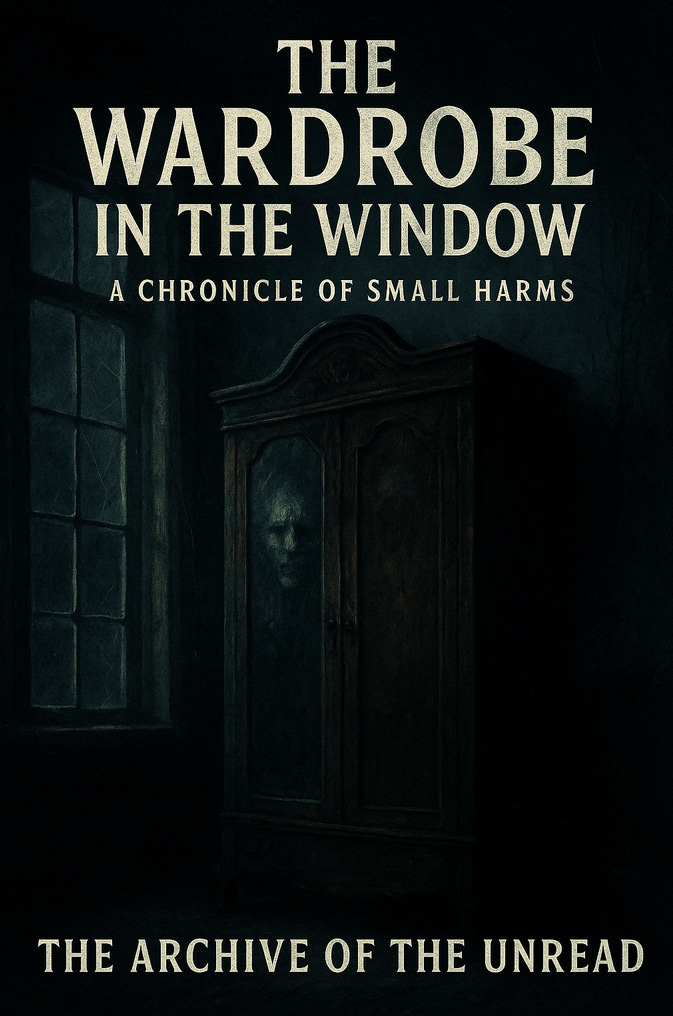
He was a middle-aged man with a face that overlooked the world. His eyes were gray, like old water under ice, his hair thin and combed to the side, his clothes always neat but colorless. He lived alone, spoke little and worked in an archive where he sorted numbers and names as if order could heal something.
He wasn't an eccentric in the obvious sense, but he didn't participate in conversations and didn't stand out in groups. Some people knew his name, but no one knew what he laughed about when he was alone. Or if he even laughed at all. He had never placed much value on heirlooms. Things had no spirit or meaning for him, they were just things. But his aunt had never been an ordinary woman.
Even as a child, he had been afraid of her long skirts, of the rustling sound they made when she crept through the narrow corridors of her house. Her gaze was always averted, not unfriendly, just... preoccupied. With inner spaces that no one was allowed to enter.
She had lived alone in a house that smelled like a forgotten library. No one in the village knew much about her. She was his mother's sister, but even she rarely spoke of her. Only once, when he was seven, had she said, “She's different. Just leave her alone.”
When he visited her once (he was fourteen) she had handed him a cup of tea without a word. The tea was bitter, almost metallic. The wardrobe was already there in her living room back then. He remembered the dark wood, the waves on the left door that seemed to move if you looked at them for too long. She hadn't explained it. Not a word about it.
And now, after her death, quiet, alone, in a winter that hardly anyone noticed - the wardrobe had arrived at his place. No will, no announcement. Just a handwritten note, barely more than a trace of ink: “You'll understand.”
At first, he had hesitated. The piece of furniture was bulky, impractical, full of memories he had never been able to place. But something about the note, about this brief message, struck him deeper than he wanted to admit. It wasn't curiosity, it was duty. A quiet, dark duty that had never been spoken, but had always lain dormant beneath the surface. A sense of guilt that could not be named. She had never given him anything, never said anything, but now she was giving him this. As her last gift. Her only gift.
And it wasn't just the note. It was also the dream that haunted him the night after he received the message: a room full of shadows, a glimpse of a surface that was moving. Her voice, whispered, barely audible: “Take it with you.”
The next morning, he arranged for it to be transported. Without thinking twice. Without resistance. As if the decision had already been made long ago.
Arrival of the Wardrobe
The mover had pushed the thing into the corner of the bedroom with a quiet curse. “Old, but sturdy,” he had said. The wardrobe was made of dark walnut, with heavy iron fittings, far too massive for the narrow stairwell and a left door whose surface was not smooth but wavy, as if water had shaped the wood. It was not a mirror in the classic sense, just a polished surface that hinted at more than it revealed.
He placed it by the window, where the morning light fell through the old panes. And there it remained. The room was small, but the wardrobe fit in like a silent guest who demanded nothing but observed everything. It smelled faintly of lavender, of old paper, of something deeper.
At first, nothing happened. The wardrobe simply stood there, motionless, as if it had never been transported, but had always been part of this room. But as the days passed, the feeling grew that its presence was expanding. Not in meters or weight, but in attention. His gaze kept wandering back to it, for no reason. And when he woke up at night, the wardrobe was there, no closer, no different, but more present.
First Distortions
It started with a flicker. A moment of pause when he passed by the wood. A barely perceptible resistance in the air, like a soft hum that vibrated only inside his thoughts. He began to slow down as he approached. He looked inside. Only briefly. Only in passing.
And then, one morning, it was there.
At first, it was just his own reflection that irritated him. Distorted, as if viewed through water. His eyes too dark. His neck too long. Then he saw more. Once he thought he saw Mrs. Lechner, the neighbor. She was standing in the mirror, even though she wasn't in the room. Her face was only hinted at, but her gaze was clear. And that expression as if she were talking about him. As if she had always done so.
He laughed about it. At first. A mirage, surely. Just a reflection, a random moment. But the thought remained. It gnawed at him. Like a splinter. And then the next morning came.
He was standing in the kitchen, cup in hand, when he saw Mr. Brockmann in the mirror. This time he wasn't wearing his usual coat, but his sleeves were rolled up, his hands were restless and his gaze was frantic. He stood in front of the mailboxes, holding an envelope, turning it over, feeling it. And then he lifted it to his nose. He sniffed it, as if it were a piece of clothing that smelled like someone else.
The letter was not addressed to him. It was his. He recognized the pattern, the narrow sender's stamp he had used himself. Mr. Brockmann let his gaze wander, did not put the letter back, but put it in his pocket.
Then he felt it. No anger. No fear. Just a tugging sensation. As if the mirror had not been mistaken but had confirmed what he already knew. As if he had always known. And the wardrobe, at that moment, it was not just a piece of furniture. It was a witness. An accomplice. An invitation.
And the mirror continued to show him.
At night, he often went into the bedroom. He stood in front of the wardrobe for a long time. And over time, something changed. Not the mirror - he himself. The way he walked. The way he spoke. Calmer, more determined. As if the image were telling him how to live upright, how to do things right. As if it were showing him another version of himself – one that judges rightly that acts.
The reactions of others were not long in coming. Mrs. Lechner avoided him. Mr. Brockmann no longer greeted him. Maybe they sensed something. Maybe they were afraid. And he wrote it down: names, sentences, movements.
An archive of hints, meticulously kept in a small notebook with a red cover.
The Pigeon and Mrs. Lechner
The first step was small. But it was no coincidence. The mirror had shown him: Ms. Lechner, late at night, at the window, talking on her phone. The sound was inaudible, but her expression, that tense smile, the glance upward, in his direction left no doubt.
And then a sentence, silent but clearly visible in the mirror: “He's getting stranger and stranger.”
He felt his throat tighten. The blood rushed to his head. That night, he went to the window and stared at her window for a long time. No movement. No silhouette. Just curtains, still. And the next morning, he didn't know why he went to the basement.
But there it was. The pigeon. Dead, but unharmed. As if it were still suspended between life and something else. He picked it up, felt its weight. And he knew: this meant something. He went to Mrs. Lechner's compartment. Unlocked the door, the key was hanging behind the radiator as usual, wrapped in an old napkin.
He entered the basement room, the air cool and still, the light dim, as if it didn't want to see what was coming. The pigeon lay in an old shopping basket, placed there by him, wrapped in newspaper as if it were a delicate gift. He sat down on the stool next to the stacked newspapers, unrolled the paper and smoothed the feathers.
Then he lifted the top layer of newspaper bundles carefully, with both hands and slid the pigeon between them, centering it like a relic. The pigeon's eyes were closed. No blood. No noise. Just the weight. And the feeling that something had been completed.
When he left the room, he closed the door quietly, hung the key back up and wiped the handle with his handkerchief. He walked slowly up the stairs, feeling the silence behind him like a cloak.
From then on, Mrs. Lechner spoke in whispers. Her voice, once loud and firm, was now just a whisper. She no longer said hello. She locked her apartment door twice, even during the day. When she met him in the stairwell, her eyes darted away, not out of fear. Out of certainty. She knew something had happened. But not what.
The Car and Mr. Brockmann
Then Mr. Brockmann's car arrived. It began with an image in the mirror: Brockmann in the parking garage, sitting in the passenger seat and whispering. The words were silent, but his name was mentioned. Then a laugh, short and dry. Next to him was a shadow - someone he didn't know. But the movement of Brockmann's hand as he pointed to the house, making a circular motion with his finger as if to show the madman in the attic that burned itself into his memory.
He followed him one Sunday. He waited until Brockmann was standing in front of the bakery, the car open, the key in the ignition. No cameras. He didn't look back. Five minutes were enough. He loosened the wheel nuts on the right rear wheel slightly, just enough to cause a vibration every time the car was driven, a fluttering that couldn't be pinpointed. No one would notice, not right away. It was like a foreign object in the metal. Something gnawing away.
In the days that followed, he heard the car drive by. It sounded sick. Nervous. Brockmann spoke to the mechanic on the phone in the stairwell. His voice was rougher, more agitated. No one could find the fault.
But he knew what it was.
The Mattress and the Tape
The next actions were more precise. And each time, they were preceded by an image. The man from the third floor, gray-haired, polite, but with a face that was different in the reflection contemptuous. He stood there with a glass of wine, talking to someone you couldn't see. Again, his name was mentioned. Again, that smile, sharp and thin.
At night, when the man was not at home, he broke into the apartment. He knew where the spare key was, the mirror had shown him. In the bedroom, he cut open the mattress, slowly, carefully, starting in the middle. Not deep. Just enough to feel it at night: a strange sensation under his back, like a shallow wound.
The letter arrived the next day. Old parchment sheets, sprinkled with dried animal blood that he had taken from the meat section. No words, just a symbol: an eye with a cross through the iris.
And the tape that was for the young man on the ground floor. The mirror had shown him laughing too loudly, talking on the phone too late too often. The voice in the mirror was clear: “The one upstairs hears everything. Do you think he's still normal?”
So he placed the microphone against the wall at night, for hours on end. Cuts, breathing, the noise of the house. Then he put it in an envelope and dropped it in the mailbox – labeled with the man's name. “Nocturne I.”
He never saw him in the stairwell again. Doors closed faster. Voices grew quieter.
He slept well those nights. Because the wardrobe rewarded him. With silence. With depth. With clarity.
The Nurse and the Doll
The images became more detailed. The wardrobe showed a nurse. Her face: tired, worn out from night shifts, but distorted in the mirror into something predatory. Her eyes were darker, her mouth narrow and hard. She came by every evening around half past nine, on her way to the clinic, her steps firm, her bag slung over her shoulder. But in the mirror, she raised her hand and pointed at his window. Her lips formed a single word: “Dirt.”
He thought he recognized her face. Maybe she had treated him once before. Maybe she had walked past his bed without looking at him. Maybe that was enough.
On the third night, he followed her. Not closely, not conspicuously, just enough to know when she entered the building, when she changed her clothes, when she unlocked her locker. He learned her shift times, her rhythm, her movements. And then, one night, he sneaked in. No camera saw him. No door squeaked.
He placed a doll on her locker, silent, blind, with a sewn-up mouth. No message. No symbol. Just this thing lying there, as if it had fallen out of a nightmare. The fabric was gray, the stitching rough. The eyes were black buttons, empty.
Two days later, she was gone. Her apartment had been broken into, but nothing had been stolen. On the kitchen table was only a glass of water, half full and a crumpled note. One word on it: “Voices.”
The Boy and the Brake
Then there was the little boy in the courtyard. The image in the mirror was fleeting: the boy with a twig, tapping on the window with it. A game, perhaps. But distorted in the mirror, a mocking grin, a thrown stone and then the finger pointing at him, like a verdict. It was enough. In the evening, he waited until the courtyard was empty and loosened the brake cable on the boy's bike - precisely as the mirror had shown him. The fall came the next morning, loud, with a cry. The boy's leg broke in two places. The boy screamed. The mother was hysterical. And the wardrobe showed: That's right.
The Woman and the Soap
Later, a new woman appeared in the mirror. One with a strict bun, glasses, a briefcase. He sometimes saw her in the stairwell, never completely, just as she disappeared into the shadows of the staircase. The mirror showed more: she was standing in the office, whispering to someone. A piece of paper in her hand, his name on it. And then the sentence, clearly visible: “He needs to be watched.”
He waited until she came home late from work. She lived in another building, but he could see the light in her bathroom from his kitchen. He noted the times. The rhythm. The footsteps on the stairs.
One night, he crept across the scaffolding at the back, which was there for renovation. The window on the third floor was tilted open. There was no one in the bathroom. On the shelf: her brush, her soap, a glass. He reached in, took the pills that were there and made them disappear. And in the soap, he scraped small splinters from the broken bathroom mirror. Fine. Invisible. Painful.
She never went to the police. But people heard she had moved house. And the mirror: remained silent.
Burial Offerings
A dog ran loose. Later it lay dead in the ditch. A cat was disemboweled. An old man fell down the stairs. No one saw him. Only the mirror.
He began to bury things. It wasn't a plan, but an urge. First, it was an old photo album, rolled up in newspaper, which he buried in a metal box under the hedge in the backyard. Then a small bundle of hair, held together by a rubber band, which he had fished out of the neighbor's bathroom trash. The hair smelled of perfume. Of life.
He carried old clothes into the garden, tore up the paving stones, buried half a pair of shoes, a torn calendar page with his name on it. On a quiet night, he broke the bathroom mirror. Piece by piece, slowly, without haste. He buried the shards near the foundation. Like glass eyes that no one should find.
With every object he buried, the wardrobe became warmer, more alive. It began to creak at night, not like wood settling, but like a breath. Sometimes it smelled like earth, damp and sweet. Sometimes like metal. And sometimes there was another smell: something reminiscent of an animal stable. Of blood that had dried in fabric for a long time.
The floor under the window developed darker edges. Not damp, but... softer. When he walked over it, it felt like he was stepping on something yielding. He began to tread more quietly. The wardrobe was listening.
The Circle Tightens
It started with a whisper at the door. A plainclothes police officer, friendly, almost apologetic. “Just a few questions,” he had said. It was about noises. About neighbors. About things that no one had seen, but many had felt. He answered everything calmly. The wardrobe stood behind him. The door was closed.
But they came back. Two of them this time. With notes. With names. “Mr. Brockmann was worried.” “The young woman with the child moved away without giving notice.” “The nurse... did you know her well?”
He smiled. Gave vague answers. And every time they left, he went to the wardrobe. Looked. The images came more slowly, as if the wardrobe were pausing. Or checking.
Later, they stood in the hallway for a long time. Asked neighbors. One of them, a young detective with a limp, looked at him too long once. The next night, the mirror showed a room, cold, bare, a board with his name on it. And underneath, in chalk: “We almost have him.”
But before that, in the days between realization and escalation, there was this state that could no longer be described as fear, but as pure fusion. He spoke to the mirror. Not loudly, not childishly, but with the quiet conviction of a man who no longer doubts. He didn't ask if something was true. Only when. Only how. He prepared meals for himself and placed a plate in front of the wardrobe. He noted the times when the mirror flickered, counted the creaks of the wood, marked them like a calendar of revelations. His writing became smaller, tighter, wilder. As if from a different alphabet.
He began to believe that the world outside was just a facade. That reality spoke through the mirror – and only through it. The police, the voices, the noises, they were tests. Will-o'-the-wisps. And he was the chosen one. The last one with vision. The last one with order.
Sometimes he whispered things as he undressed. He laid his clothes precisely on the bed and stood naked in front of the mirror. He asked, “Now?” and waited. For minutes. For hours.
Then, only then: from that moment on, everything was control. No windows open. No visitors. Just the wardrobe. And him.
He locked every door twice, stuck rubber seals under the window frames so that no sound, no glance, no question from outside could penetrate. He only accepted deliveries, spoke through the door. The mirror showed him faces blurrier now, but more urgent. A policeman with a ballpoint pen clicking nervously. A neighbor leaning over someone and saying, “Missing smell.” A woman from the public order office leafing through a file folder with his name written in large letters on the back.
That night he heard footsteps. On the stairs, behind the wall, under the floor. Maybe he was imagining them. Maybe not.
The mirror reflected the elderly lady from across the street. She was on the phone. Her voice was inaudible, but her expression was alert, determined, knowing. She tapped on something a piece of paper, a list. And then she nodded. As if she had signed something.
He waited until three in the morning. He crept across the roof, through the shaft, just as the wardrobe had once shown him. Her kitchen was silent.
Her glasses were on the table; the tea was still warm. He took the phone off the hook and turned off the power at the fuse box. Then he stood behind her. No one knew exactly what happened. In the morning, she was gone. Her apartment smelled of cold metal and orange blossoms. A pair of crushed glasses lay on the floor, a coffee stain next to them.
And on the table: a card with a line carved into it. It ran from the top right to the bottom left, like a cut.
The mirror showed nothing. But the wood was warm. Almost alive.
When they came, ten of them, with flashing lights and drawn weapons, it was no surprise. He closed the door. Went into the bedroom.
The wardrobe was waiting.
But this time it showed nothing. No face. No judgment. Just him. Old. Tired. Empty.
He stood there, his face in the dull morning light streaming through the window and something in him was different. The mirror had remained silent for days. No image, no instructions, no more faces. Just his own reflection, motionless, as if frozen. And then, a flicker. Not in the mirror, but in his memory. A detail that didn't add up. The nurse. In the mirror, she had been wearing a red bracelet on her left wrist. But when he followed her, when he watched her, it had been on her right wrist. A tiny detail that no one would have noticed. Only him.
He went back, thinking about the child, the cat, Mrs. Lechner. And again and again, these contradictions appeared. Things that the mirror had shown – reflected incorrectly. Left instead of right. Words he had never heard himself. Movements that had not taken place. He began to understand: the mirror did not show the truth. Never.
He looked at himself. Not in the mirror, but in the window, in the shadow on the wall, in the skin of his hands. And the image that formed was not that of a judge. It was that of a man who knew nothing. Only believed. And obeyed.
“You lied,” he said quietly.
Then he struck. Not like someone who destroys, but like someone who liberates.
But before the wood splintered, the mirror showed one last image. Not his face. Not the faces of the others. But that of his aunt. Young, but recognizable. Her eyes open, black, as if burned with coal. And she spoke, not with her lips, but with her eyes. A sentence formed like smoke behind the surface: “Thank you.”
Then the image flickered. The face became his own. Then many. All smiling. All silent. And behind them, in the background of the reflection: the wardrobe, open but not empty. Instead, it was filled with things he had buried. The dove. The broken mirror. The doll. Everything was there.
He took a step back. And the mirror moved. Not the image.
The surface itself. As if it were breathing. As if it wanted to take him. He screamed. For the first time. And struck out. He grabbed the bar from the bed frame, heavy, cold, trembling in his hand. The wardrobe stood still, waiting. When he struck, it was like an earthquake in the room. The wood splintered with a sound that was not loud, but deep. A lamp tipped over, glass shattered on the wall and the room filled with shadows. He struck again. Again. Again. The door burst open as if something wanted to escape from inside. The mirror trembled. It no longer showed any images, only a dark, pulsating something, as if the wood were breathing. And then - a crack. Not in the wardrobe. In him.
A splinter, long and jagged, fast as an arrow, sprang from the door frame and dug deep into his side. No scream. Just a rush of air. He staggered back, hit the wall and collapsed. The blood beneath him grew slowly but steadily. Warm. Dark. The floor seemed to welcome him.
The last thing he felt was the wood against his cheek. Not hard. Not cold. But alive. And somehow: expectant.
They found him in the morning. The wardrobe was open. The door hung crooked. And the mirror: was silent.
Whoever looked inside saw themselves. But not quite.
- The End -
Loved this!
Suspenseful, well written, and layered in detail! I enjoyed reading 🧡
TOO SCARED!!